




























Views
Downloads



Complete Order of Operations Worksheet | Grade 6 Math

Paste this activity's link or code into your existing LMS (Google Classroom, Canvas, Teams, Schoology, Moodle, etc.).
Students can open and work on the activity right away, with no student login required.
You'll still be able to track student progress and results from your teacher account.
This Grade 6 math worksheet guides students through evaluating complex numerical expressions with whole-number exponents, mixed grouping symbols, and multiple operations. Students build procedural fluency and conceptual precision as they analyze operational hierarchy, correct common evaluation errors, and model multi-step real-world scenarios.
At a Glance
- Grade: 6 · Subject: Math
- Standard:
6.EE.A.1— Write and evaluate numerical expressions involving whole-number exponents and grouping symbols- Skill Focus: Mix Grouping, Powers, and Operations
- Format: 5 pages · 16 problems · Answer key included · PDF
- Best For: Mid-unit practice and error analysis
- Time: 45–60 minutes
What's Inside
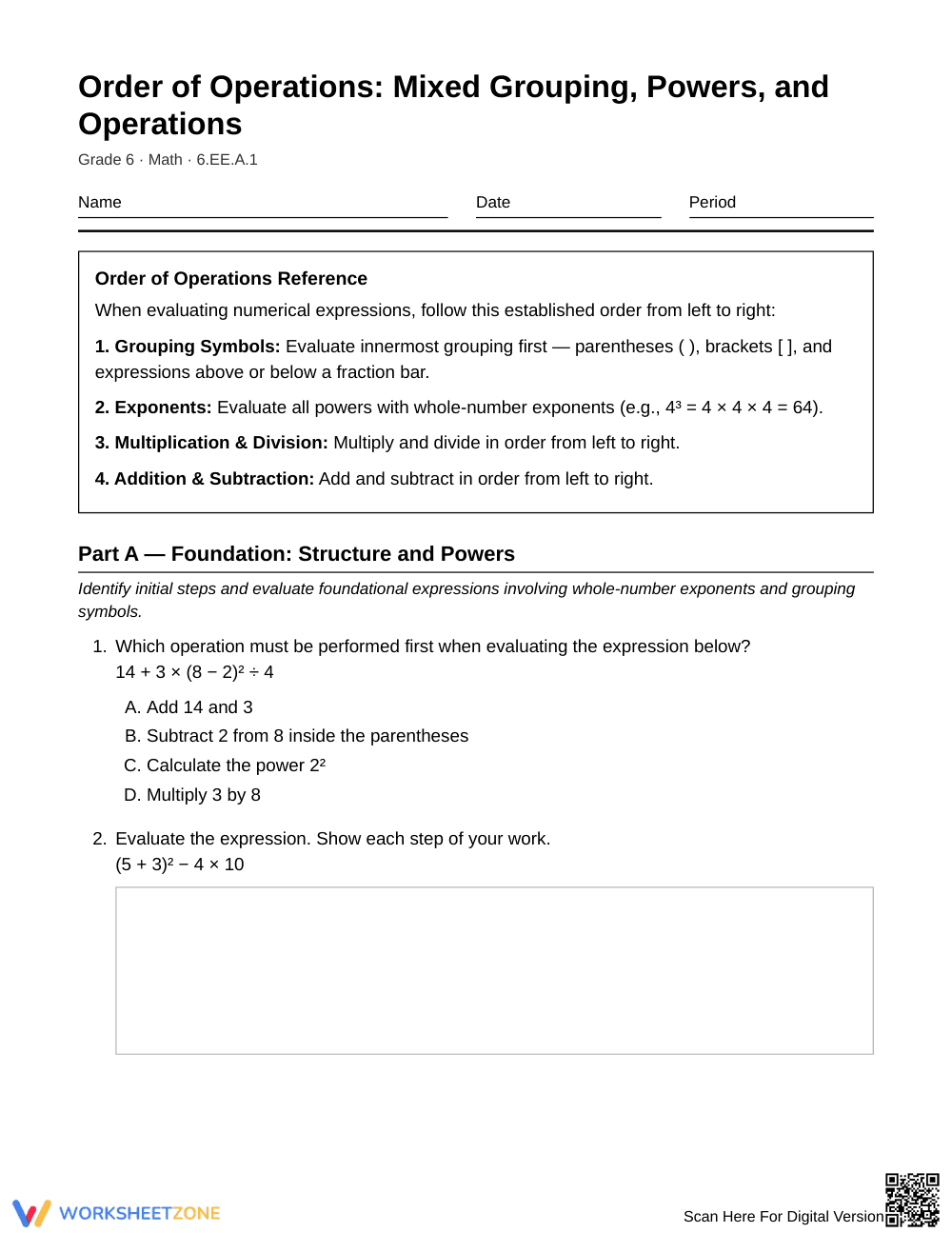
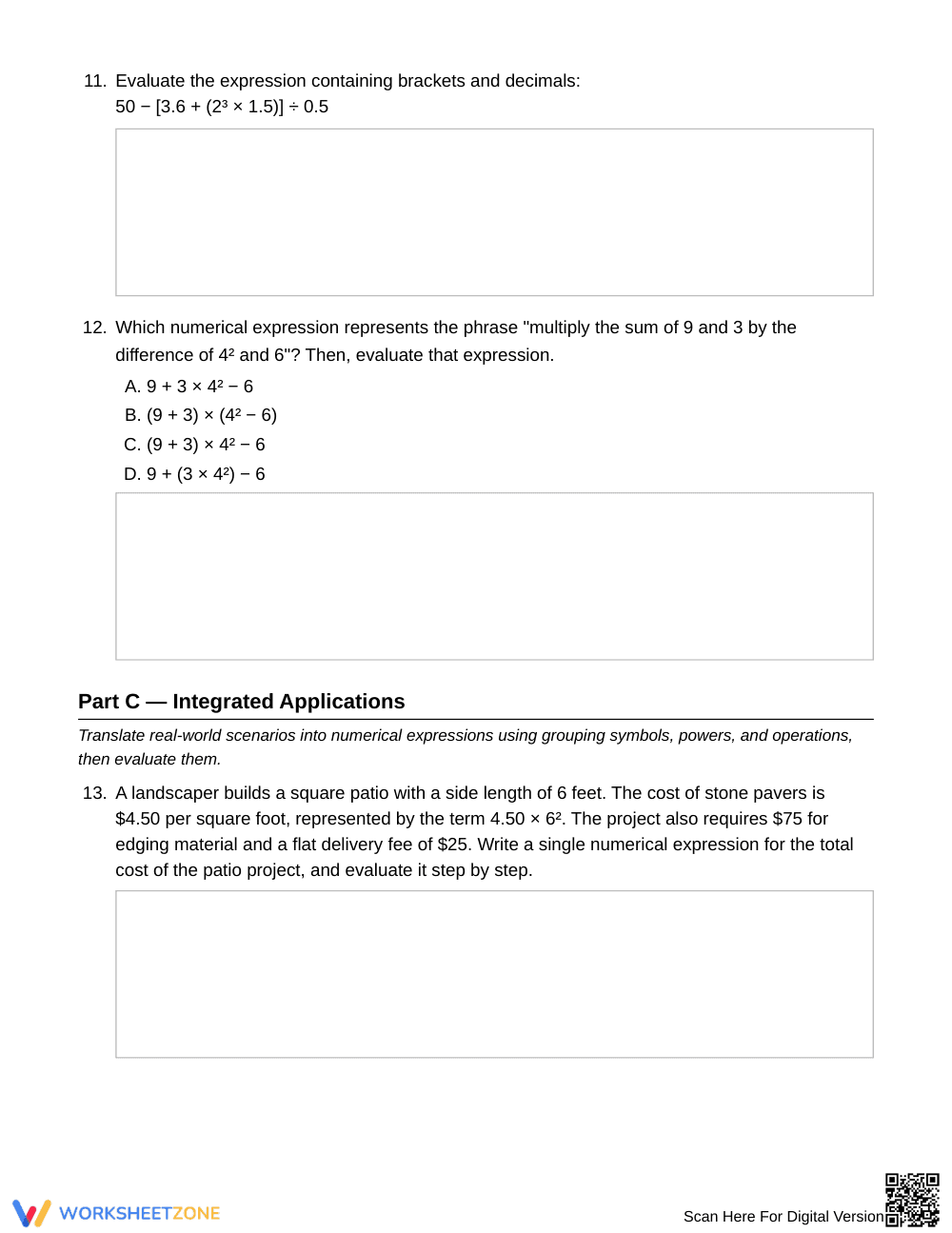
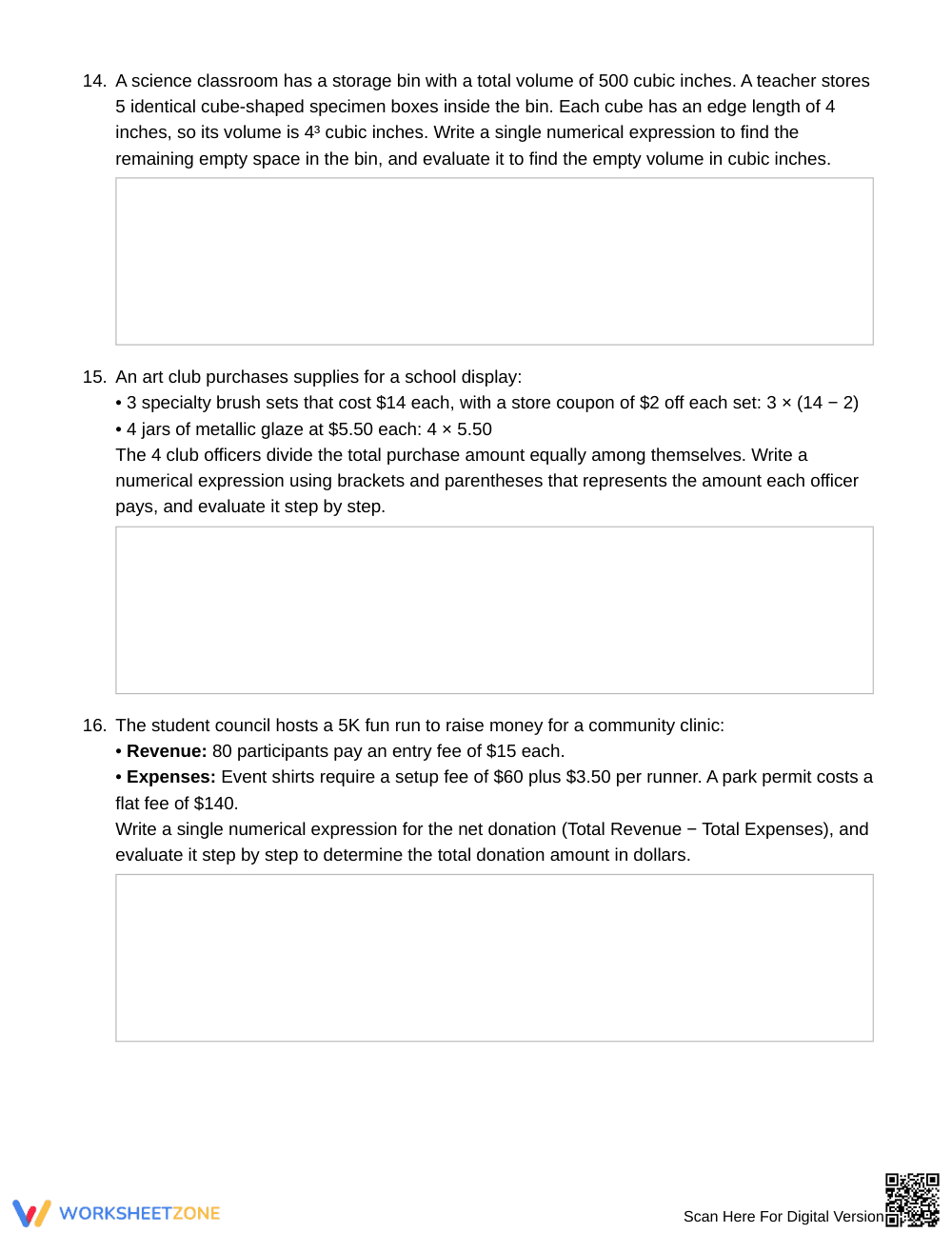
This 5-page printable resource delivers 16 carefully structured tasks organized across three distinct sections. It begins with an order of operations reference box defining evaluation rules for grouping symbols, exponents, multiplication, division, addition, and subtraction. The resource includes multiple-choice hierarchy identification, step-by-step numerical evaluations with nested brackets and decimals, error analysis tasks, expression insertion challenges, and complex word problems. A 4-page step-by-step answer key provides complete solutions.
Skill Progression
- Guided practice (Part A, 4 tasks): Students identify operational priorities and evaluate foundational expressions featuring powers, parentheses, and decimals with structured calculation prompts.
- Supported practice (Part B, 8 tasks): Learners evaluate expressions with nested brackets, fraction bars, and decimals, diagnose calculation errors, insert parentheses to satisfy target equations, and compare expression structures.
- Independent practice (Part C, 4 tasks): Students translate multi-step real-world scenarios involving area, volume, and budget calculations into single mathematical expressions before computing solutions.
This sequence follows an intentional gradual-release model, transitioning students from structural recognition to independent mathematical modeling.
Standards Alignment
This worksheet aligns directly with standard 6.EE.A.1: Write and evaluate numerical expressions involving whole-number exponents. Students apply conventional order of operations to compute expressions containing nested grouping symbols, whole-number powers, and fractional bars. Both standard codes can be copied directly into lesson plans, IEP goals, or district curriculum mapping tools.
How to Use It
Administer this worksheet during or immediately after direct instruction on algebraic expressions. Use Part A as a quick check for understanding before releasing students to collaborate on Part B's error analysis problems. During classwork, observe whether students correctly prioritize exponents before multiplication when grouping symbols are absent. Plan for 45 to 60 minutes of instructional time.
Who It's For
Designed for Grade 6 general mathematics classrooms, this resource supports students developing pre-algebraic fluency. It offers built-in scaffolds for tier-2 intervention groups while providing rigorous multi-step modeling tasks for on-grade and advanced learners. Pair this worksheet with an anchor chart detailing grouping hierarchy or concrete volume manipulatives.
According to research by Fisher & Frey (2014) on structured instructional frameworks, student mastery of complex mathematical procedures accelerates when instruction moves deliberately from explicit rule identification to collaborative error analysis and independent modeling. Standard 6.EE.A.1 requires sixth-grade students to write and evaluate numerical expressions involving whole-number exponents, decimals, and multiple operational steps. Developing this foundational proficiency prevents persistent arithmetic misconceptions surrounding operational precedence, such as confusing exponentiation with standard multiplication or misapplying left-to-right calculation sequences across nested grouping symbols. By integrating an explicit structural reference guide alongside rigorous non-routine tasks and contextual applications, this resource provides the deliberate practice necessary to secure long-term procedural accuracy, conceptual understanding, and mathematical reasoning throughout middle school pre-algebra coursework.


