




























Views
Downloads



Complete Nuclear Power Worksheet | Grades 9–12 Science

Paste this activity's link or code into your existing LMS (Google Classroom, Canvas, Teams, Schoology, Moodle, etc.).
Students can open and work on the activity right away, with no student login required.
You'll still be able to track student progress and results from your teacher account.
This comprehensive physical science worksheet guides high school students through the core mechanisms of nuclear power generation. Learners analyze pressurized water reactor systems, evaluate mass-energy equivalence in fission reactions, interpret life-cycle greenhouse gas emission data, and differentiate fission from fusion. Through structured tasks, students build a rigorous understanding of nuclear energy technology and conservation principles.
At a Glance
- Grade: Grades 9–12 · Subject: Science
- Standard: High School Physical Science — Model nuclear processes, calculate energy transformations, and evaluate comparative energy impacts
- Skill Focus: Guided application of nuclear fission, reactor components, and fusion
- Format: 4 pages · 28 problems · Answer key included · PDF
- Best For: Nuclear chemistry and physics application units
- Time: 45–60 minutes
What's Inside
The 4-page activity provides 28 targeted questions across four cohesive parts. It features an anatomical schematic of a pressurized water reactor, nuclear conservation equations, quantitative energy calculations converting electron-volts to joules, and a comparative carbon emissions bar chart. A matching 4-page complete teacher answer key supplies step-by-step mathematical solutions and model written responses.
Skill Progression
- Guided Practice (Part A): Students examine a pressurized water reactor schematic, labeling eight essential components from core to cooling tower while tracing closed-loop fluid containment.
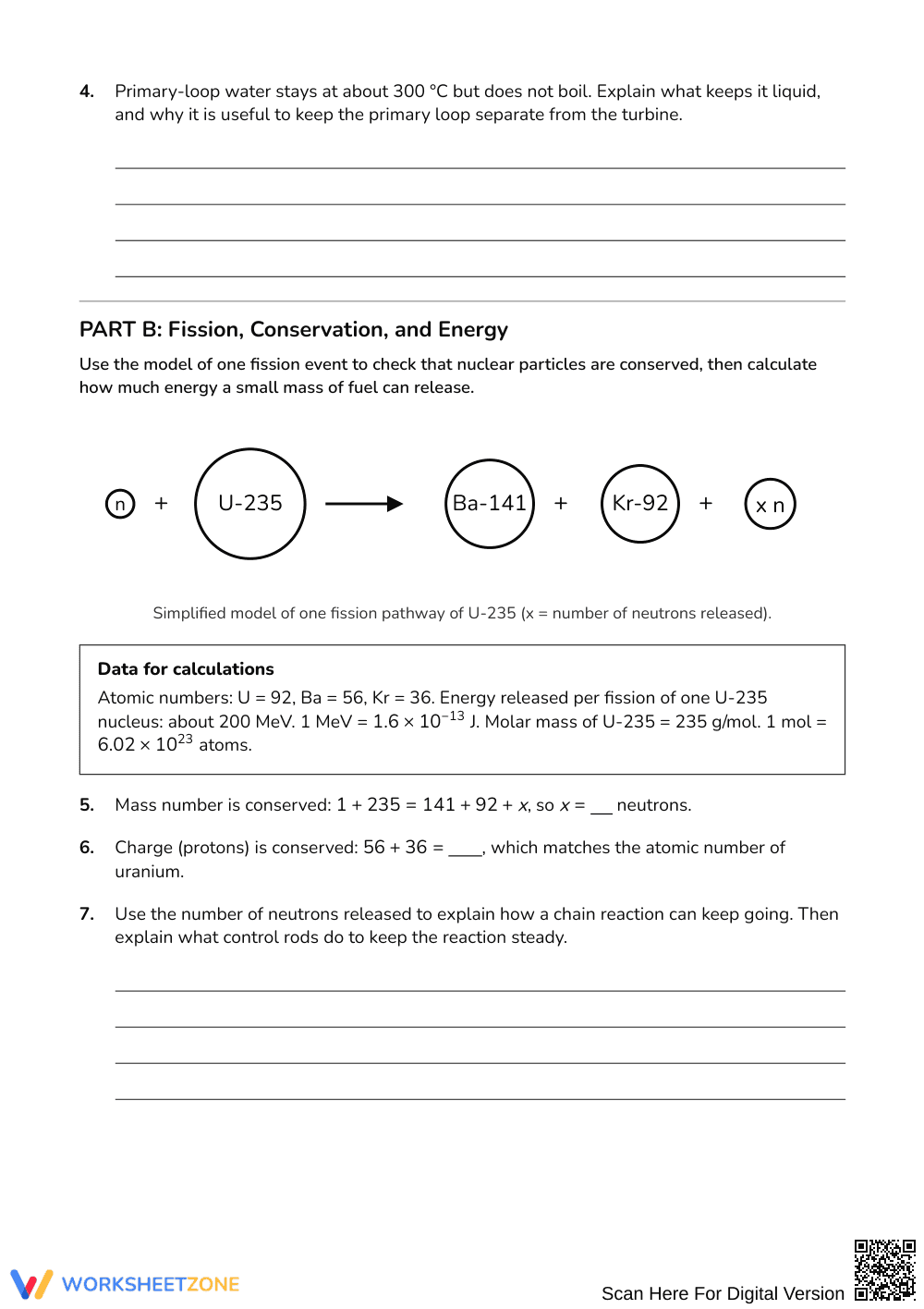
- Supported Practice (Part B & Part C): Learners balance nuclear equations to confirm nucleon conservation, compute E = mc² mass defect yields, and evaluate life-cycle emissions graphs against fossil alternatives.
- Independent Practice (Part D): Students independently analyze deuterium-tritium fusion, explain Coulomb barrier mechanics at high temperatures, and justify energy release using binding energy concepts.
This scaffolded structure follows the gradual-release framework, guiding students from structural recall to quantitative analysis and higher-order synthesis.
Standards Alignment
This resource aligns with high school physical science performance expectations for nuclear processes and conservation of energy. Students demonstrate how subatomic rearrangements yield mass defects and massive energy outputs according to fundamental conservation laws. Teachers can copy these instructional goals directly into unit syllabi, lesson plans, or district curriculum mapping documentation.
How to Use It
Deploy this activity immediately after introducing fission and reactor components during direct instruction. For formative assessment, observe student reasoning in Part B to verify whether learners recognize that mass number conservation does not contradict mass defect energy conversion. The full worksheet takes approximately 45 to 60 minutes of active classroom engagement.
Who It's For
This activity supports general high school chemistry, physics, and environmental science students exploring modern energy sources. Differentiate by providing the included reactor diagram labels as a reference bank for developing learners. Pair this assignment directly with an introductory nuclear decay lesson or interactive simulation.
According to Fisher & Frey (2014), intentional scaffolding that progresses from visual identification to complex mathematical modeling ensures deeper retention in secondary science education. This nuclear power resource provides 28 structured tasks where students examine pressurized water reactor schematics, calculate nuclear binding energy conversions, and evaluate comparative environmental data. By isolating primary, secondary, and tertiary cooling systems before challenging learners to compute mass defect energy yields, the resource systematically builds conceptual competence. The included 4-page answer key provides clear benchmarks for evaluating student explanations of neutron moderation and isotopic chain reactions. When secondary science teachers implement structured scaffolds that connect microscopic nuclear events to macroeconomic carbon emissions, students achieve durable mastery of physical science standards without experiencing cognitive overload.


