




























Views
Downloads



Complete Nuclear Decay Worksheet | Grades 9–12 Science

Paste this activity's link or code into your existing LMS (Google Classroom, Canvas, Teams, Schoology, Moodle, etc.).
Students can open and work on the activity right away, with no student login required.
You'll still be able to track student progress and results from your teacher account.
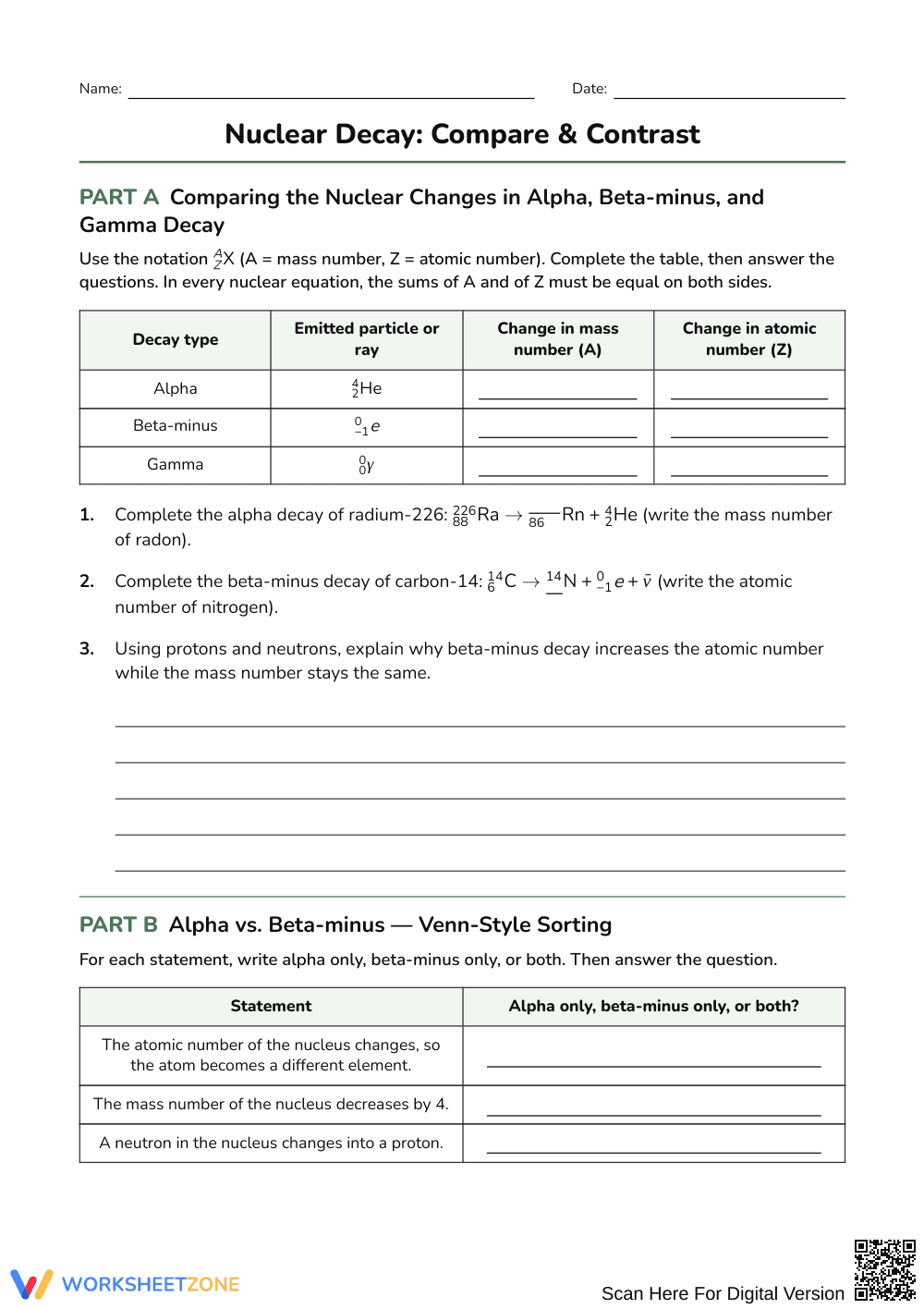
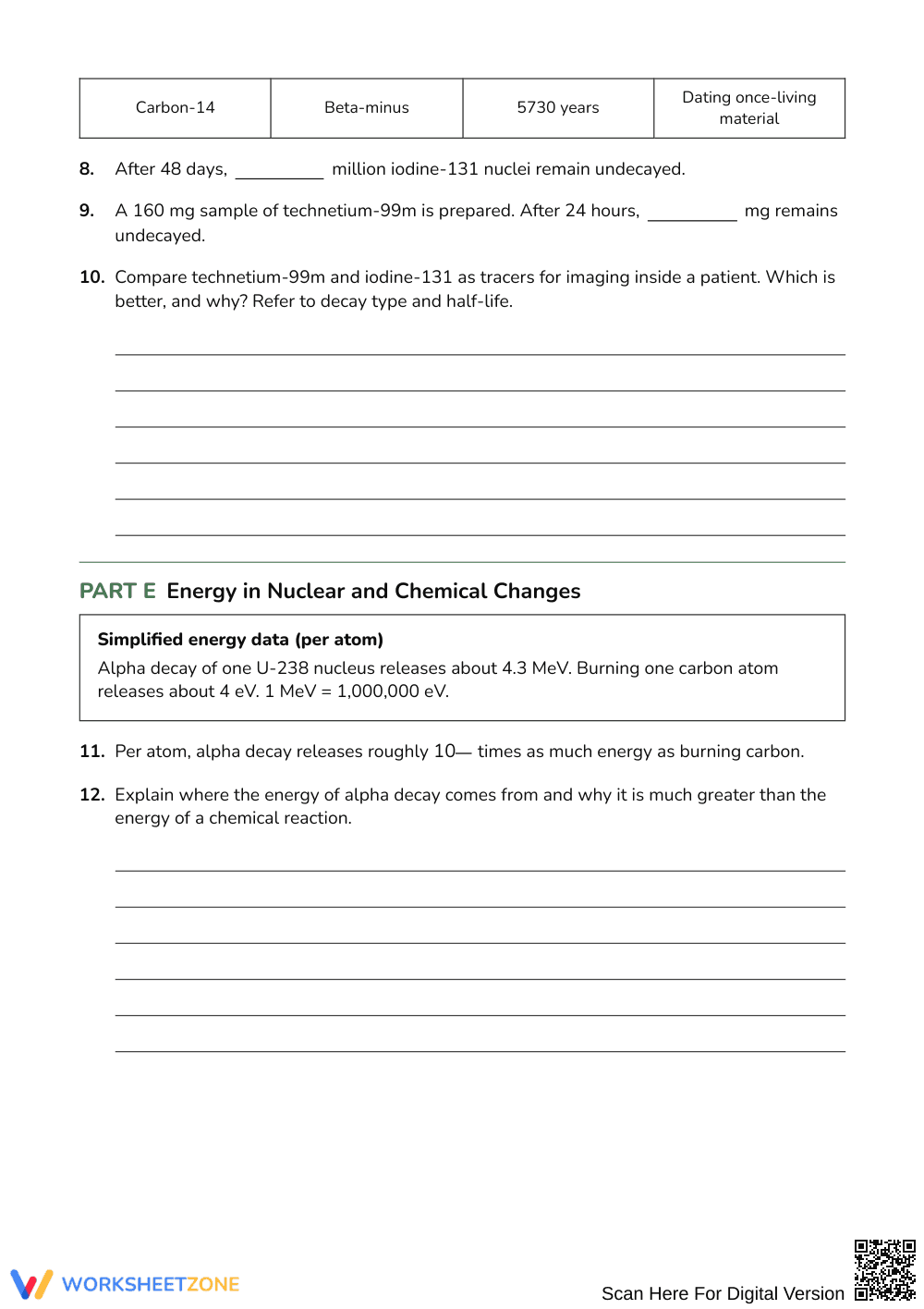
This comprehensive physical science worksheet guides high school students through comparing and contrasting alpha, beta-minus, and gamma decay processes. Working across 23 targeted tasks, students examine nuclear equations, evaluate subatomic changes, analyze penetrating power through shielding models, calculate half-life intervals, and evaluate the dramatic energetic differences between nuclear transitions and chemical bonds.
At a Glance
- Grade: Grades 9–12 · Subject: Science
- Standard: Nuclear Structure — Model nuclear decay processes, balance transmutation equations, and contrast radiation properties
- Skill Focus: Comparing nuclear decay types using models and empirical data
- Format: 4 pages · 23 problems · Answer key included · PDF
- Best For: High school chemistry and physics review
- Time: 45–60 minutes
What's Inside
The four-page student packet features a structured five-part sequence comprising data completion tables, nuclear equation balancing, Venn-style concept sorting, diagrammatic shielding models, decay curves, and quantitative energy comparisons. A four-page complete answer key provides worked equation balances, sample qualitative explanations, and step-by-step decay calculations for rapid grading and student self-assessment.
Skill Progression
- Guided Practice (Part A): Students reference an explicit notation reminder to complete particle notation tables and balance guided alpha and beta equations (7 tasks).
- Supported Practice (Parts B & C): Learners categorize decay properties using a Venn-style classification matrix and analyze a visual penetration model to contrast particle hazards (7 tasks).
- Independent Application (Parts D & E): Students interpret half-life graphs, select medical radioisotopes based on decay profiles, and compare nuclear mass defects against chemical bond energies (9 tasks).
This structure follows a gradual-release model, transitioning students from foundational particle accounting to rigorous, evidence-based scientific argumentation.
Standards Alignment
This resource aligns with high school physical science standards addressing the structure of matter and nuclear processes. Students model how unstable nuclei emit particles or rays to achieve stability, evaluate conservation of nucleon number, and analyze how mass changes release energy. These curricular competencies match core physical science objectives and integrate smoothly into standard unit lesson plans and district pacing frameworks.
How to Use It
Deploy this worksheet after direct instruction on subatomic structure and isotope notation. During classwork, circulate during Part C to confirm students connect particle charge and mass to ionizing ability rather than merely memorizing barrier materials. The assignment takes 45 to 60 minutes and works effectively for paired collaborative problem-solving or independent review.
Who It's For
Designed for general chemistry, physics, and integrated physical science classrooms, this activity supports on-grade learners while offering clear scaffolding for developing science students. Pair this activity with an interactive cloud chamber simulation or a core lecture on binding energy to reinforce particulate concepts.
High school science instruction requires structured opportunities for students to bridge atomic-scale mechanisms with observable physical phenomena. According to Fisher & Frey (2014), purposeful instructional sequencing that moves systematically from guided representations to authentic data analysis significantly deepens conceptual retention in complex science domains. This 23-task packet systematically operationalizes that pedagogical framework by having students balance nuclear equations, classify transmutation mechanisms, inspect half-life decay curves, and contrast nuclear energy output against electron-level chemical reactions. By grounding abstract isotopic transformations in concrete visual models and medical isotope applications, the resource ensures high school learners construct enduring mental models of radioactive phenomena. Teachers obtain clear diagnostic data regarding student grasp of nucleon conservation and ionizing power, making this resource an indispensable asset for high school physical science units.


