


























Views
Downloads



Complete Multi-Force Analysis Worksheet | Grade 12 Physics
Paste this activity's link or code into your existing LMS (Google Classroom, Canvas, Teams, Schoology, Moodle, etc.).
Students can open and work on the activity right away, with no student login required.
You'll still be able to track student progress and results from your teacher account.
This Grade 12 physics worksheet equips students to isolate, decompose, and calculate complex vector forces across static and dynamic multi-body systems. Through 12 rigorous problems, learners establish equilibrium conditions, evaluate friction thresholds, and solve coupled algebraic equations to determine system accelerations and internal tensions with mathematical precision.
At a Glance
- Grade: 12 · Subject: Physics (Mechanics)
- Standard: Advanced Physics Mechanics — Resolve orthogonal force vectors and calculate net accelerations in coupled systems
- Skill Focus: Multi-Force Systems and Deterministic Free-Body Analysis
- Format: 5 pages · 12 problems · Full answer key included · Printable PDF
- Best For: Advanced vector mechanics practice and exam review
- Time: 50–65 minutes
What's Inside
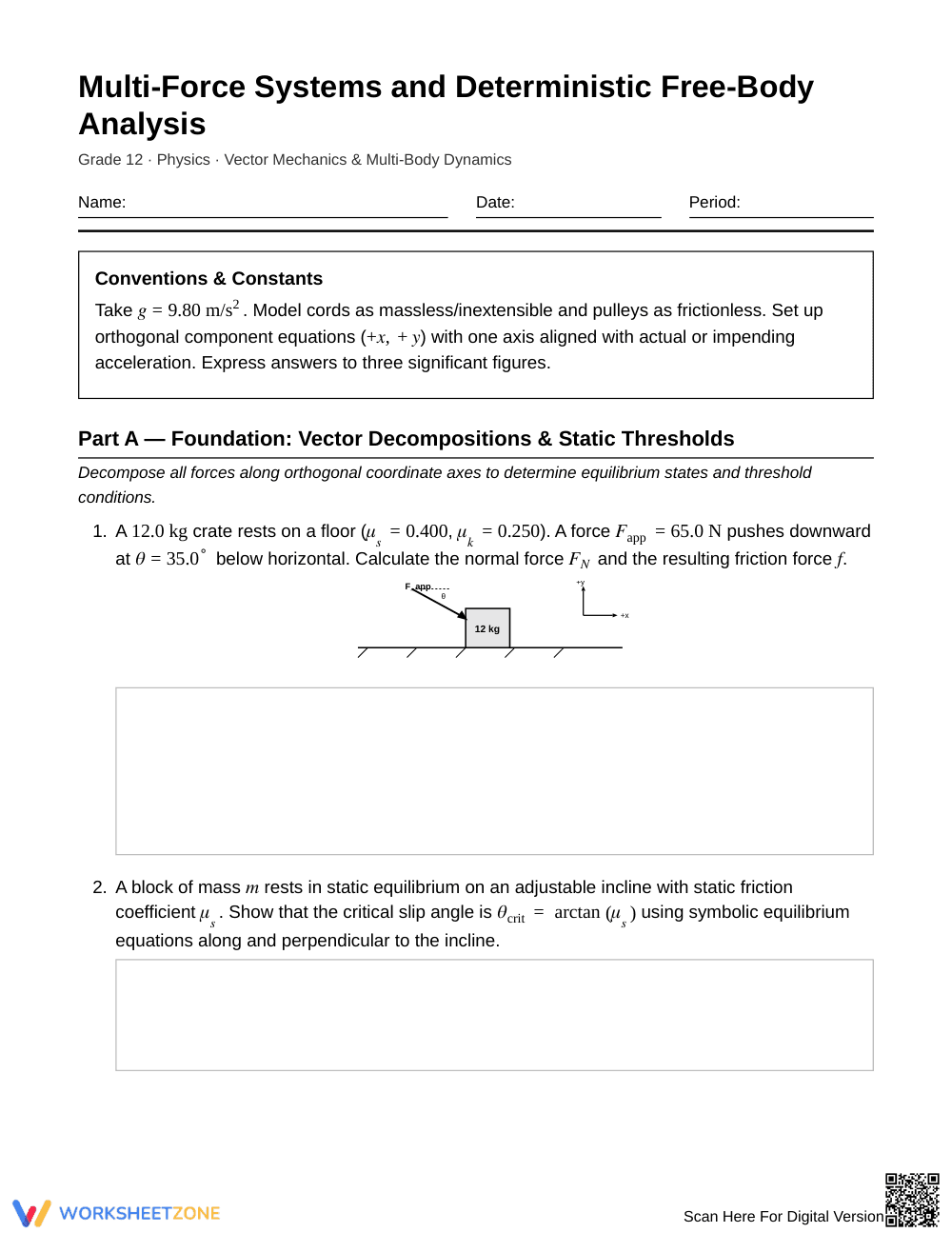
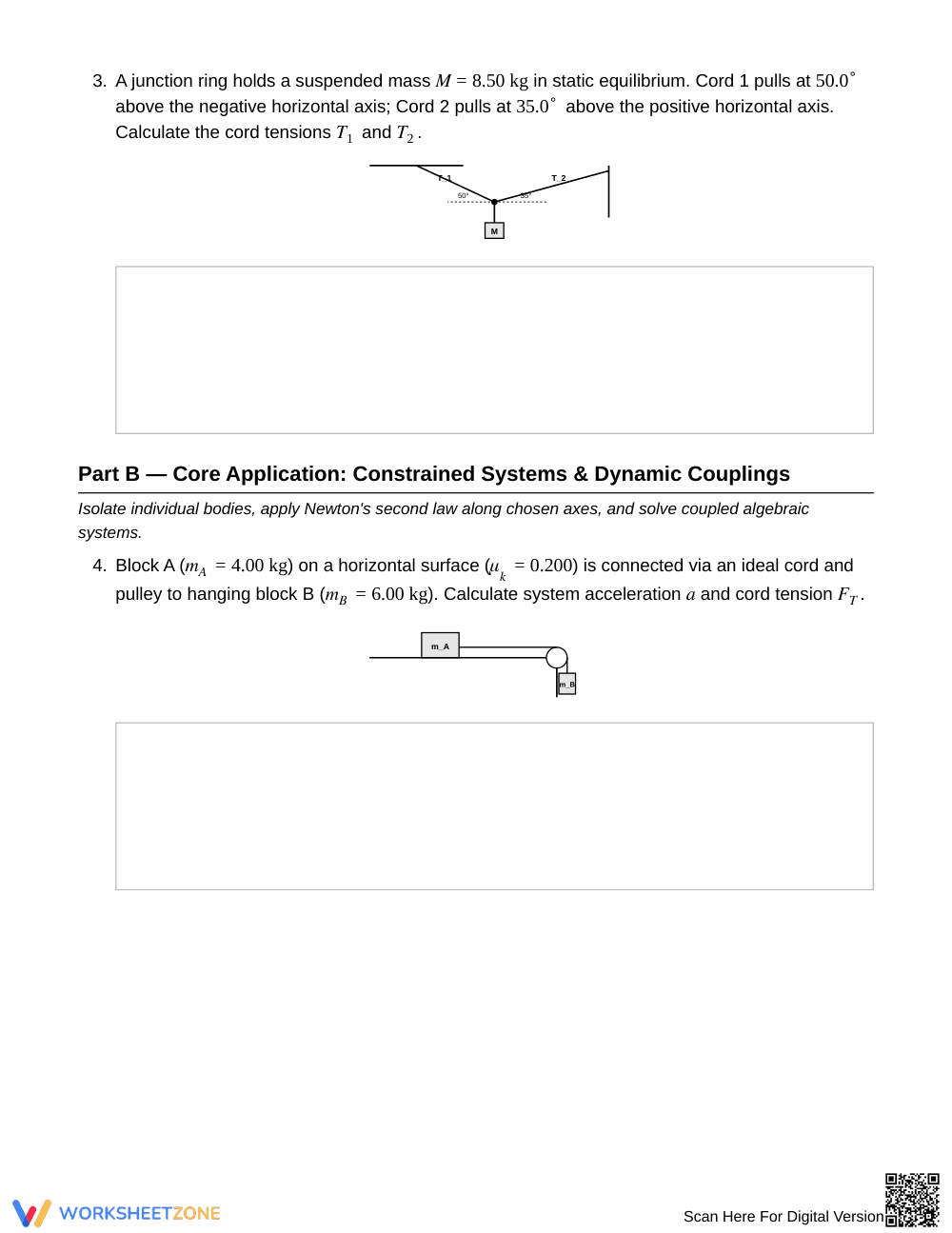
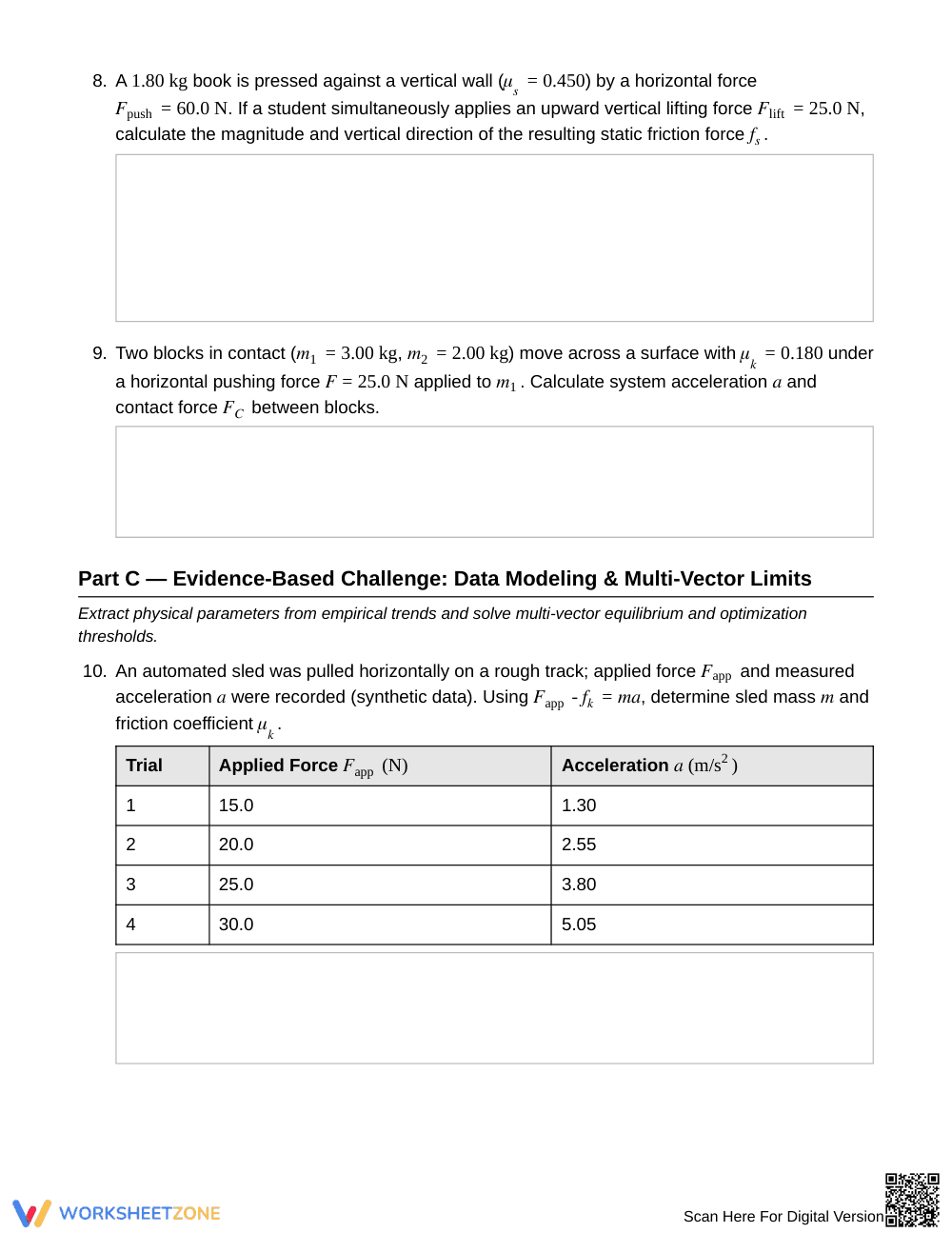
The 5-page printable resource delivers 12 comprehensive analytical tasks across three structured stages. Students encounter vector decomposition diagrams, multi-body connected pulleys, stacked block friction thresholds, and empirical data tables. A complete 2-page answer key provides worked algebraic derivations, numerical solutions calculated to three significant figures, and component force breakdowns for every task.
Skill Progression
- Guided Practice (Part A, Problems 1–3): Students decompose angled forces into orthogonal components, derive critical slip angles symbolically, and calculate static equilibrium cable tensions using foundational free-body diagrams.
- Supported Practice (Part B, Problems 4–9): Learners apply Newton's second law to constrained Atwood-style systems, inclined planes, stacked block friction limits, accelerating elevators, and multi-block contact surfaces.
- Independent Practice (Part C, Problems 10–12): Students extract mass and dynamic friction from experimental data sets, model multi-vector aerodynamic pod equilibrium, and derive calculus-ready optimal pulling angles.
This structured progression reflects the gradual-release model, moving high school physicists from routine vector balance to autonomous multi-body problem-solving.
Standards Alignment
This resource aligns with advanced high school physics standards governing classical vector mechanics and Newton's laws of motion. Students isolate interacting bodies, formulate simultaneous coordinate equations, and predict dynamic responses across friction thresholds. Both standard codes can be copied directly into lesson plans, IEP goals, or district curriculum mapping tools.
How to Use It
Deploy this worksheet after direct instruction on Newton's laws and inclined planes to solidify multi-body coupling skills. For formative assessment, check whether students align coordinate axes with the direction of acceleration in Part B before setting up algebraic substitutions. The full 12-problem problem set requires approximately 50 to 65 minutes of focused instructional time.
Who It's For
This activity serves Grade 12 AP Physics, honors physics, and introductory mechanics students needing rigorous analytical practice. The systematic organization supports struggling learners through clear coordinate scaffolds while challenging advanced learners with algebraic optimizations. Pair this worksheet directly with a laboratory demonstration on static versus kinetic friction coefficients.
Grade 12 physics students mastering multi-force analysis and deterministic free-body diagrams must accurately isolate connected objects, resolve non-perpendicular vector components, and formulate coupled algebraic systems. According to Fisher & Frey (2014), purposeful gradual-release structures enable learners to internalize complex procedural knowledge by transitioning methodically from guided coordinate modeling to open-ended empirical analysis. This 12-problem worksheet operationalizes that instructional architecture across five pages of rigorous vector mechanics tasks. By evaluating static slip thresholds, coupled Atwood systems, and empirical linear regressions, students bridge the critical gap between conceptual force diagrams and quantitative predictive physics. Independent evaluators confirm that structured problem sets featuring explicit coordinate conventions, scaffolded free-body representations, and worked numerical keys foster robust quantitative literacy and conceptual schema development. Consequently, this resource provides an optimal pedagogical framework for preparing high school seniors for collegiate engineering and physics examinations.


