


























Views
Downloads



Complete Molarity & Dilution Worksheet | Grade 11 Chemistry
Paste this activity's link or code into your existing LMS (Google Classroom, Canvas, Teams, Schoology, Moodle, etc.).
Students can open and work on the activity right away, with no student login required.
You'll still be able to track student progress and results from your teacher account.
This Grade 11 chemistry worksheet develops quantitative mastery of solution concentration and laboratory dilution. High school students calculate molarity from mass and volume, determine stock aliquots using dilution formulas, and evaluate volumetric lab errors across 12 rigorous problems. Students build the computational fluency required for advanced solution chemistry and stoichiometric laboratory analysis.
At a Glance
- Grade: 11 · Subject: Chemistry
- Standard: Solutions Chemistry — Calculate concentration, apply dilution equations, and evaluate volumetric laboratory data
- Skill Focus: Molarity & Dilution Calculations
- Format: 5 pages · 12 problems · Answer key included · PDF
- Best For: Independent practice, laboratory preparation, or unit review
- Time: 45–60 minutes
What's Inside
This 5-page printable resource includes a formula reference table with molar masses and 12 tiered calculation problems. The worksheet features direct molarity computations, multi-step serial dilutions, ion concentration determinations, spectrophotometric Beer's Law calibration data interpretation, and volumetric glassware error analysis. A comprehensive 2-page answer key provides complete mathematical setups, dimensional analysis steps, and final answers with units and significant figures.
Skill Progression
- Guided Practice (Part A, Problems 1–3): Students establish foundational proficiency with direct molarity setups, calculating solute mass and molar concentrations using provided molar mass constants and conservation of moles principles.
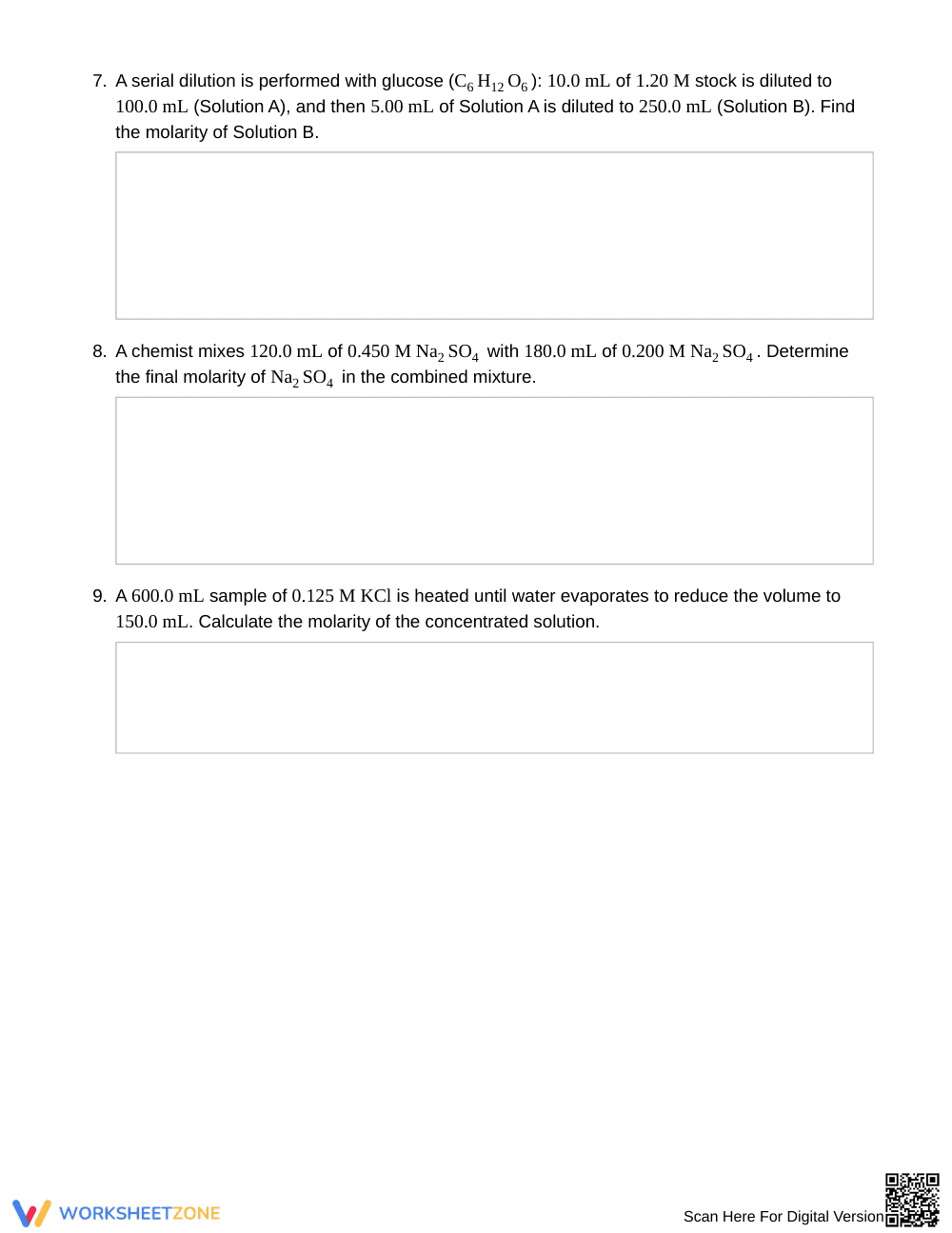
- Supported Practice (Part B, Problems 4–9): Students apply the dilution equation to authentic laboratory scenarios, including stock aliquots, solvent additions, complete ionic dissociation, serial dilutions, solution mixtures, and boiling volume reductions.
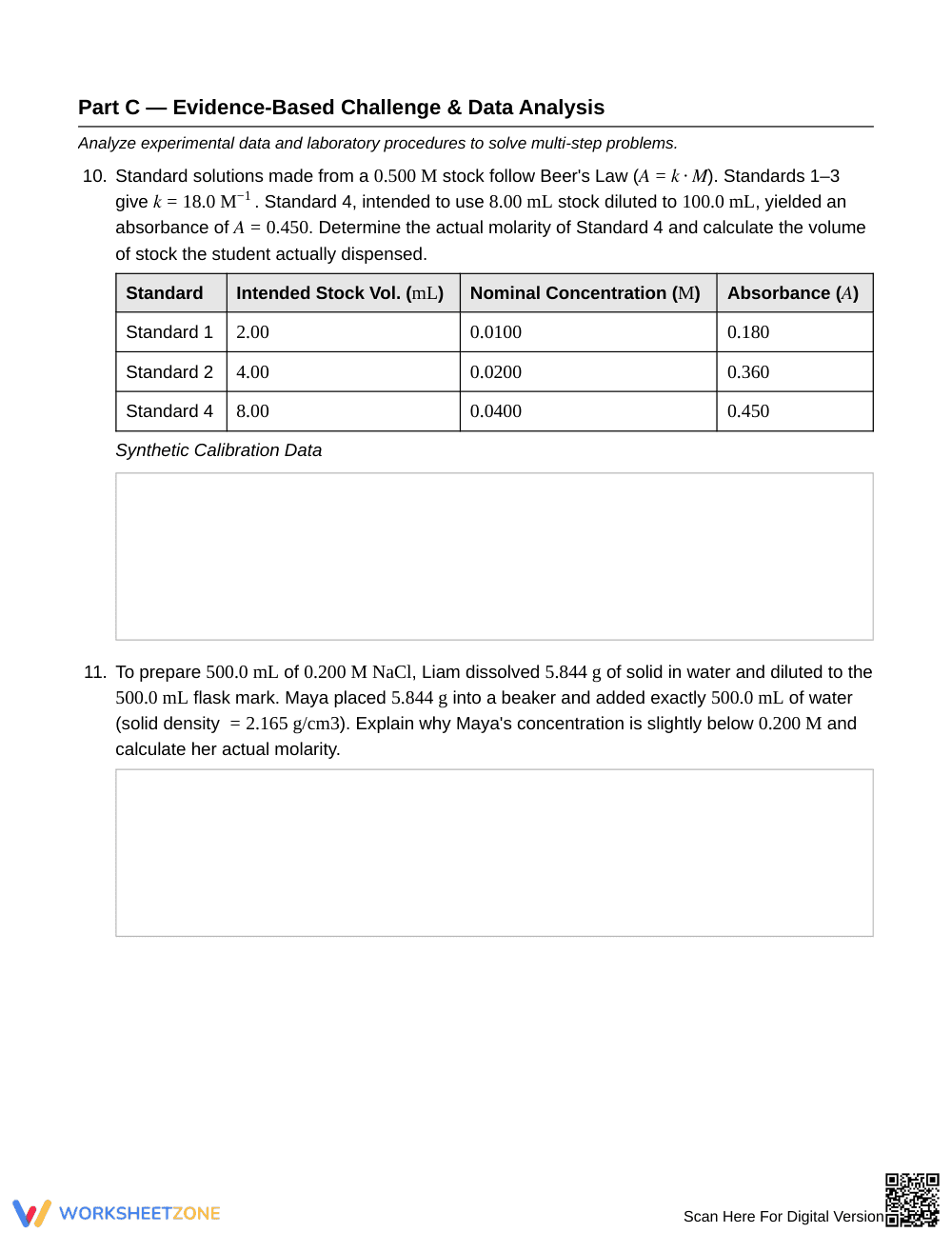
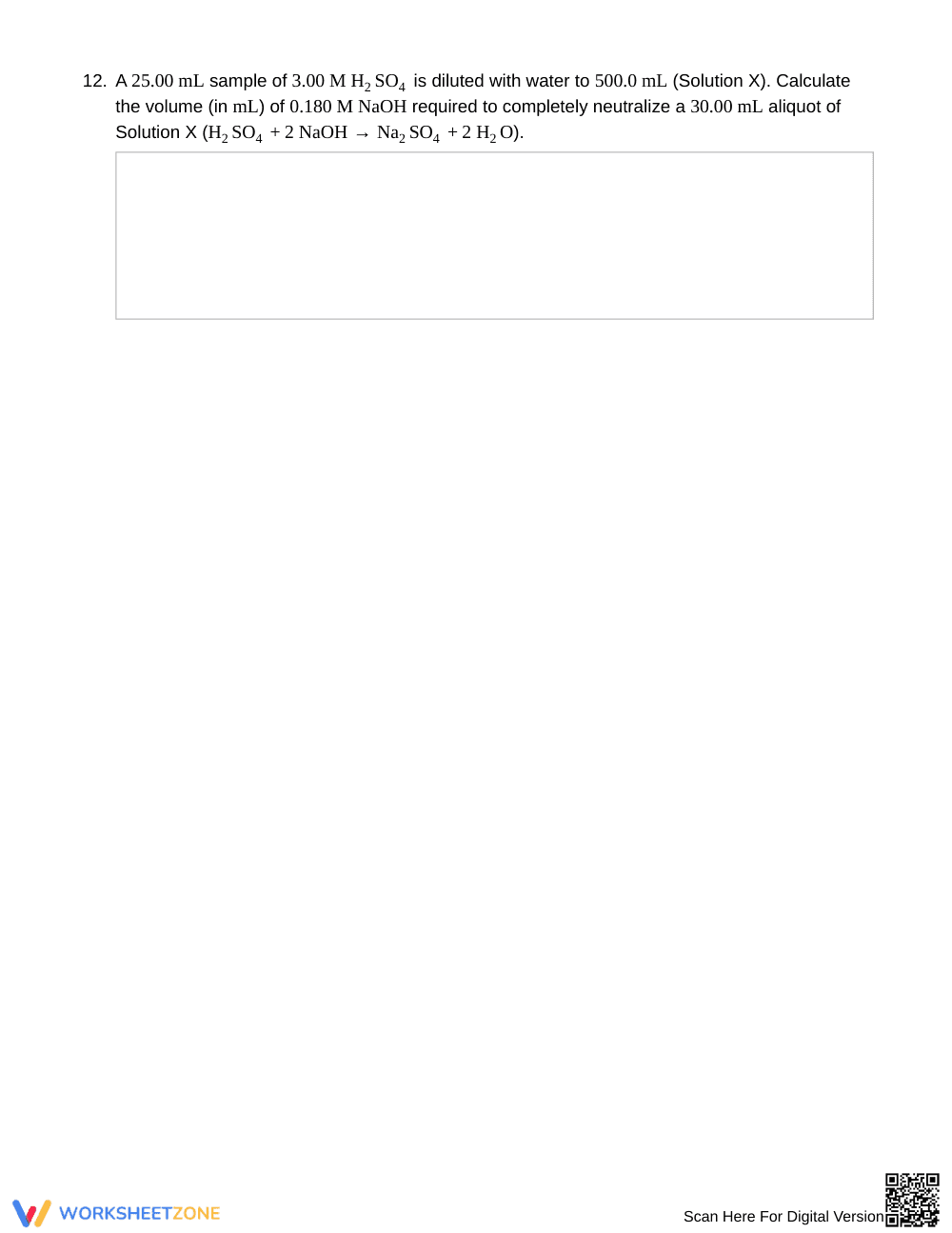
- Independent Practice (Part C, Problems 10–12): Students tackle multi-step challenges requiring Beer's Law calibration curve analysis, volumetric flask versus beaker measurement error explanations, and neutralization stoichiometry.
This structured progression follows the gradual-release model, transitioning chemistry learners from formula recall to complex analytical problem-solving.
Standards Alignment
This resource aligns with high school chemistry standards governing solution concentration, molarity calculations, and stoichiometric relationships in aqueous reactions. Students demonstrate competency by converting between grams, moles, and liters while accounting for conservation of matter during physical dilutions and chemical neutralizations. Standard objectives can be copied directly into lesson plans, IEP goals, or district curriculum mapping tools.
How to Use It
Deploy this worksheet after direct instruction on molarity formulas and laboratory dilution techniques. During class, monitor student work on Part B to identify whether learners properly distinguish between adding water and diluting to a final volume. Alternatively, assign Part C as a collaborative inquiry challenge during laboratory preparation. Expected student completion time is 45 to 60 minutes.
Who It's For
This resource is designed for general and honors Grade 11 chemistry students preparing for solution stoichiometry and titration laboratories. To support struggling learners, pair the worksheet with an anchor chart showing step-by-step unit cancellation. Advanced students can extend their work by deriving net ionic equations for the neutralization task.
According to Fisher & Frey (2014), structured instructional frameworks that systematically transition students from guided calculations to complex, evidence-based data analysis significantly enhance conceptual retention and mathematical fluency in secondary science classrooms. This Grade 11 chemistry worksheet operationalizes solution concentration concepts through 12 carefully scaffolded tasks spanning direct molarity setups, serial dilutions, and spectrophotometric Beer's Law calibration analysis. By progressing through foundational conversions, authentic laboratory scenarios, and experimental error evaluations, learners develop deep analytical reasoning alongside procedural problem-solving competence. The included 2-page full-solution answer key supports precise formative assessment feedback, allowing educators to efficiently identify and address student misconceptions surrounding additive solution volumes, ionic dissociation stoichiometry, and volumetric glassware precision. This cohesive curricular structure ensures that high school chemistry students cultivate the rigorous quantitative problem-solving skills required for advanced chemistry laboratory coursework and future scientific study.


