




























Views
Downloads




Complete Mixed Inequalities Worksheet | Grade 9 Algebra I

Paste this activity's link or code into your existing LMS (Google Classroom, Canvas, Teams, Schoology, Moodle, etc.).
Students can open and work on the activity right away, with no student login required.
You'll still be able to track student progress and results from your teacher account.
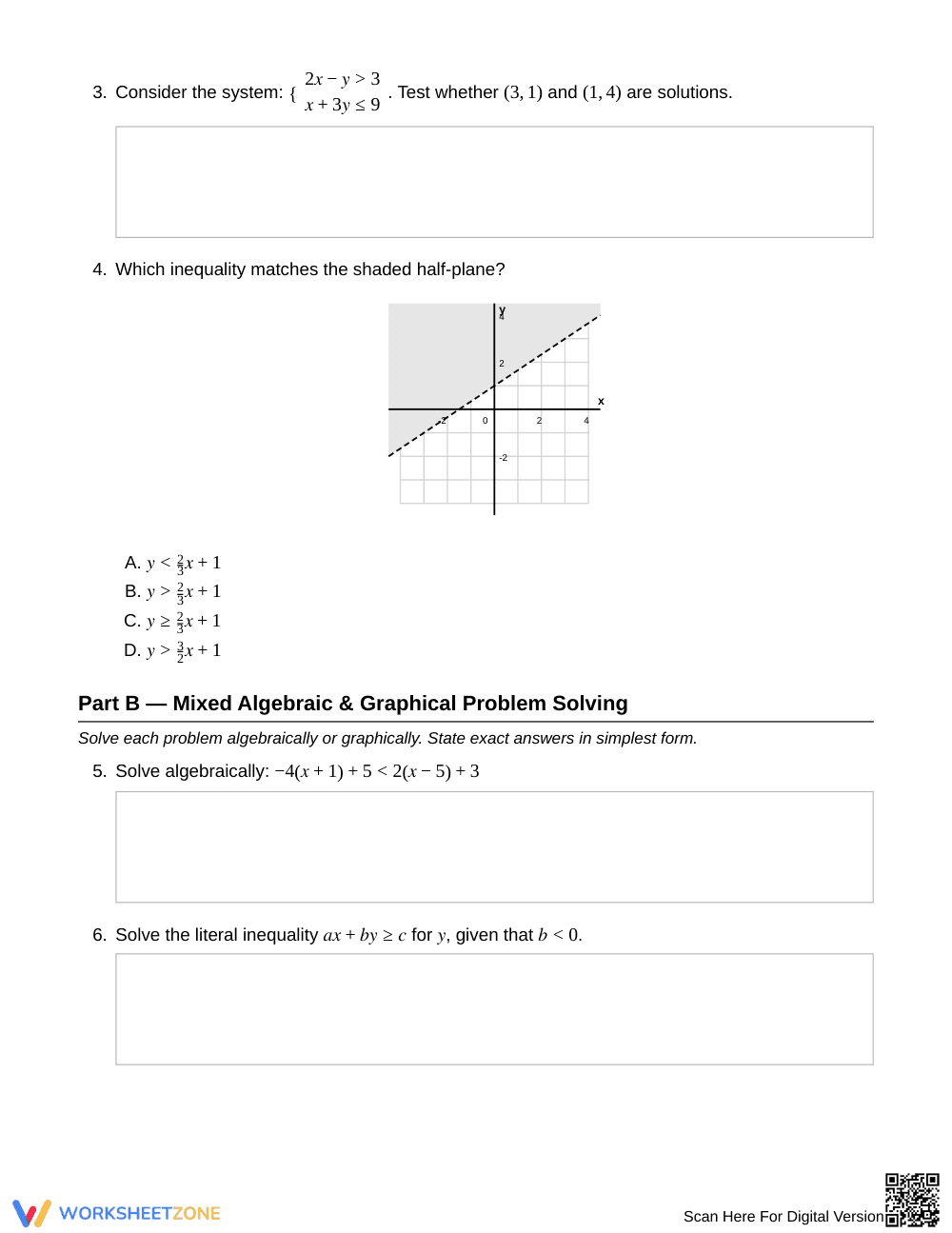
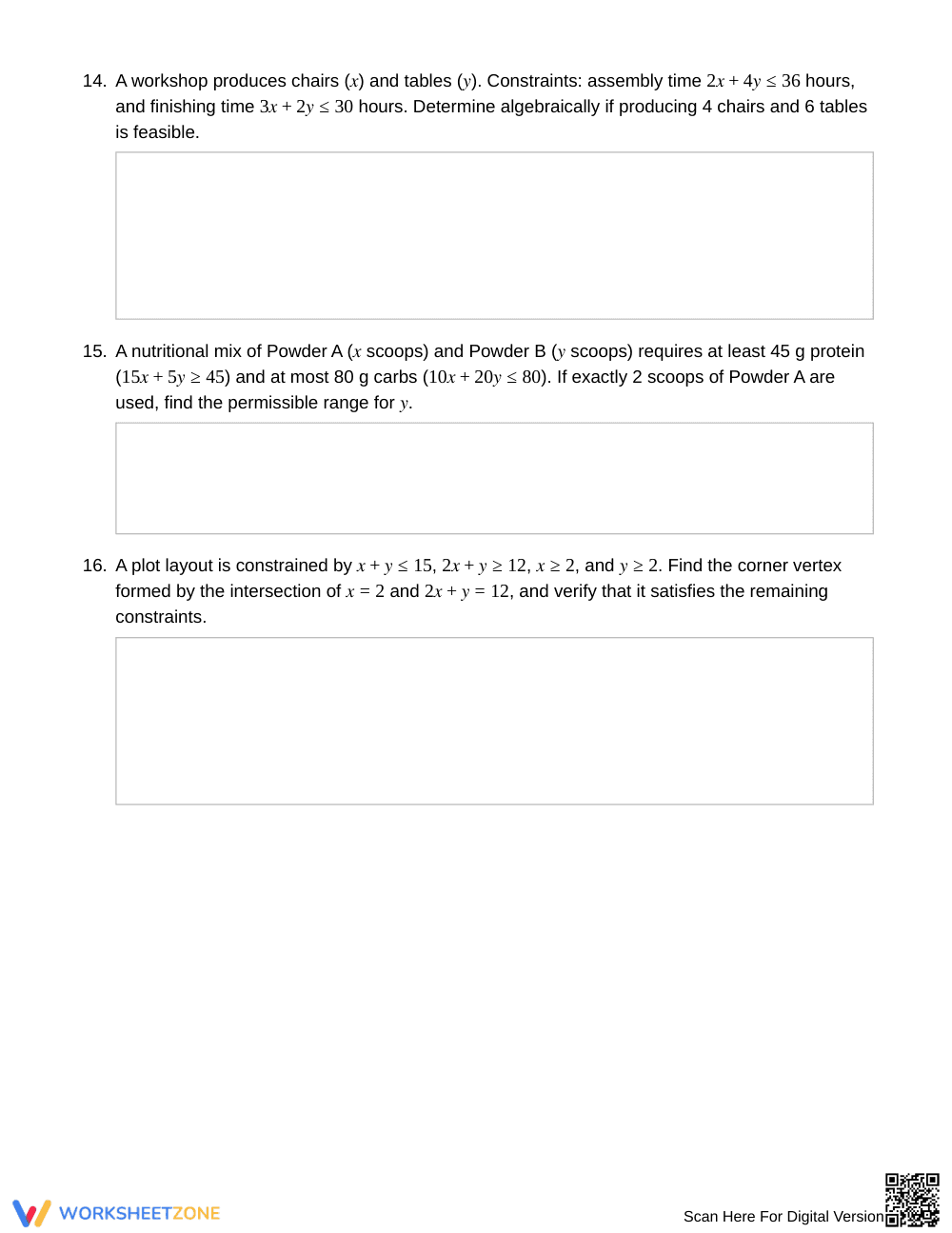
This mixed linear inequalities worksheet builds student fluency in solving, graphing, and modeling one- and two-variable constraints across 16 problems. Designed for Grade 9 Algebra I, this resource connects algebraic operations with coordinate graphing to help learners verify boundaries, shade half-planes, and analyze feasible regions.
At a Glance
- Grade: 9 · Subject: High School Algebra I
- Standard: High School Algebra Standards — Solve, graph, and interpret one- and two-variable linear inequalities and feasible systems.
- Skill Focus: Mix Algebraic and Graphical Inequalities
- Format: 5 pages · 16 problems · Answer key included · PDF
- Best For: Targeted skill consolidation and exam preparation
- Time: 45–60 minutes
What's Inside
This 5-page worksheet delivers 16 practice problems structured across three parts, beginning with a Core Reference Rules box summarizing boundary styles and sign reversals. Students complete structural classification tables, graph linear inequalities on coordinate grids, solve compound inequalities, and model multi-constraint scenarios. A comprehensive 2-page answer key provides complete algebraic steps and graphs.
Skill Progression
- Guided practice (Problems 1–4): Scaffolded foundational tasks use rule boxes to classify boundary lines, determine shading half-planes, and solve basic linear inequalities.
- Supported practice (Problems 5–12): Multi-step tasks prompt students to isolate literal variables, graph constraints, solve compound inequalities, and evaluate coordinate test points.
- Independent practice (Problems 13–16): Applied word problems require learners to model real-world business, manufacturing, and nutritional constraints autonomously.
This sequence implements a gradual release of responsibility, guiding students from structural recall to independent mathematical modeling.
Standards Alignment
This resource aligns with high school algebra standards for reasoning with equations and inequalities. Students solve linear inequalities in one variable, graph two-variable inequalities as half-planes, and determine solution sets for systems of linear inequalities representing realistic constraints. Both standard codes can be copied directly into lesson plans, IEP goals, or district curriculum mapping tools.
How to Use It
Use this worksheet during guided practice or following direct instruction on linear systems. Have students work in pairs through Parts A and B, reserving Part C for individual assessment. During circulation, check whether students reverse inequality symbols when dividing by negative coefficients and confirm correct boundary line styles. Completion takes 45 to 60 minutes.
Who It's For
This set is designed for Grade 9 Algebra I students and high school intervention groups needing practice with coordinate graphing and constraint modeling. The reference rules support developing learners, while multi-constraint applications challenge advanced students. Pair this activity with an introductory direct instruction lesson on systems of inequalities.
Structured practice in mixed algebraic and graphical linear inequalities strengthens secondary students' capacity to connect abstract symbolic operations with concrete geometric representations. According to Fisher & Frey (2014), intentional instructional scaffolding that transitions from foundational rule reinforcement to independent application produces measurable gains in procedural fluency and conceptual retention. This Grade 9 instructional packet operationalizes that gradual-release architecture through 16 calibrated tasks spanning literal manipulation, coordinate half-plane graphing, and multi-variable system modeling. By prompting learners to verify boundary classifications, apply test points algebraically, and determine feasible regions in real-world contexts, the resource builds comprehensive mastery of secondary linear inequality standards. High school mathematics educators can utilize the integrated reference rules and complete 2-page answer key to evaluate student reasoning efficiently, ensuring that learners develop robust mathematical modeling habits while successfully resolving common misconceptions surrounding boundary line styles and negative sign reversals.


