


























Views
Downloads




Complete Missing Coordinate Slope Worksheet | Grade 8 Math
Paste this activity's link or code into your existing LMS (Google Classroom, Canvas, Teams, Schoology, Moodle, etc.).
Students can open and work on the activity right away, with no student login required.
You'll still be able to track student progress and results from your teacher account.
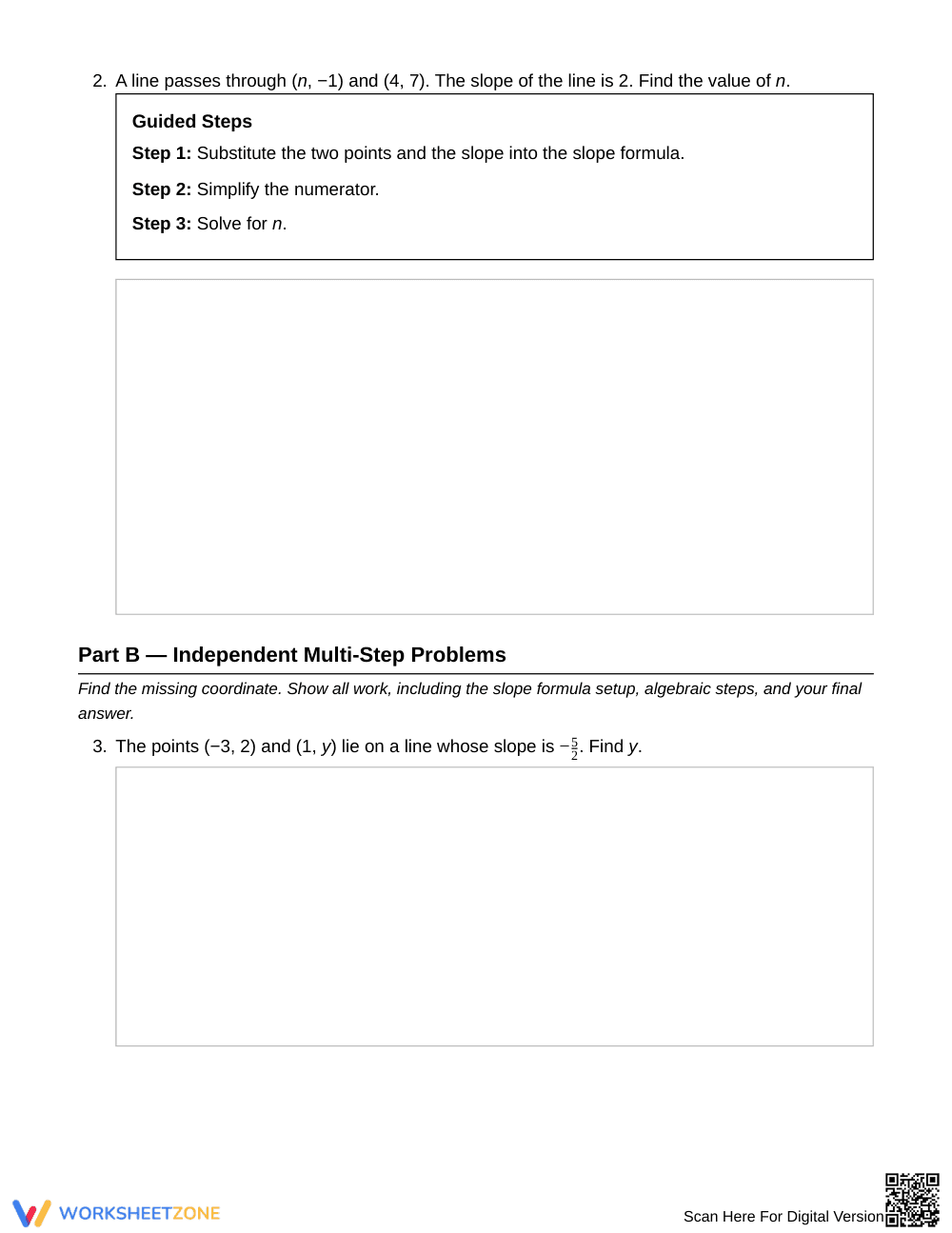
This Grade 8 mathematics worksheet provides structured algebraic practice on finding a missing coordinate when given a target slope and two points. Students apply the slope formula to write and solve linear equations, checking their work through algebraic calculation and coordinate grid graphing.
At a Glance
- Grade: 8 · Subject: Math
- Standard: Rate of Change — Calculate slope and solve for unknown coordinates in linear relationships
- Skill Focus: Find a Missing Coordinate for a Target Slope
- Format: 5 pages · 6 problems · Answer key included · PDF
- Best For: Independent practice and intervention
- Time: 35–45 minutes
What's Inside
The 5-page worksheet includes 6 structured problems moving from guided formula application to graphical justification. Features include a key slope formula box, step-by-step prompts, table-based rate of change analysis, unknown coordinate expressions, coordinate grid plotting, and a comprehensive 4-page answer key showing full algebraic solutions.
Skill Progression
- Guided Practice (Part A, 2 problems): Explicit 3-step prompts guide students through substitution, simplification, and one-step equation solving.
- Supported Practice (Part B, 3 problems): Scaffolds fade as students solve coordinate problems unprompted, analyze rate of change tables, and solve expressions with variable binomials.
- Independent Practice (Part C, 1 problem): Students calculate an unknown coordinate, plot the resulting points on a grid, and write a justification connecting rise and run.
This structure follows the gradual release of responsibility model, ensuring learners master algebraic mechanics before completing open-ended graphing tasks.
Standards Alignment
This resource focuses on applying the slope formula as a constant rate of change between coordinate pairs to solve linear equations. Students interpret rate of change across tables, points, and graphs while verifying solutions algebraically. Both standard concepts can be copied directly into lesson plans, IEP goals, or district curriculum mapping tools.
How to Use It
Use this worksheet after direct instruction on the slope formula as a mid-unit check. During seatwork, observe whether students set up fractions accurately when the unknown coordinate is in the second point. Alternatively, assign Part A in small-group intervention and Parts B and C for independent practice. Expected completion time is 35 to 45 minutes.
Who It's For
This resource is designed for eighth-grade math classes and introductory Algebra I students studying linear relationships. It provides guided scaffolding for striving learners, alongside coordinate graphing for on-grade practice. Pair this worksheet with a direct instruction lesson on linear rates of change or a classroom slope anchor chart.
According to research by Fisher & Frey (2014) on the gradual release of responsibility, structured instructional scaffolding enables middle school students to transition from guided procedural steps to independent problem solving. This Grade 8 math worksheet operationalizes that framework by guiding learners through finding a missing coordinate for a target slope across six structured tasks. Starting with explicit formula substitution prompts in Part A, progressing to tabular data and multi-step algebraic equations in Part B, and culminating in coordinate graphing with written justification in Part C, students systematically deepen their conceptual understanding of constant rate of change. Learners connect algebraic equations directly to geometric representations on a coordinate plane, solidifying the relationship between slope, rise, and run. The four-page answer key provides complete worked solutions, ensuring effective formative assessment and instructional intervention.


