


























Views
Downloads




Complete Log Conversions Worksheet | Grade 11 Algebra II
Paste this activity's link or code into your existing LMS (Google Classroom, Canvas, Teams, Schoology, Moodle, etc.).
Students can open and work on the activity right away, with no student login required.
You'll still be able to track student progress and results from your teacher account.
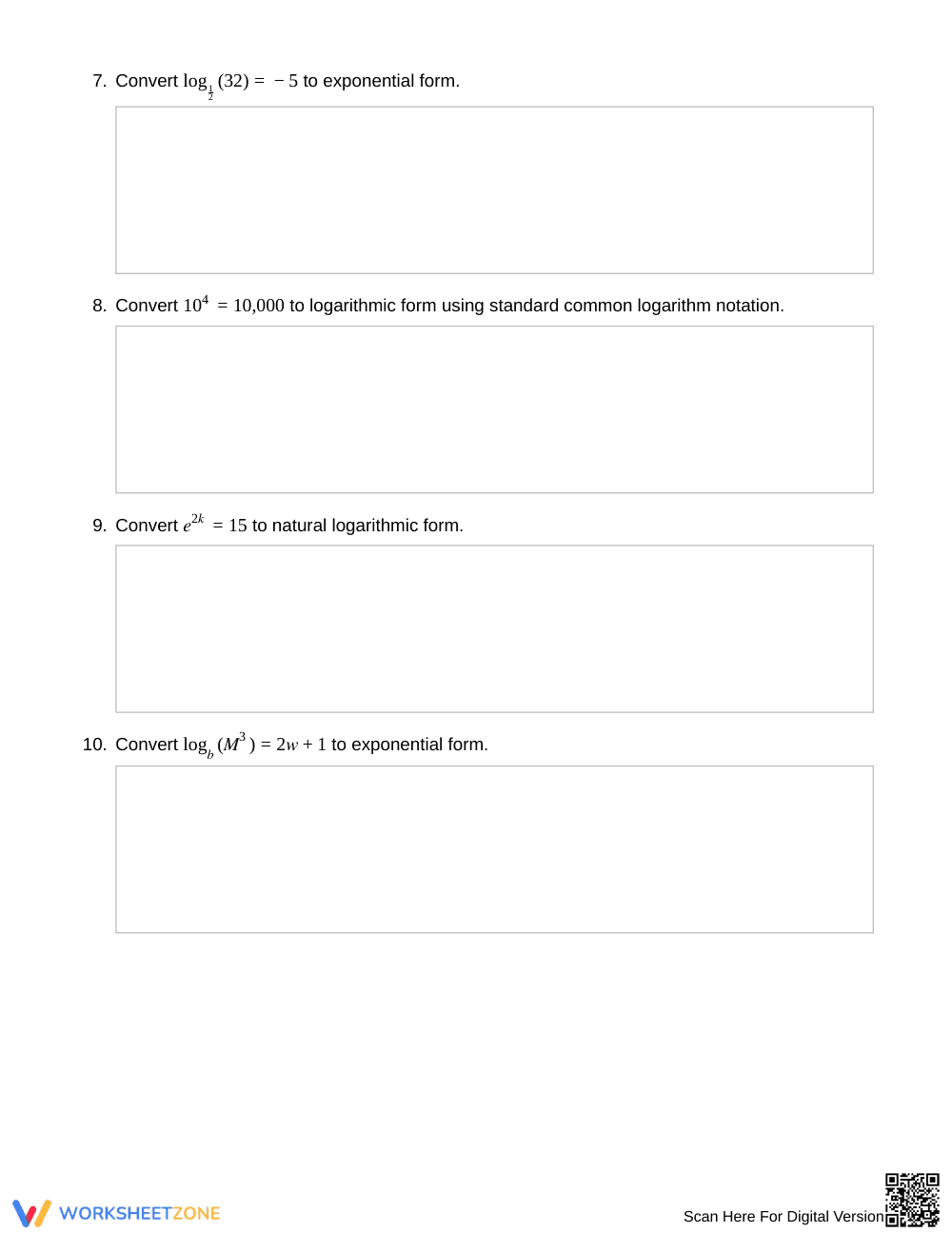
Mastering the inverse relationship between logarithmic and exponential equations is essential for success in advanced algebra. This Grade 11 worksheet guides students through converting expressions between logarithmic and exponential forms across 12 targeted problems, strengthening algebraic fluency with standard, common, and natural logarithms.
At a Glance
- Grade: 11 · Subject: Algebra II
- Standard:
HSF-BF.B.5— Convert between equivalent exponential and logarithmic forms to solve equations- Skill Focus: Logarithmic and exponential form equivalence
- Format: 5 pages · 12 structured problems · Answer key included · PDF
- Best For: Core guided practice and skill consolidation
- Time: 30–45 minutes
What's Inside
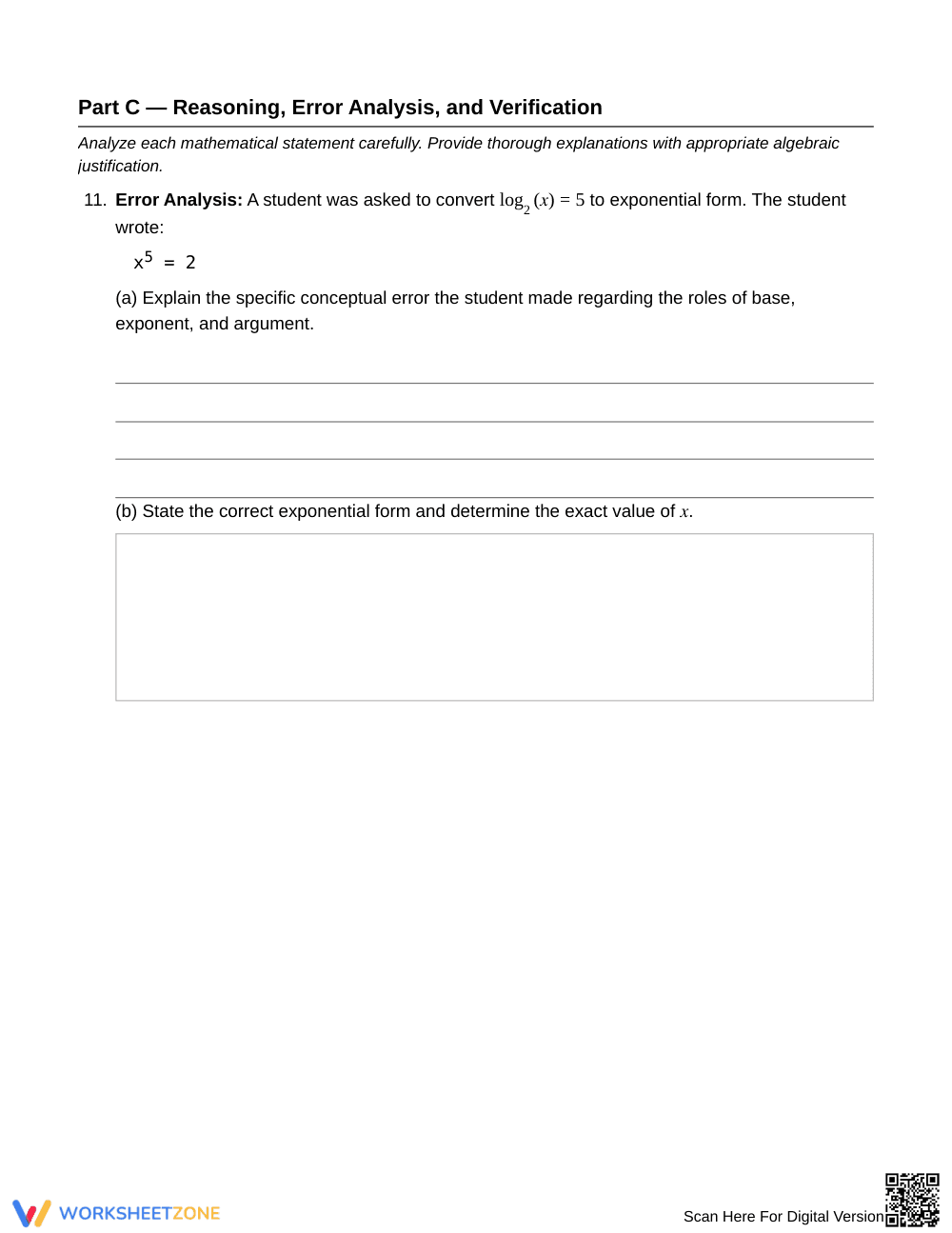
This 5-page resource includes a core reference box, two modeled examples, 12 practice exercises, and a complete 2-page answer key. Students review the equivalence log_b(x) = y if and only if b^y = x alongside common and natural log rules before completing scaffolded conversions, independent problems, and written error analysis.
Skill Progression
- Guided practice (Part A): Four scaffolded tasks prompt students to identify bases, exponents, and arguments, addressing both common and natural logarithms.
- Supported practice (Part B): Six conversion problems require students to transform equations across negative exponents, fractions, and multi-variable powers without prompts.
- Independent practice (Part C): Two rigorous reasoning exercises challenge learners to diagnose algebraic misconceptions and justify logarithmic domain restrictions using exponential logic.
This sequence implements the gradual release of responsibility model, moving students from guided component identification to independent algebraic reasoning.
Standards Alignment
This worksheet aligns directly to HSF-BF.B.5: Understand the inverse relationship between exponents and logarithms and use this relationship to solve problems involving logarithms and exponents. It also connects to supporting standard HSF-LE.A.4 by expressing exponential solutions as logarithms. Both standard codes can be copied directly into lesson plans, IEP goals, or district curriculum mapping tools.
How to Use It
Assign this worksheet immediately following direct instruction on the definition of logarithms. Allocate 30 to 45 minutes, using Part A for partner practice before students tackle Part B individually. While circulating, observe whether students identify implicit base 10 in common logs and base e in natural logs. Collect Part C as an exit ticket to assess conceptual reasoning.
Who It's For
This activity is designed for Grade 11 Algebra II students learning logarithmic functions. Part A offers scaffolding for English language learners and students with IEP accommodations, while Part C provides rigorous extension for advanced learners. Pair this resource with a logarithmic properties anchor chart or inverse function graphing activity.
Algebra II curricula require students to develop a rigorous conceptual understanding of the inverse relationship between logarithmic and exponential expressions under standard HSF-BF.B.5. Educational research by Fisher & Frey (2014) demonstrates that structured gradual release instructional frameworks—moving systematically from modeled teacher examples to scaffolded component identification and independent problem-solving—significantly enhance cognitive retention in secondary mathematics. Converting between logarithmic and exponential forms serves as the critical gateway skill for solving exponential equations, graphing logarithmic curves, and modeling real-world exponential phenomena. By requiring learners to explicitly identify the base, exponent, and argument before executing conversions, this worksheet reinforces structural mathematical literacy. Furthermore, incorporating targeted error analysis and domain justification tasks compels students to verify mathematical validity rather than relying on superficial algorithmic memorization, aligning directly with evidence-based practices that cultivate enduring mastery across advanced high school algebra courses.


