




























Views
Downloads




Complete Linear Modeling Worksheet | Grade 9 Algebra I

Paste this activity's link or code into your existing LMS (Google Classroom, Canvas, Teams, Schoology, Moodle, etc.).
Students can open and work on the activity right away, with no student login required.
You'll still be able to track student progress and results from your teacher account.
This Algebra I worksheet builds student fluency in constructing, comparing, and interpreting linear models across authentic scenarios. High school learners analyze rates of change, solve break-even systems, and establish contextual domain boundaries across 16 rigorous problems. Designed for secondary classrooms, it connects procedural graphing with conceptual evaluation to deepen function comprehension.
At a Glance
- Grade: 9 · Subject: Algebra I
- Standard:
HSF-LE.A.2— Construct linear functions from contextual descriptions, tables, and graphs- Skill Focus: Linear Modeling, Comparison, and Evaluation
- Format: 5 pages · 16 problems · Answer key included · PDF
- Best For: Mid-unit practice or guided review
- Time: 45–60 minutes
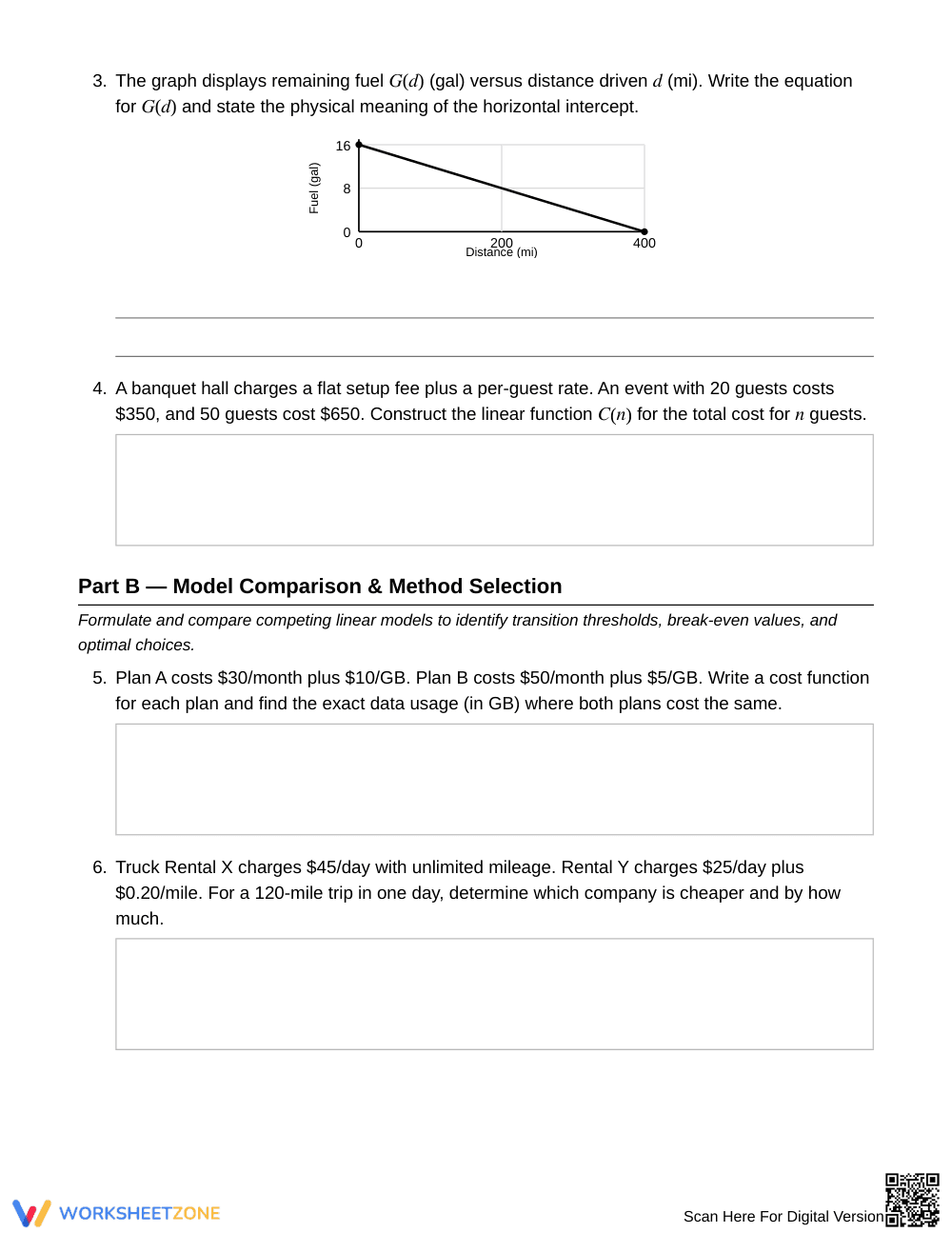
The 5-page resource delivers 16 carefully sequenced modeling tasks alongside a complete 2-page answer key. A reference box anchors the first page with definitions of slope as constant rate of change, initial values, and algebraic break-even criteria. Students work through verbal scenarios, data tables, coordinate graphs, multiple-choice comparisons, and multi-step constraint problems.
Skill Progression
- Guided practice (Part A, Problems 1–4): Students construct linear equations from verbal prompts, data tables, and coordinate graphs using foundational rate scaffolds.
- Supported practice (Part B, Problems 5–12): Learners formulate paired linear models to determine break-even points, compare competing service rates, and solve contextual inequalities.
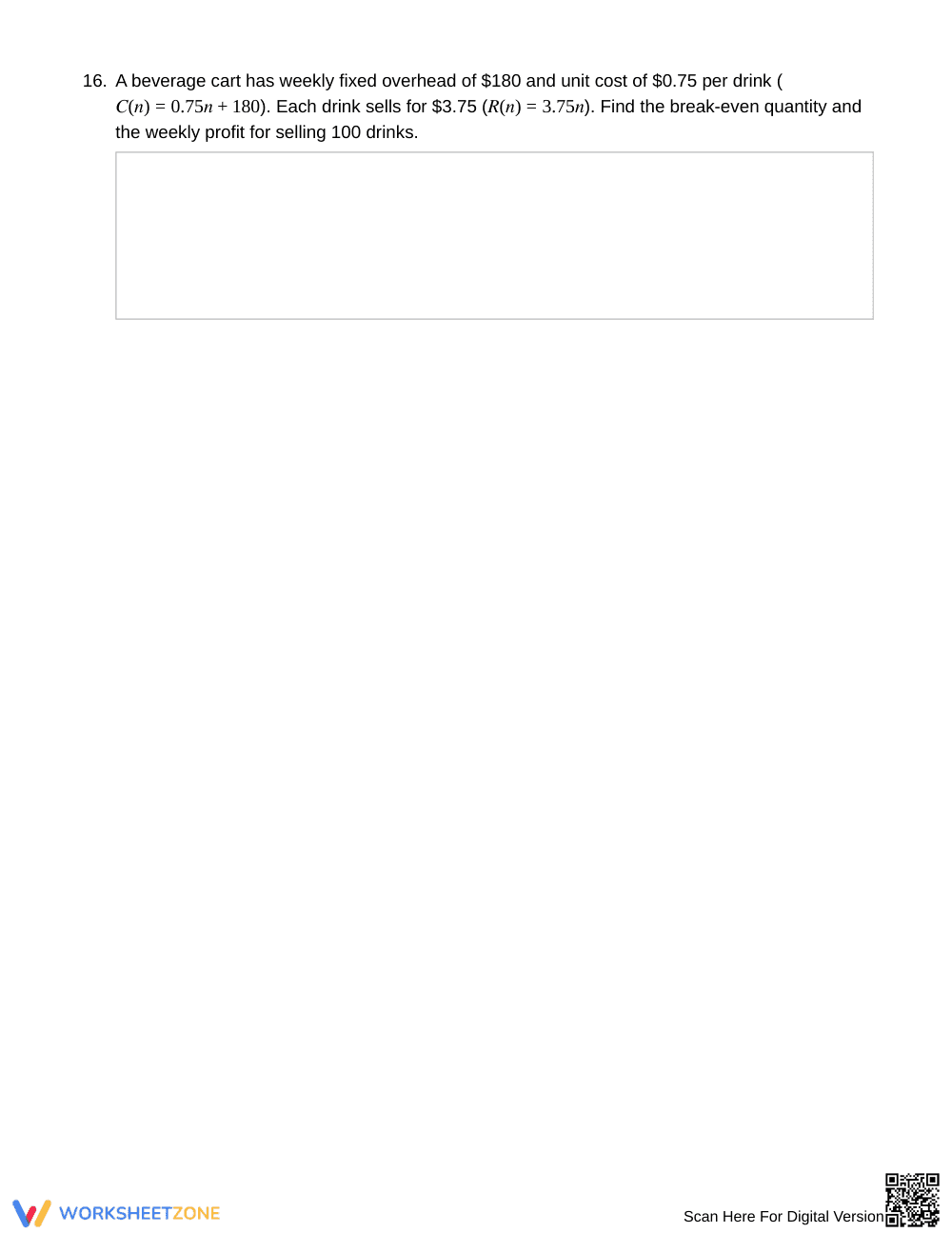
- Independent practice (Part C, Problems 13–16): Students integrate multiple constraints, applying contextual domains, tracking opposing motion systems, and calculating business profit.
This sequence reflects the gradual release of responsibility model, moving students from guided construction to independent system evaluation.
Standards Alignment
This resource aligns directly to Common Core standard `HSF-LE.A.2`: Construct linear and exponential functions, including arithmetic and geometric sequences, given a graph, a description of a relationship, or two input-output pairs. It also supports solving linear systems in contextual modeling. Both standard codes can be copied directly into lesson plans, IEP goals, or district curriculum mapping tools.
How to Use It
Deploy this worksheet during the second half of a linear functions unit after direct instruction on rate of change and systems. Alternatively, assign Part B for collaborative pairs to compare competing rates before completing Part C individually. For formative assessment, check whether students correctly interpret units on slopes and intercepts in Part A before tackling multi-step comparisons. Completion takes 45 to 60 minutes.
Who It's For
This practice set serves Grade 9 Algebra I students learning applied modeling. Scaffolding supports mixed-ability classrooms, while multi-step rate comparisons provide rigorous extension. Pair this resource with a visual anchor chart illustrating rate-of-change formulas and graphical break-even intersections.
Targeting standard HSF-LE.A.2, this worksheet reinforces linear modeling, comparative analysis, and constraint evaluation for secondary learners. Research by Fisher & Frey (2014) highlights the efficacy of gradual release instructional frameworks in secondary mathematics, demonstrating that shifting cognitive load from guided equation formulation to multi-step comparative problem solving significantly strengthens mathematical reasoning. By guiding students through foundational function construction, paired rate comparisons, and bounded domain applications across 16 scaffolded tasks, this resource operationalizes structured cognitive transfer. Students progress from defining initial values and constant rates of change in tabular and graphical formats to evaluating authentic break-even scenarios and optimization problems. This systematic design ensures high school Algebra I students build durable conceptual understandings alongside procedural competence, preparing them to interpret real-world linear relationships accurately across academic assessments and practical decision-making contexts.


