


























Views
Downloads




Complete Inverse Functions Worksheet | Grade 12 Precalculus
Paste this activity's link or code into your existing LMS (Google Classroom, Canvas, Teams, Schoology, Moodle, etc.).
Students can open and work on the activity right away, with no student login required.
You'll still be able to track student progress and results from your teacher account.
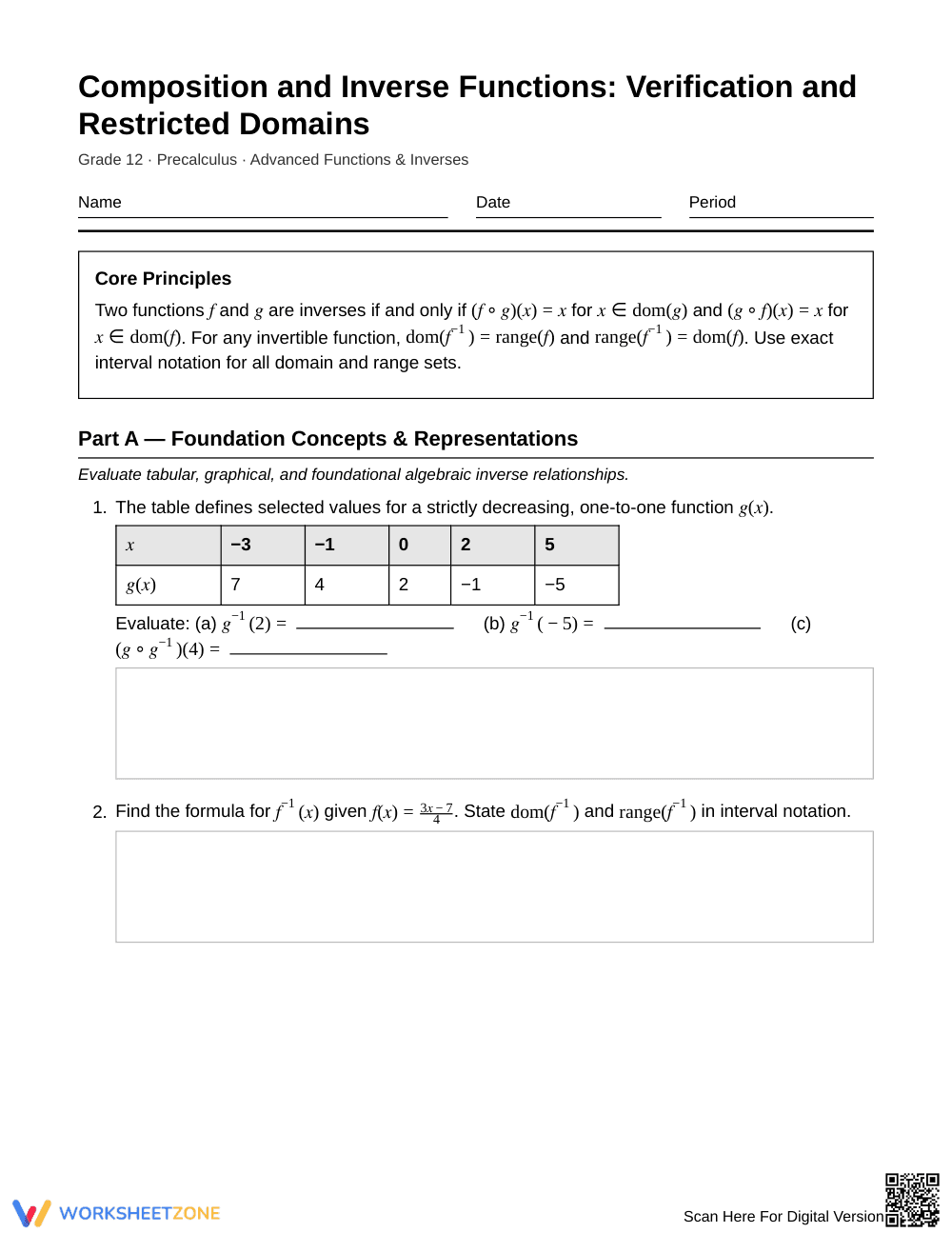
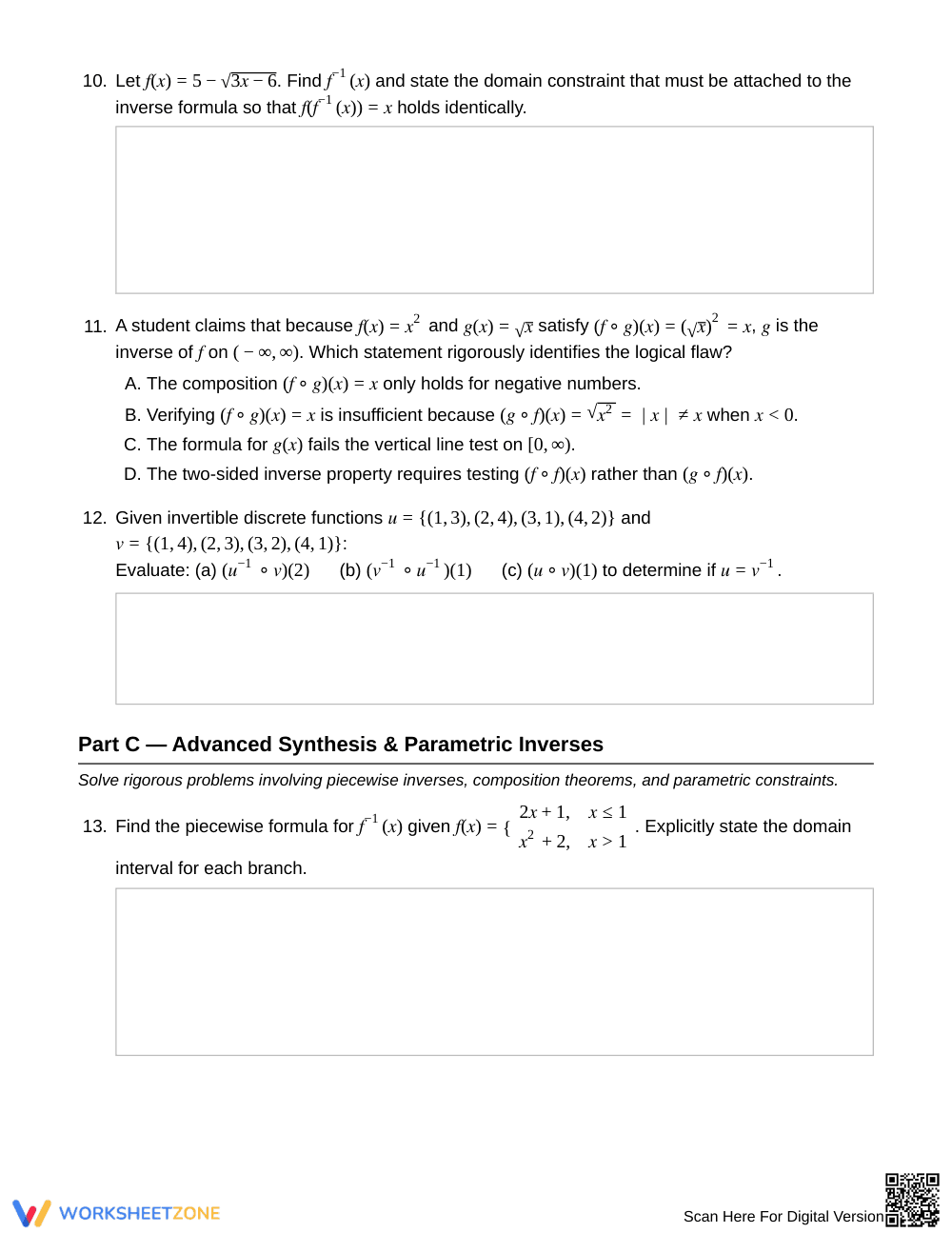
This Precalculus worksheet equips Grade 12 students to master inverse functions, domain restrictions, and algebraic verification. Learners evaluate tabular and graphical models, calculate inverse equations for rational and radical functions, and prove inverse pairs through two-sided composition, securing essential readiness for higher-level calculus.
At a Glance
- Grade: 12 · Subject: Mathematics (Precalculus)
- Standard:
HSF-BF.B.4— Find inverse functions and verify reciprocal relationships using algebraic composition- Skill Focus: Composition-and-Inverse Check with Restricted Domains
- Format: 5 printable pages · 16 multi-step problems · Complete 3-page answer key · PDF
- Best For: Precalculus mastery practice and exam review
- Time: 45–60 instructional minutes
What's Inside
This 5-page resource provides 16 analytical problems spanning tabular values, piecewise graphs, rational functions, and quadratic restrictions. It opens with a Core Principles reference box and includes a detailed 3-page answer key showing step-by-step algebraic verifications.
Skill Progression
- Guided practice (Problems 1–4): Students review inverse concepts using tables, piecewise graphs, and simple radicals with explicit domain prompts.
- Supported practice (Problems 5–12): Learners derive rational and quadratic inverses, identify restricted domains in interval notation, and verify pairs through two-sided composition.
- Independent practice (Problems 13–16): Students solve piecewise inverses, involution proofs, and parametric functions without scaffolding.
This gradual-release sequence moves students systematically from concept retrieval to rigorous formal proof.
Standards Alignment
This worksheet aligns with primary standard `HSF-BF.B.4`, which requires students to find inverse functions and verify inverse relationships through algebraic composition. It also supports `HSF-IF.B.5` by requiring students to determine restricted domains in interval notation. Both standard codes can be copied directly into lesson plans, IEP goals, or district curriculum mapping tools.
How to Use It
Use this worksheet after direct instruction on function inverses. Assign Problems 5–8 during partner practice to check whether students verify both (f ∁ g)(x) and (g ∁ f)(x). Alternatively, use Part C as a summative assessment. Expected completion time is 45 to 60 minutes.
Who It's For
This resource serves Grade 12 Precalculus students preparing for AP Calculus. Offer an interval notation guide for students needing support, while assigning Part C extensions to advanced learners. Pair this printable with a direct instruction lesson on horizontal line tests.
Under standard HSF-BF.B.4, high school students must develop both computational fluency and structural reasoning when deriving inverse functions and verifying inverse pairs through algebraic composition. Rather than relying on rote algorithmic steps such as swapping variables mechanically, students need to analyze domain and range constraints, coordinate systems, and bidirectional identity relationships across diverse mathematical representations. According to Fisher & Frey (2014), purposeful gradual-release architectures that scaffold instruction from multi-representational foundations to independent multi-step proofs significantly improve mathematical retention and conceptual transfer. This 16-problem Precalculus resource operationalizes that evidence-based framework by moving students systematically from discrete tables and graphs to complex rational and piecewise function verifications. The structured progression equips twelfth-grade learners to diagnose non-invertible behaviors, formulate valid interval restrictions, and execute rigorous algebraic checks essential for subsequent mastery in college-level calculus courses.


