




























Views
Downloads




Complete Initial Value & Rate Worksheet | Grade 9 Algebra I

Paste this activity's link or code into your existing LMS (Google Classroom, Canvas, Teams, Schoology, Moodle, etc.).
Students can open and work on the activity right away, with no student login required.
You'll still be able to track student progress and results from your teacher account.
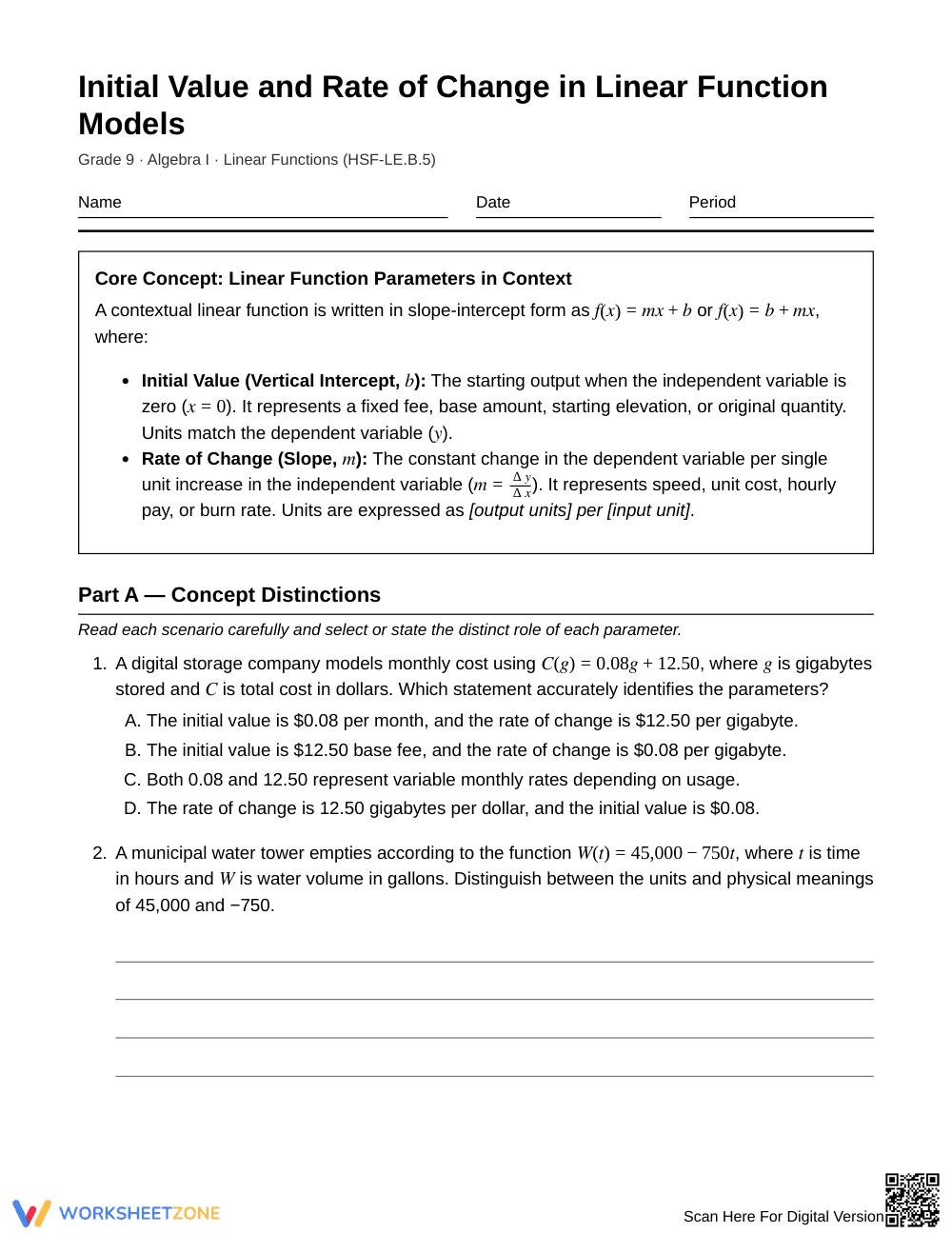
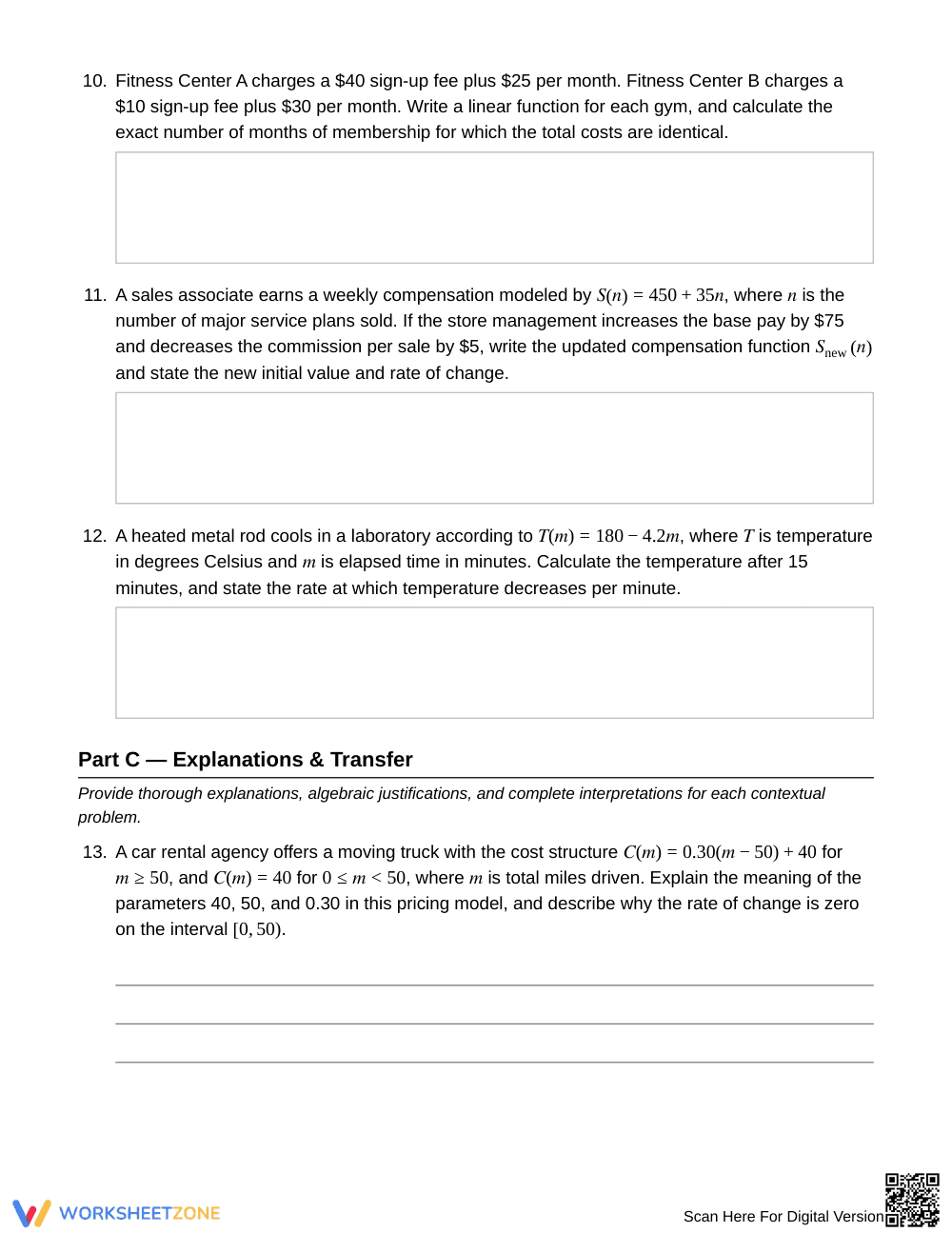
Mastering linear models requires students to connect abstract equation parameters to concrete real-world quantities. This 5-page Algebra I worksheet provides 16 targeted contextual problems designed to help Grade 9 students identify, calculate, and interpret initial values (y-intercepts) and constant rates of change (slopes) in applied linear functions.
At a Glance
- Grade: 9 · Subject: Algebra I
- Standard:
HSF-LE.B.5— Interpret the parameters in a linear or exponential function in terms of a context.- Skill Focus: Initial Value and Rate in a Function Model
- Format: 5 pages · 16 problems · Answer key included · PDF
- Best For: Linear functions practice and contextual parameter modeling
- Time: 45–60 minutes
This comprehensive practice set features 16 rigorous problems distributed across three instructional stages, complete with a detailed 3-page answer key showing step-by-step mathematical reasoning. Students analyze tables, graphs, verbal descriptions, and function notation across diverse real-world contexts, including pricing plans, physical motion, candle burning, and temperature decay. Scaffolding supports include explicit parameter definition reference notes and structured response prompts.
Skill Progression
- Guided practice (Part A — Tasks 1–4): Focuses on concept distinctions and direct parameter identification from equations, tables, and scenario comparisons with foundational prompting.
- Supported practice (Part B — Tasks 5–12): Challenges students to solve applied problems, evaluate functional inputs, calculate rates of descent, graph rate plans, and construct new linear models.
- Independent practice (Part C — Tasks 13–16): Demands conceptual transfer, error analysis, piecewise interpretation, and multi-step break-even justification without scaffolding.
This structured sequence follows the gradual release of responsibility model, guiding learners from basic identification to deep contextual synthesis.
Standards Alignment
This resource aligns directly with standard HSF-LE.B.5: "Interpret the parameters in a linear or exponential function in terms of a context." Students examine slope as a constant rate of change and the y-intercept as a starting value across varied contextual representations. Both standard codes can be copied directly into lesson plans, IEP goals, or district curriculum mapping tools.
How to Use It
Deploy this worksheet after direct instruction on linear functions as paired collaborative practice or post-lecture independent application. Formatively assess student understanding by checking Task 15 during circulation to verify whether students correctly identify parameter roles based on variable placement rather than term sequence. Expect students to complete the full 16-problem set within 45 to 60 minutes.
Who It's For
This resource is tailored for Grade 9 Algebra I students learning linear modeling. Differentiated tiers of questioning allow teachers to assign Parts A and B for targeted intervention or Part C for honors extensions. It pairs naturally with an introductory anchor chart on slope-intercept form and linear rate-of-change contextual vocabulary.
Interpreting functional parameters within authentic contexts bridges abstract algebraic manipulation and practical quantitative literacy. According to research on structured mathematical progression by Fisher & Frey (2014), gradual release frameworks that move systematically from parameter identification to contextual justification significantly improve conceptual retention in secondary algebra. Standard HSF-LE.B.5 requires Grade 9 students to interpret the parameters in a linear or exponential function in terms of a context, specifically distinguishing between fixed base values and continuous rates of change. By analyzing 16 varied problems spanning data tables, graphical comparisons, and contextual word problems, learners develop the analytical precision necessary to explain what numerical constants represent in physical, financial, and scientific models. This 5-page worksheet provides the scaffolded practice and multi-step transfer tasks essential for students to master linear modeling parameters, justify break-even points, and critique common algebraic misconceptions with complete mathematical reasoning.


