




























Views
Downloads



Complete Groundhog Habitats Word Search | Grades 7–8 Science

Paste this activity's link or code into your existing LMS (Google Classroom, Canvas, Teams, Schoology, Moodle, etc.).
Students can open and work on the activity right away, with no student login required.
You'll still be able to track student progress and results from your teacher account.
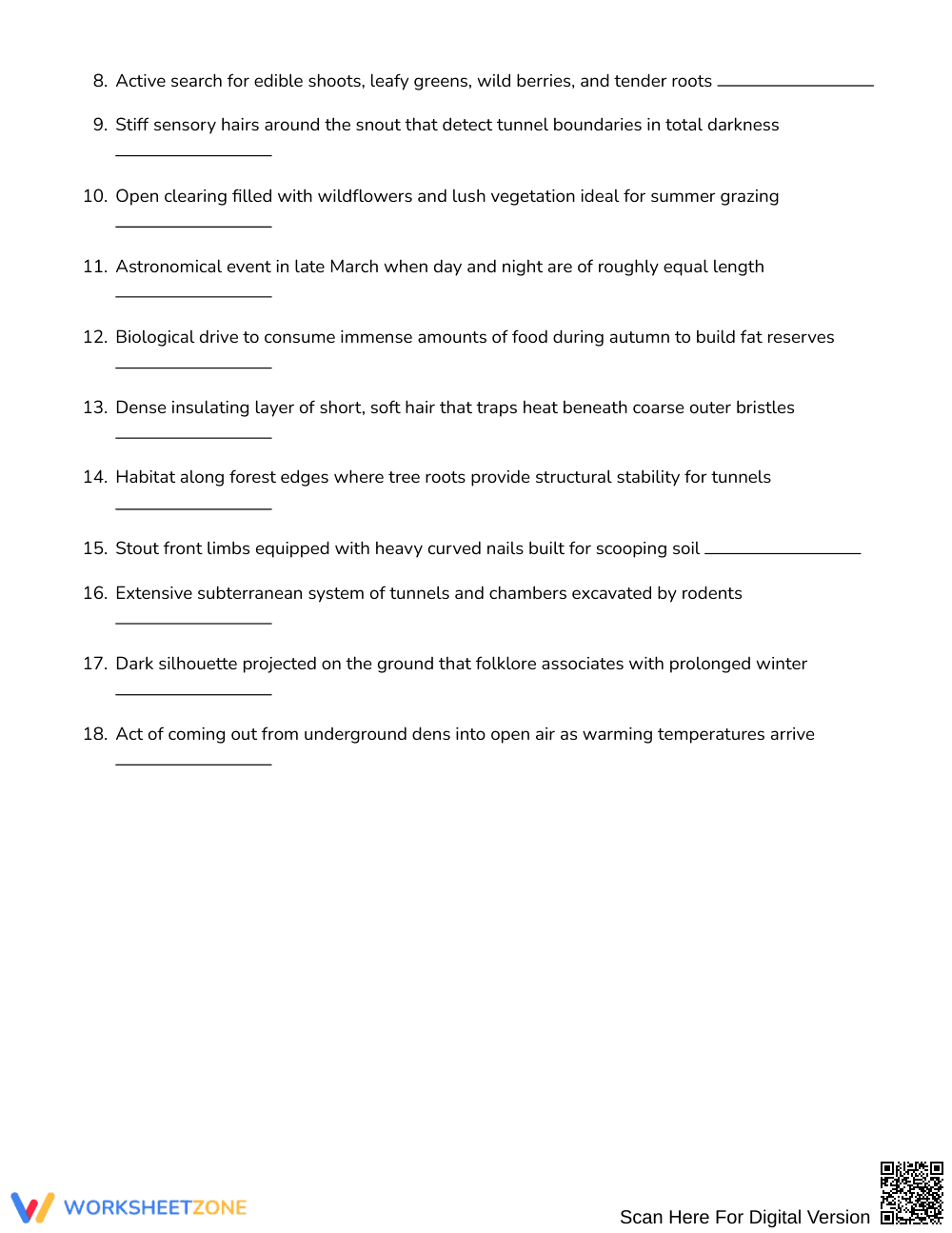
This Grades 7–8 science word search reinforces student mastery of animal habitats, anatomical traits, and seasonal dormancy behaviors. Students read scientific clues to identify 18 vocabulary terms—including hibernaculum, hyperphagia, and torpor—before locating each term within the grid. The activity builds biological literacy and contextual understanding.
At a Glance
- Grade: Grades 7–8 · Subject: Science
- Standard: Not standards-assessed — vocabulary enrichment
- Skill Focus: Groundhog seasonal adaptations, burrow habitats, and winter survival physiology
- Format: 3 pages · 18 words · Complete answer key included · Printable PDF
- Best For: Mid-unit vocabulary review, independent seatwork, and emergency substitute plans
- Time: 20–30 minutes total activity time
What's Inside
This 3-page printable science resource contains an 18-word puzzle alongside comprehensive clues and a four-page answer key. Rather than relying on a passive word list, students interpret biological clues defining physical adaptations like incisors and vibrissae, habitats like meadows, and physiological states like torpor. A complete four-page teacher answer key highlights every word location across the puzzle grid, enabling rapid grading and self-checking.
Puzzle Mechanics and Structure
The puzzle features a 20 x 20 grid designed to challenge middle school students. Vocabulary terms run in all eight directions: North, Northeast, East, Southeast, South, Southwest, West, and Northwest, incorporating forward, backward, and diagonal orientations. Students work from a shuffled word bank paired with definition clues. Learners analyze descriptive clues about physiology and astronomical cycles to deduce the correct term before finding it within the letter grid.
Standards Alignment
This learning resource serves as targeted vocabulary enrichment and is not aligned to a specific state or national standard. It supports broader middle school life science units on ecology, animal adaptations, and seasonal cycles by cementing domain-specific terminology through contextual reading practice.
How to Use It
Deploy this word search during an ecology unit after direct instruction on seasonal dormancy, or use it as a thematic Groundhog Day science lesson. For formative assessment, observe whether students identify terms like hyperphagia and torpor directly from clues before consulting the shuffled word bank. The entire activity requires approximately 20 to 30 minutes of focused independent or partner work.
Who It's For
This activity is designed for Grades 7–8 science students reviewing habitat structures and behavioral adaptations. It offers natural differentiation: striving readers benefit from analyzing contextual clues with a partner, while advanced learners can explain how terms like solstice and frost line dictate groundhog behaviors. Pair this puzzle with an informational reading passage on marmot biology or an anchor chart detailing subterranean burrows.
According to Fisher & Frey (2014), intentional exposure to disciplinary vocabulary through meaningful context and retrieval practice significantly strengthens long-term concept retention across middle school science domains. This Grades 7–8 word search targets groundhogs habitats and seasons, reinforcing 18 academic terms that span mammalian anatomy, subterranean ecology, and seasonal cycles. By requiring students to process definition clues rather than merely hunting for isolated letter strings, the activity prompts active semantic retrieval prior to spatial pattern recognition. Students synthesize concepts such as torpor, hyperphagia, and frost line depth, anchoring biological mechanisms into their working memory. As highlighted by Fisher & Frey (2014), integrating word-level challenges into life science coursework solidifies domain-specific literacy and bridges basic recall with complex conceptual understanding, providing middle school learners with the foundational terminology necessary for rigorous scientific discourse.


