


























Views
Downloads


Complete Graph Key Features Worksheet | Grade 9 Algebra I
Paste this activity's link or code into your existing LMS (Google Classroom, Canvas, Teams, Schoology, Moodle, etc.).
Students can open and work on the activity right away, with no student login required.
You'll still be able to track student progress and results from your teacher account.
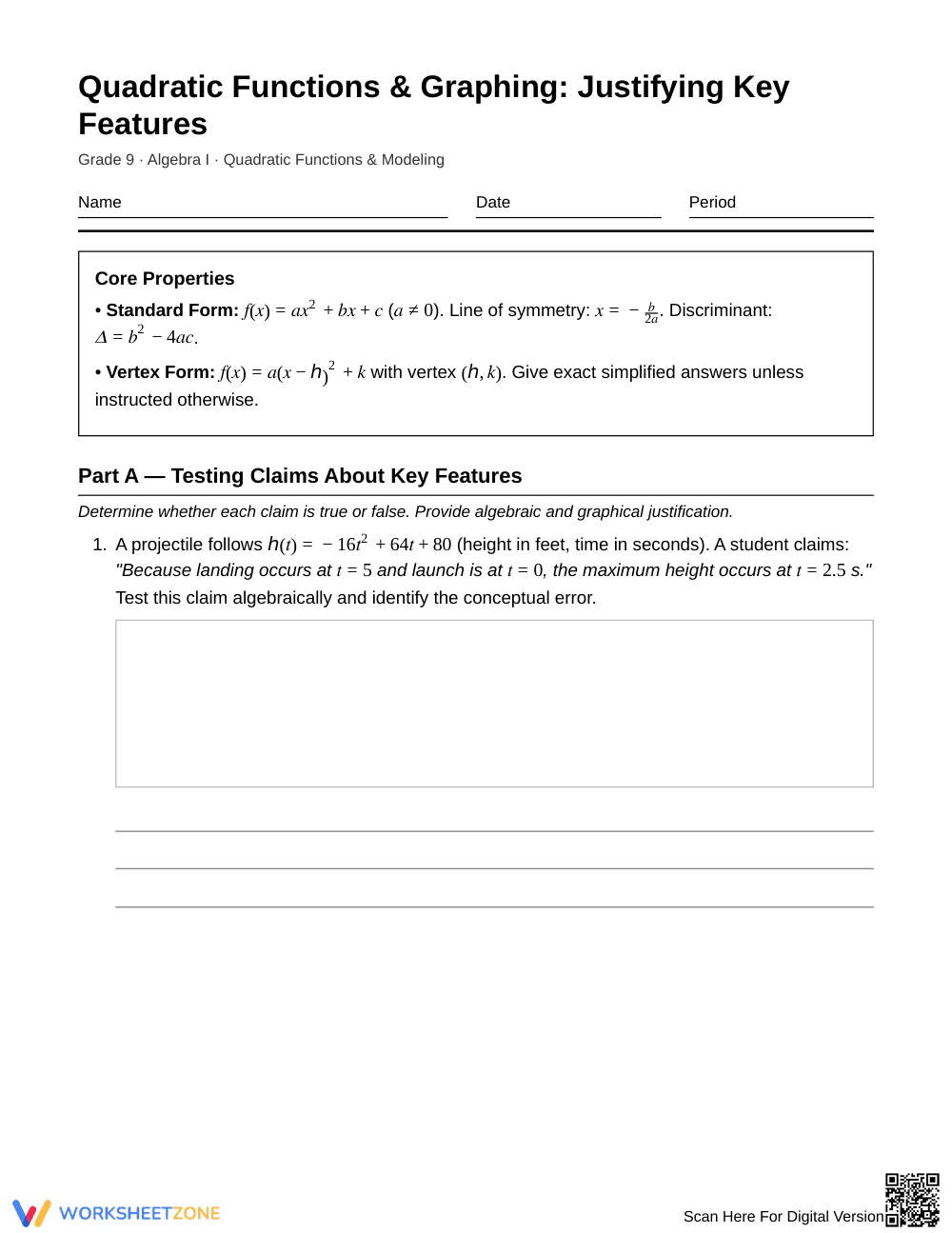
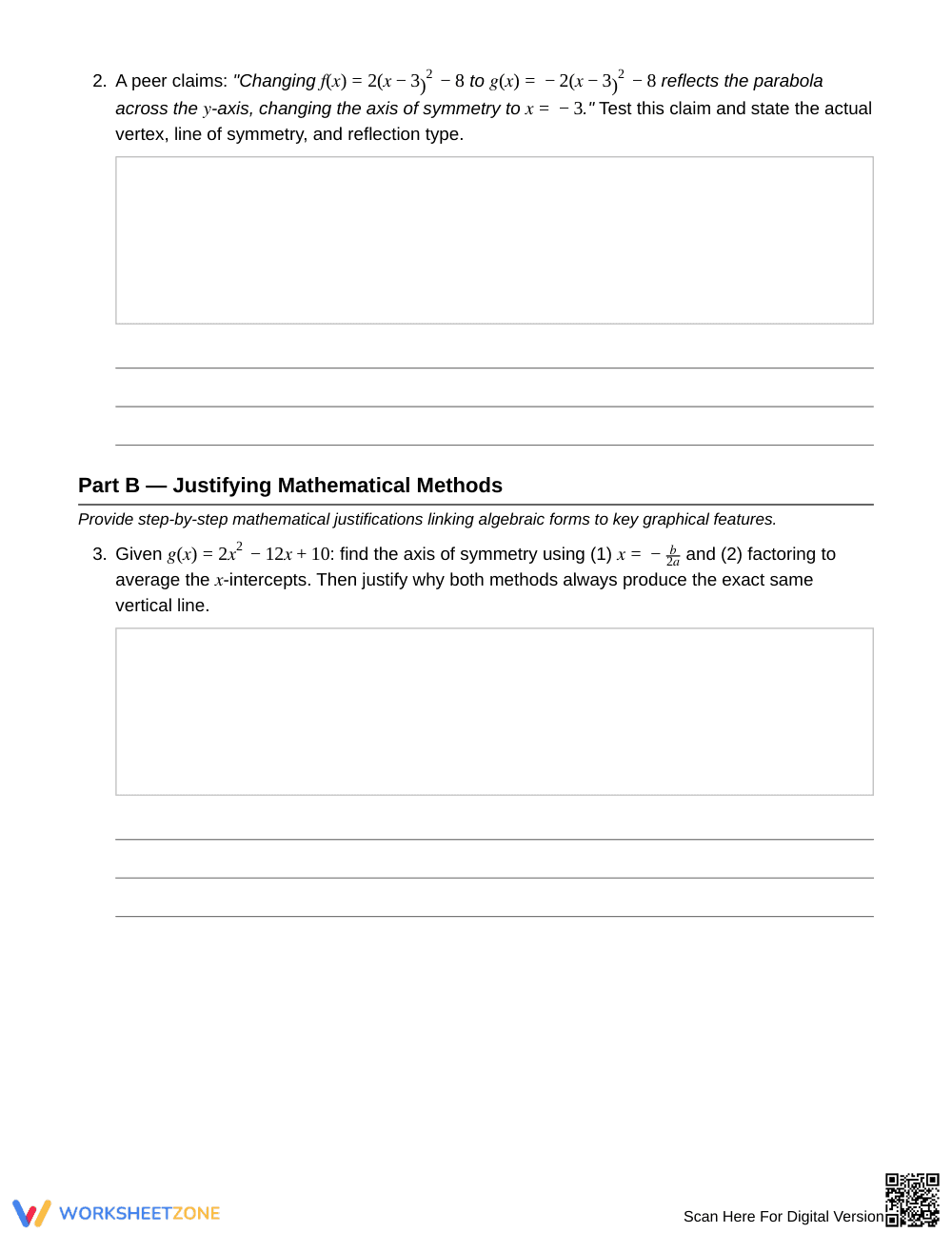
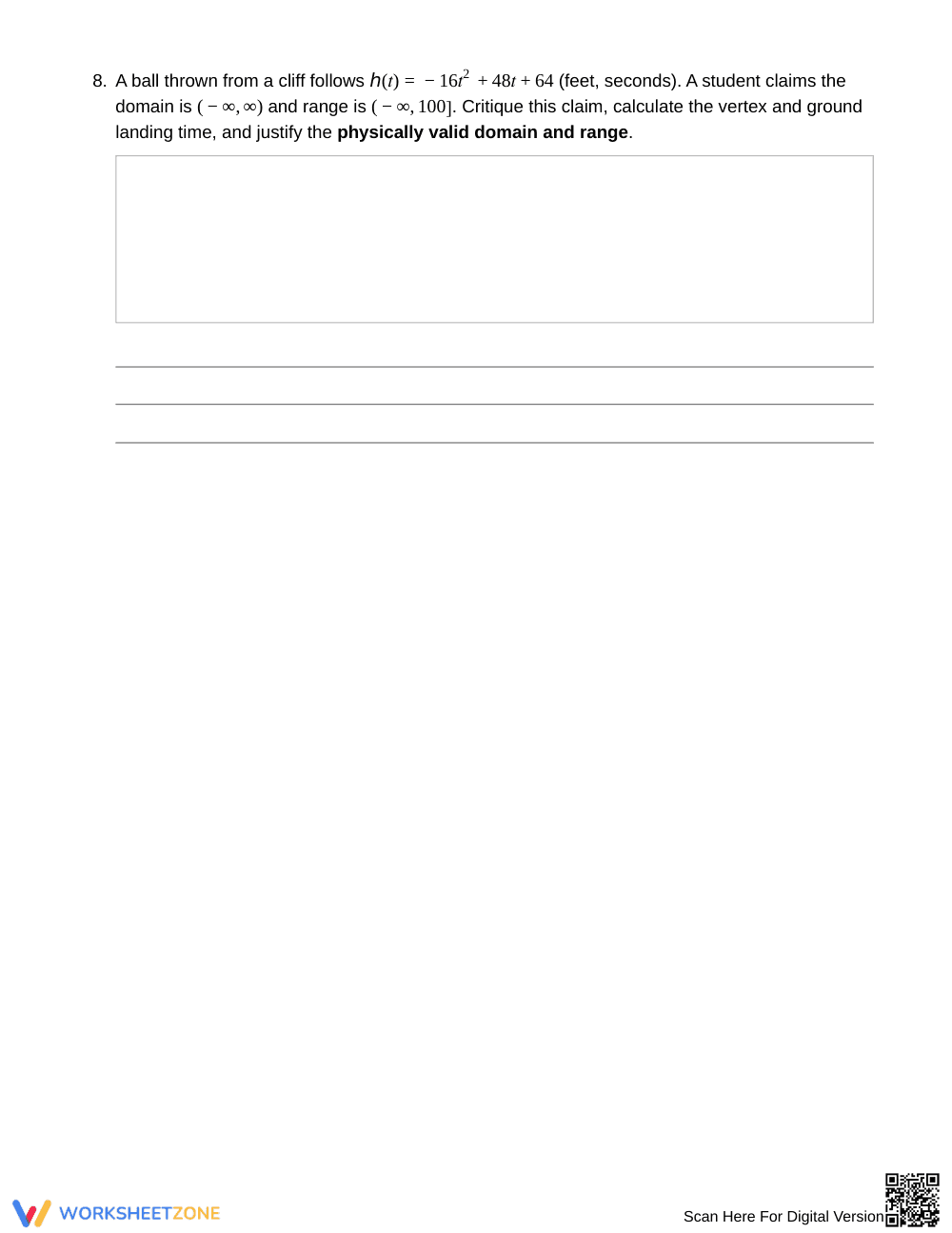
This rigorous Grade 9 Algebra I worksheet equips students to mathematically justify key features of quadratic graphs through algebraic proof and critical analysis. High school learners analyze claims, calculate vertices and intercepts, construct counterexamples, and establish physically valid domains across 8 rich tasks to build conceptual mastery in quadratic modeling.
At a Glance
- Grade: 9 · Subject: Algebra I
- Standard: Quadratic Functions — Interpret and justify key features of quadratic graphs and real-world models
- Skill Focus: Justify a Graph’s Key Features
- Format: 5 pages · 8 problems · Answer key included · PDF
- Best For: In-depth quadratic reasoning and error analysis
- Time: 45–60 minutes
What's Inside
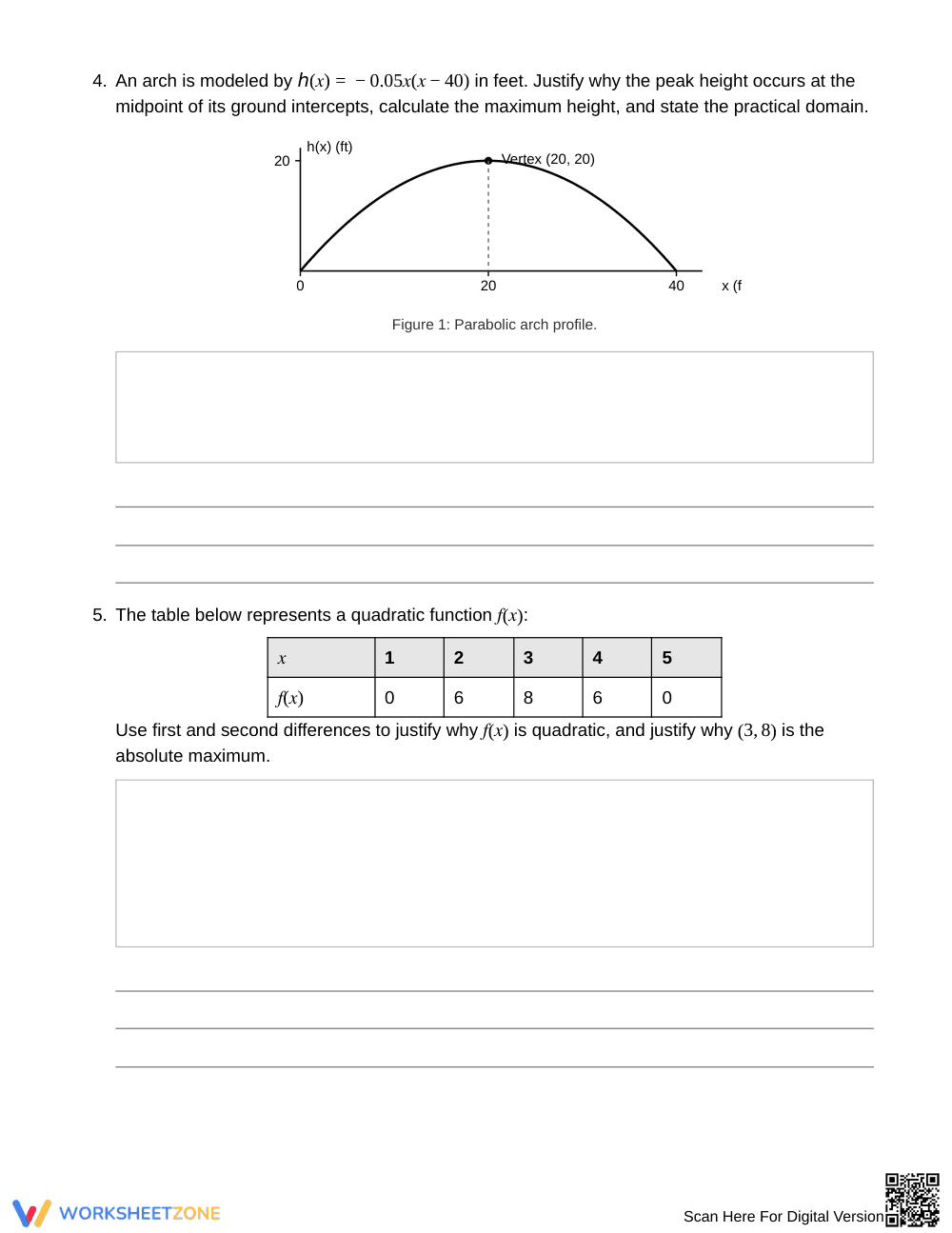
This comprehensive 5-page printable includes a core properties reference header, 8 multi-step justification problems divided into three structured parts, an arch modeling diagram, data table analysis, and a detailed 2-page step-by-step answer key showing complete algebraic reasoning.
Skill Progression
- Guided Practice (Part A, Problems 1–2): Students analyze student claims regarding projectile motion and transformations, critiquing misconceptions about symmetry, vertex location, and reflections with scaffolding from the core formula box.
- Supported Practice (Part B, Problems 3–6): Students supply formal mathematical proofs linking algebraic representations to graphical properties, comparing axis of symmetry methods, calculating arch dimensions, verifying quadratic patterns via finite differences, and completing the square.
- Independent Practice (Part C, Problems 7–8): Students generate algebraic counterexamples regarding discriminant values and define contextually constrained domain and range intervals for real-world cliff-drop models.
This sequence follows the gradual-release model (I Do, We Do, You Do) to move learners from peer error analysis to autonomous mathematical argumentation.
Standards Alignment
This resource aligns with high school Algebra I standards focusing on interpreting functions and analyzing quadratic models. Students interpret key features of graphs and tables in terms of contextual quantities, sketch graphs showing period symmetry and extrema, and relate domains to quantitative relationships. Both standard codes can be copied directly into lesson plans, IEP goals, or district curriculum mapping tools.
How to Use It
Deploy this resource during the synthesis phase of a quadratic graphing unit after students have learned standard and vertex forms. Alternatively, use it as a collaborative partner review activity before a unit exam. For formative assessment, monitor Problem 3 to observe whether students recognize why averaging factored intercepts yields the same value as the axis of symmetry formula (−b/2a). Typical completion time ranges from 45 to 60 minutes.
Who It's For
This worksheet is designed for Grade 9 Algebra I students needing rigorous practice in mathematical communication. It provides embedded formulas to support emerging learners while challenging advanced thinkers with domain restrictions and counterexamples. Pair it directly with an introductory lesson on parabolic symmetry or a graphing calculator investigation.
Rigorous mathematical justification is essential for high school algebra proficiency. According to EdReports 2024 instructional materials criteria, high-quality secondary mathematics instruction requires students to routinely construct viable arguments, critique peer reasoning, and connect multiple algebraic representations to graphical behaviors. This 5-page instructional resource fulfills these criteria through 8 structured tasks targeting quadratic properties. Students evaluate algebraic claims, prove vertex boundaries using completing the square, analyze tabular second differences, and apply the discriminant to test global assertions. By requiring precise algebraic reasoning alongside graphical interpretation, the worksheet deepens conceptual understanding and strengthens problem-solving fluency in Algebra I. Educators can readily integrate this worksheet into daily instruction, targeted intervention blocks, or standards-based mastery assessments to verify student competence in analyzing quadratic models.


