


























Views
Downloads
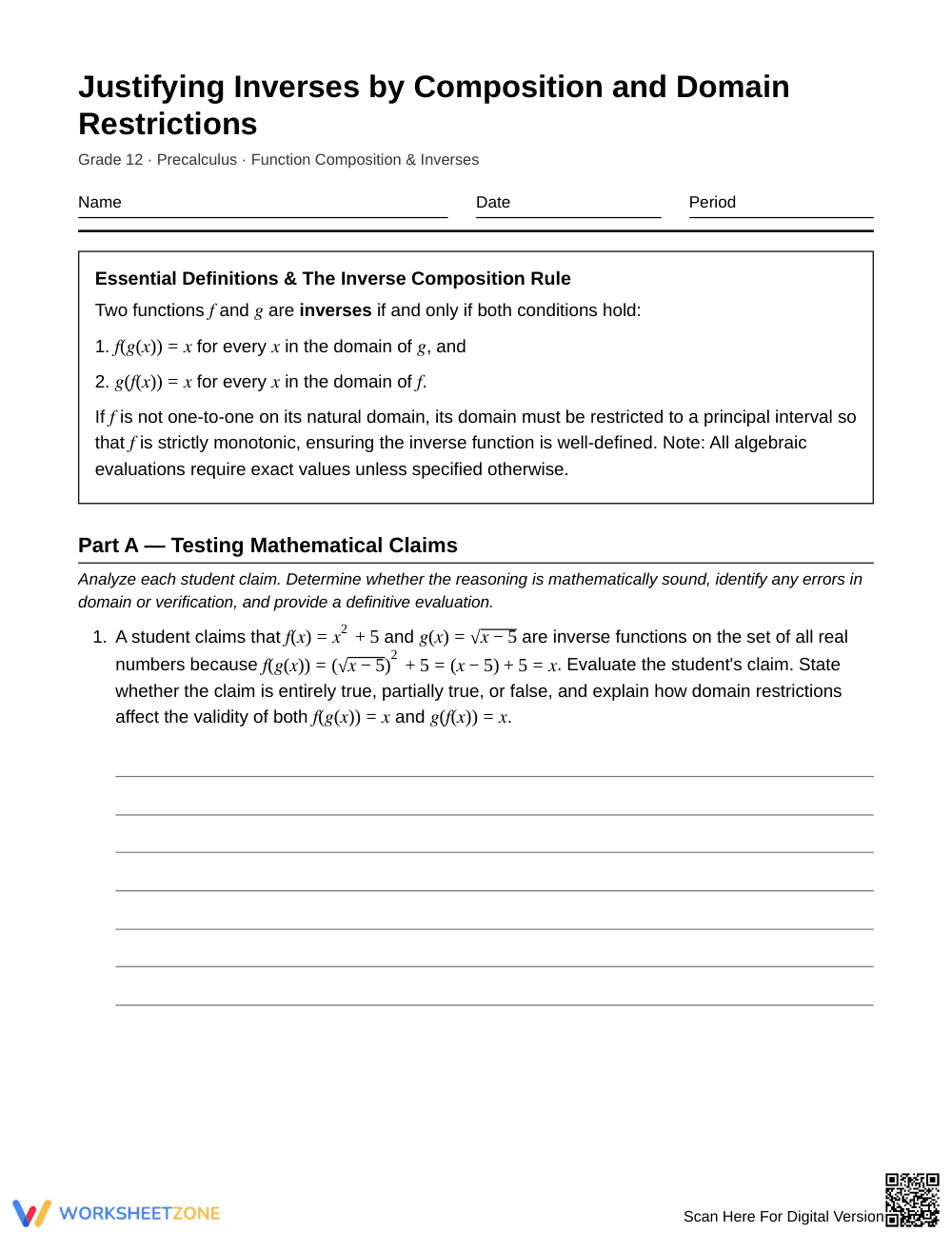
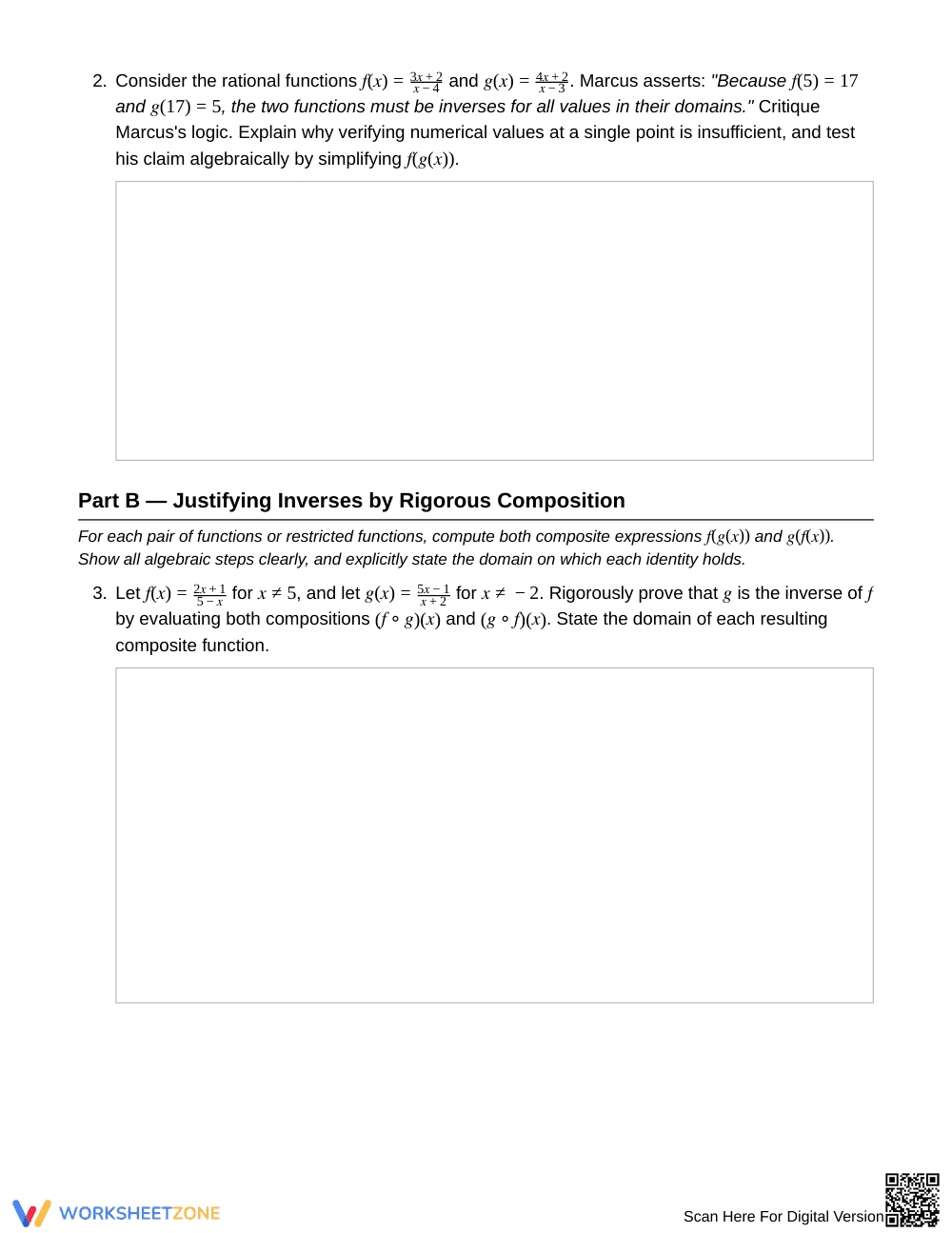
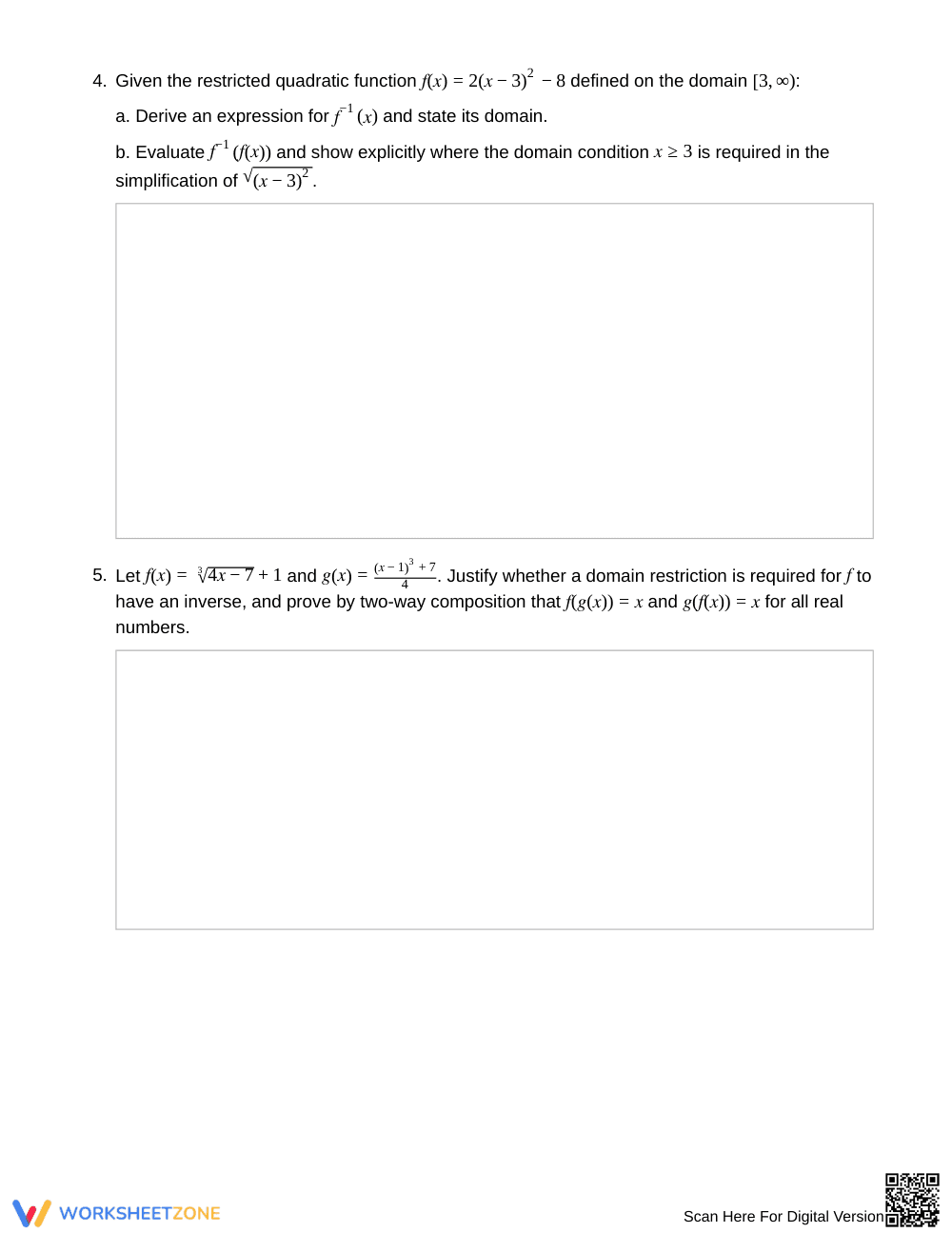
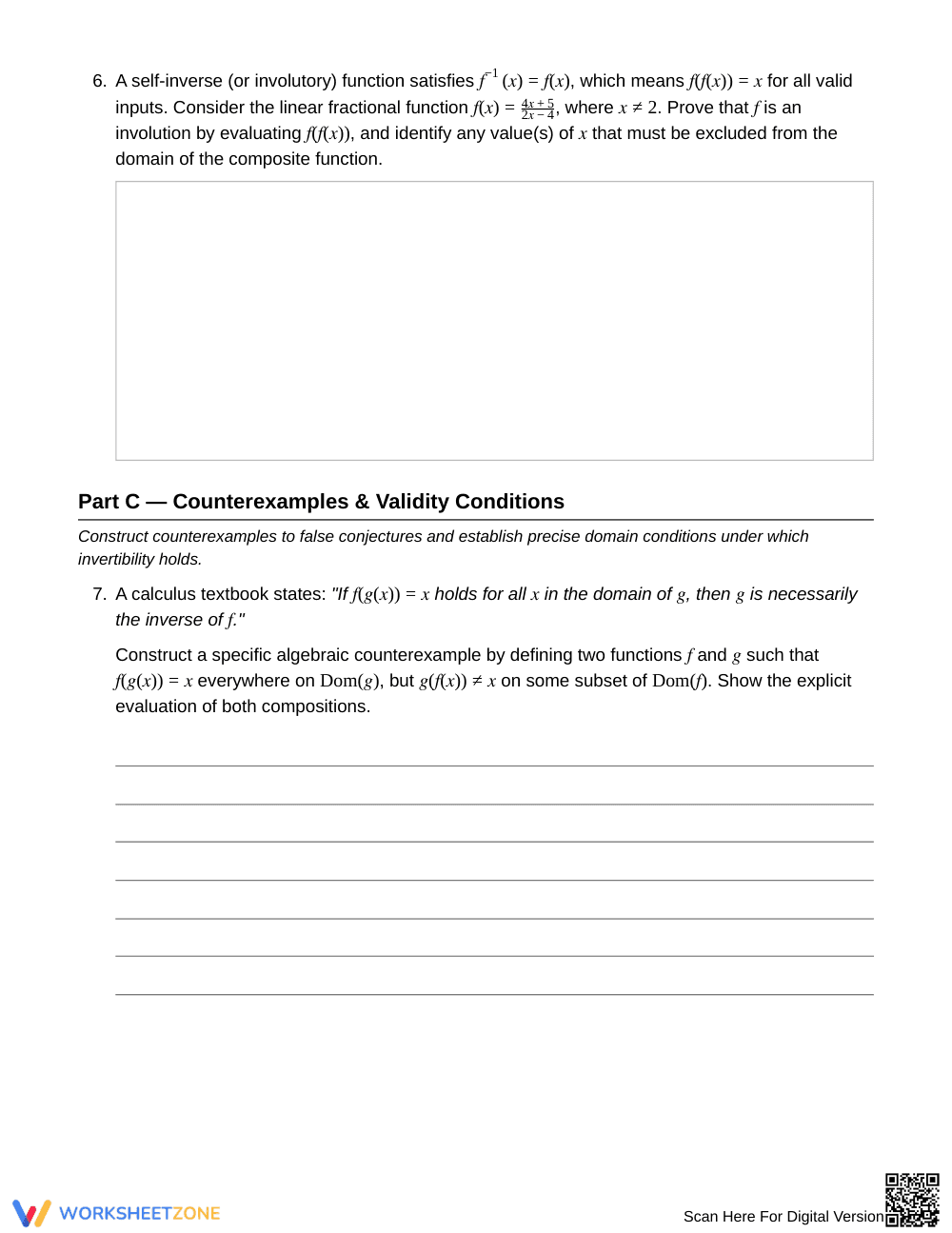

Complete Function Inverses Worksheet | Grade 12 Precalculus
Paste this activity's link or code into your existing LMS (Google Classroom, Canvas, Teams, Schoology, Moodle, etc.).
Students can open and work on the activity right away, with no student login required.
You'll still be able to track student progress and results from your teacher account.
This rigorous Grade 12 Precalculus worksheet equips students to master verifying function inverses through two-way algebraic composition and domain analysis. High school mathematicians critique flawed reasoning, evaluate rational and radical functions, establish restricted domains, and construct algebraic counterexamples to prove invertibility rigorously, building the analytical precision required for college-level calculus coursework.
At a Glance
- Grade: 12 · Subject: Precalculus
- Standard:
HSF-BF.B.4— Verify by composition that one function is the inverse of another- Skill Focus: Justify Inverses by Composition
- Format: 5 pages · 8 problems · Answer key included · PDF
- Best For: Advanced function analysis and exam prep
- Time: 45–60 minutes
What's Inside: This 5-page printable resource includes 8 multi-part analytical problems structured across three progressive sections, supported by a formal rule box covering the Inverse Composition Rule and principal domain restrictions. Students engage with rational, radical, quadratic, and absolute value functions while calculating exact algebraic compositions. A complete 3-page step-by-step answer key provides detailed proof steps and explicit domain identifications.
Skill Progression
- Guided practice (Part A, Problems 1–2): Students analyze student claims and critique common mathematical errors involving unverified domains and single-point evaluations with structured prompts.
- Supported practice (Part B, Problems 3–6): Learners construct rigorous two-way composition proofs across rational expressions, restricted quadratic domains, cubic relationships, and self-inverse involutions.
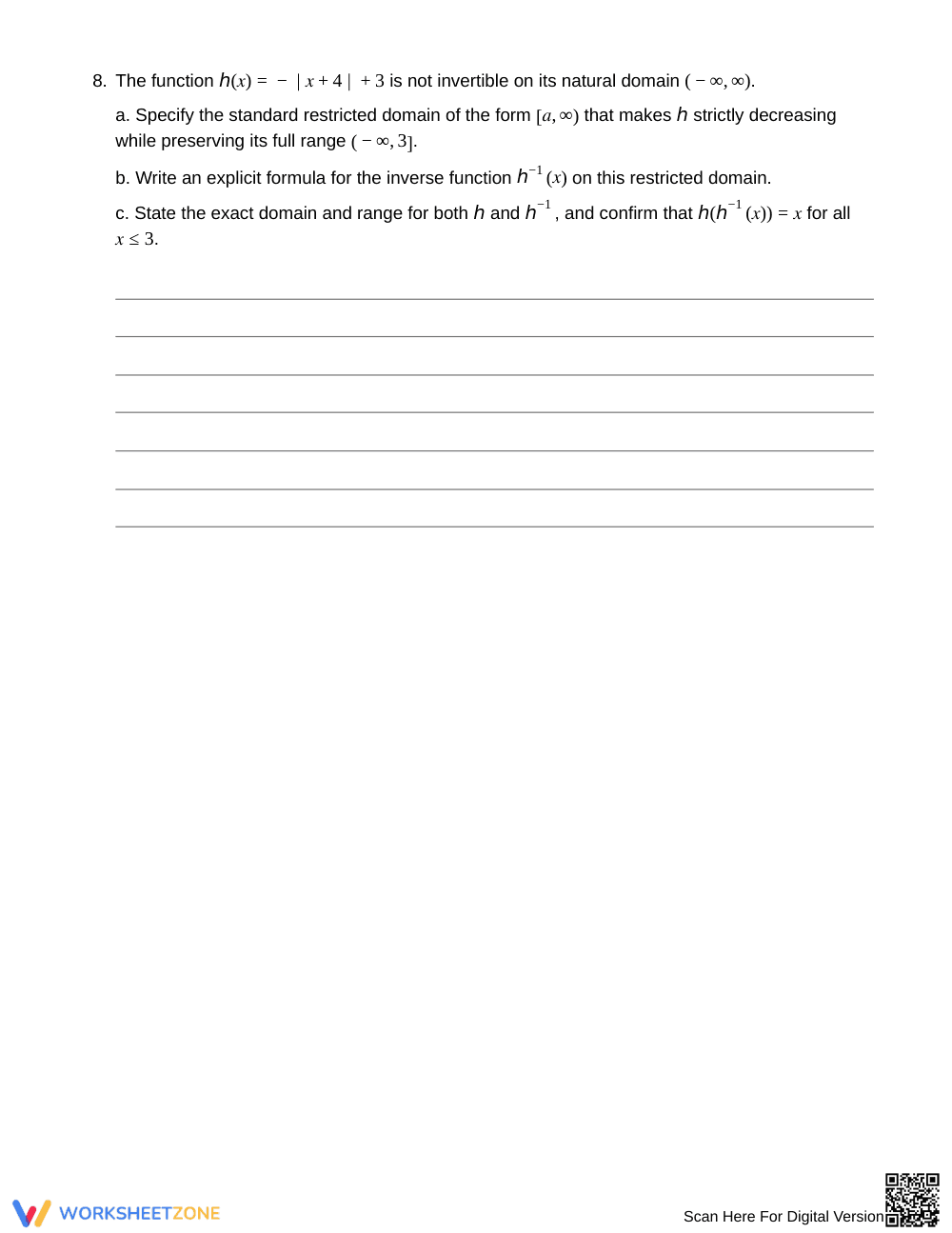
- Independent practice (Part C, Problems 7–8): Students demonstrate advanced mastery by constructing algebraic counterexamples to false invertibility conjectures and deriving restricted-domain formulas for absolute value functions.
This sequence implements a gradual-release model that moves students from conceptual error analysis to autonomous algebraic proof and counterexample generation.
Standards Alignment
Primary Standard: HSF-BF.B.4 — Find inverse functions. Verify by composition that one function is the inverse of another and read values of an inverse function from a graph or a table, given that the function has an inverse. Supporting Standard: HSF-IF.B.5 involves relating the domain of a function to its quantitative relationship. Both standard codes can be copied directly into lesson plans, IEP goals, or district curriculum mapping tools.
How to Use It
Deploy this worksheet after direct instruction on function composition and inverse definitions. It serves effectively as a structured collaborative proof activity during class or as an intensive take-home assignment before a unit exam. Formative assessment tip: Check whether students remember to evaluate both directions, f(g(x)) = x and g(f(x)) = x, rather than stopping after the first composition. Expected completion time is 45 to 60 minutes.
Who It's For
This activity is designed for Grade 12 Precalculus, Advanced Math, or Honors Algebra II students preparing for AP Calculus. For differentiation, provide struggling learners with coordinate graphs to visualize domain restrictions before composing functions algebraically, while advanced students can explore the algebraic properties of involutory functions. Pair this resource with a direct instruction lesson on bijective functions and horizontal line tests.
Rigorous algebraic verification of inverse functions through composition underpins advanced student readiness for differential and integral calculus. According to empirical research synthesized by Fisher & Frey (2014) on productive mathematical struggle, engaging high school learners in identifying mathematical fallacies and generating non-trivial counterexamples significantly strengthens conceptual schema and retention. Standard HSF-BF.B.4 requires students not only to derive inverse formulas mechanically but also to confirm bijectivity through bidirectional composition proofs where f(g(x))=x and g(f(x))=x over strictly specified domains. Emphasizing domain boundaries and composition conditions prevents the persistent algebraic misconception that one-way identity satisfaction guarantees global invertibility. By evaluating restricted domains across rational, quadratic, radical, and absolute value models, students develop the formal proof structures and deductive precision emphasized in collegiate mathematics standards, fostering durable mathematical literacy and analytical independence across secondary STEM curricula.


