


























Views
Downloads


Complete Function Inverses Worksheet | Grade 12 Precalculus
Paste this activity's link or code into your existing LMS (Google Classroom, Canvas, Teams, Schoology, Moodle, etc.).
Students can open and work on the activity right away, with no student login required.
You'll still be able to track student progress and results from your teacher account.
Master inverse functions across representations with this Grade 12 Precalculus worksheet. Students evaluate invertibility, derive algebraic inverses, and verify graphical reflections across the line y = x. Designed for advanced learners, this resource helps students resolve domain restrictions and verify function compositions with precision.
At a Glance
- Grade: 12 · Subject: Precalculus
- Standard:
HSF-BF.B.4— Find inverse functions algebraically and verify relationships across graphical and tabular models.- Skill Focus: Comparing Algebraic and Graphical Inverse Evidence
- Format: 5 pages · 12 problems · Answer key included · PDF
- Best For: Function analysis practice
- Time: 45–60 minutes
This 5-page worksheet delivers 12 analytical tasks across three structured parts. It features an anchor reference box outlining one-to-one invertibility and domain-range swapping. Students examine graphical curves, tabular values, rational asymptotes, and exponential models, supported by a 3-page step-by-step answer key.
Skill Progression
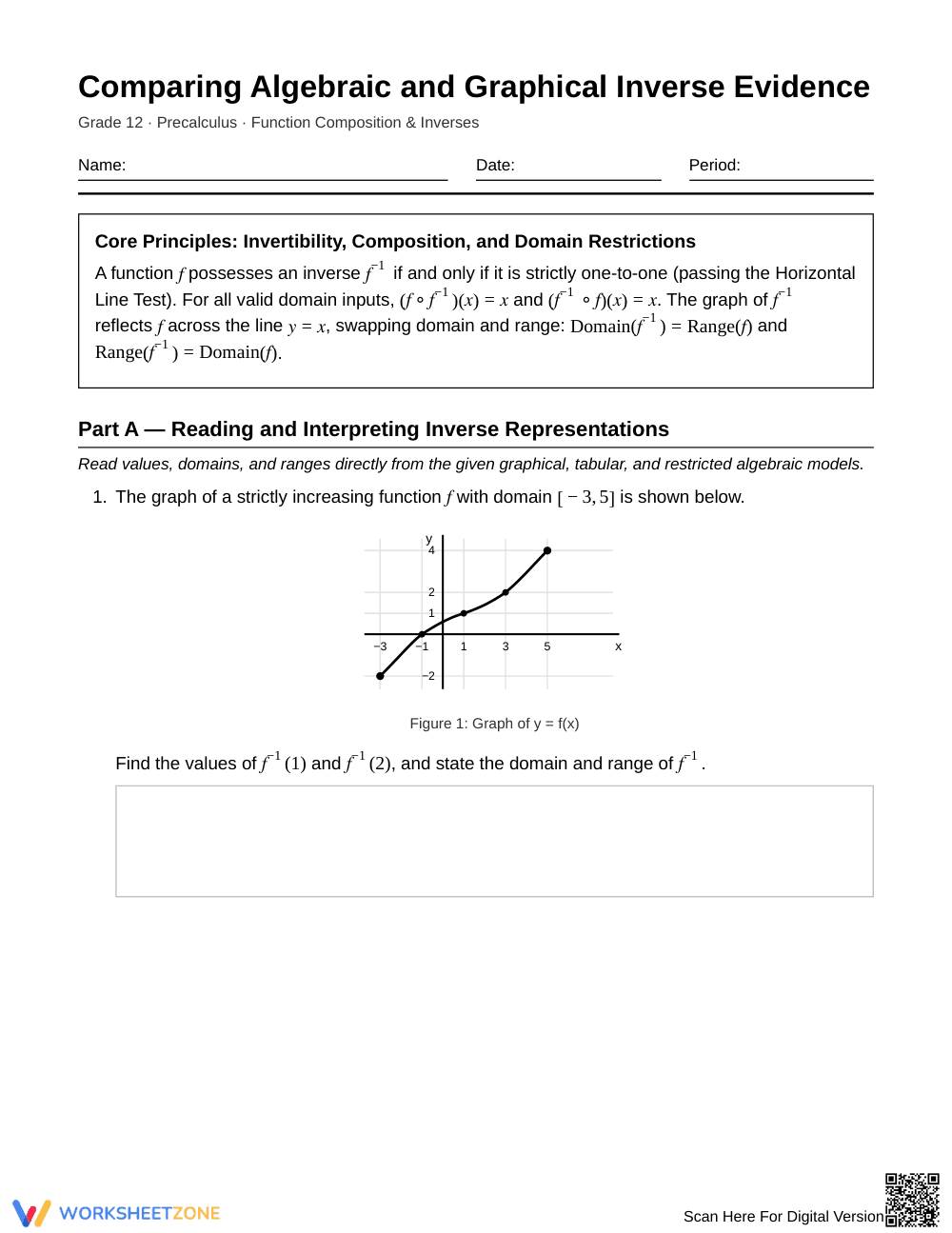
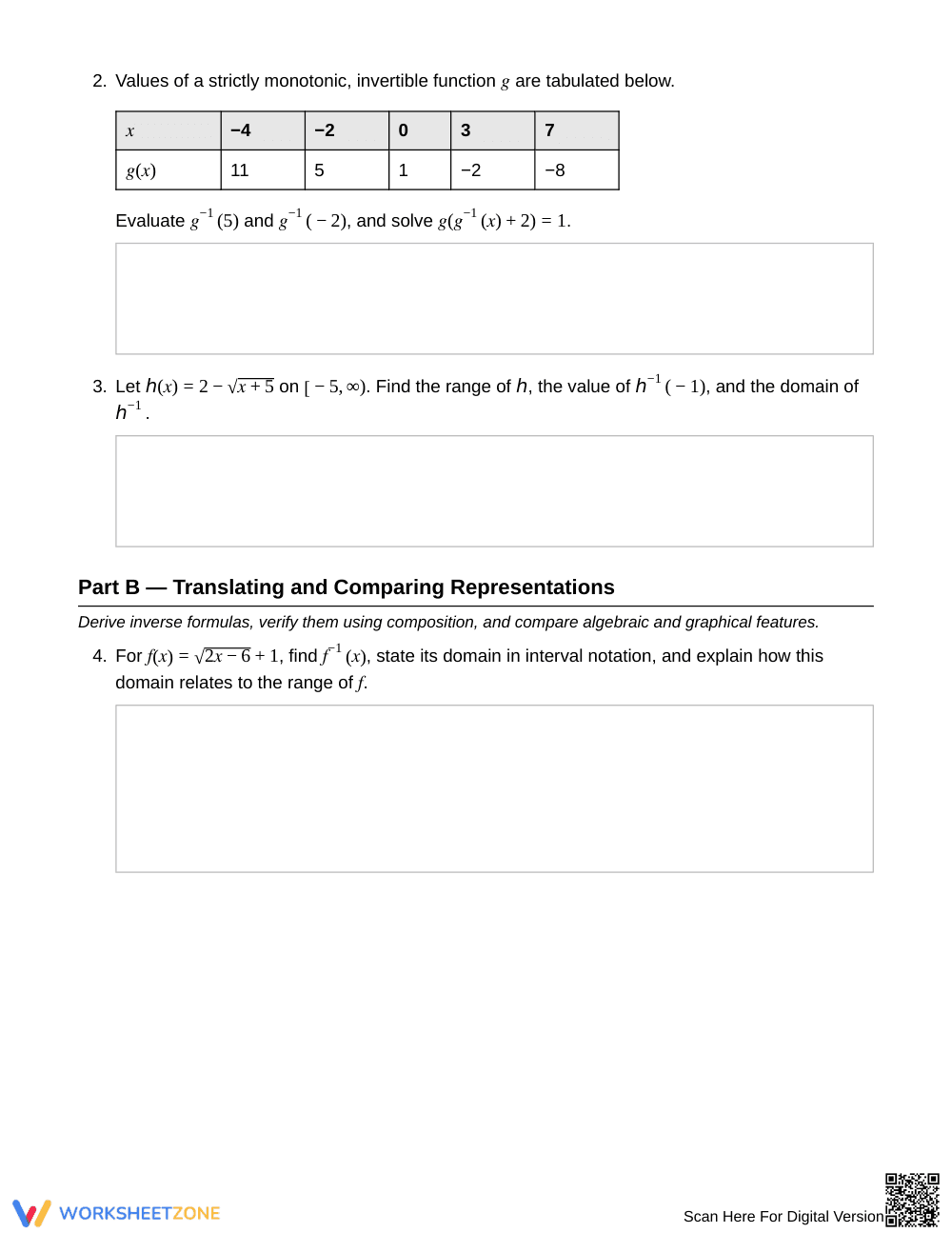
- Guided Practice (Part A, Problems 1–3): Students read values, extract domains, and evaluate inverse outputs from graphical, tabular, and radical models.
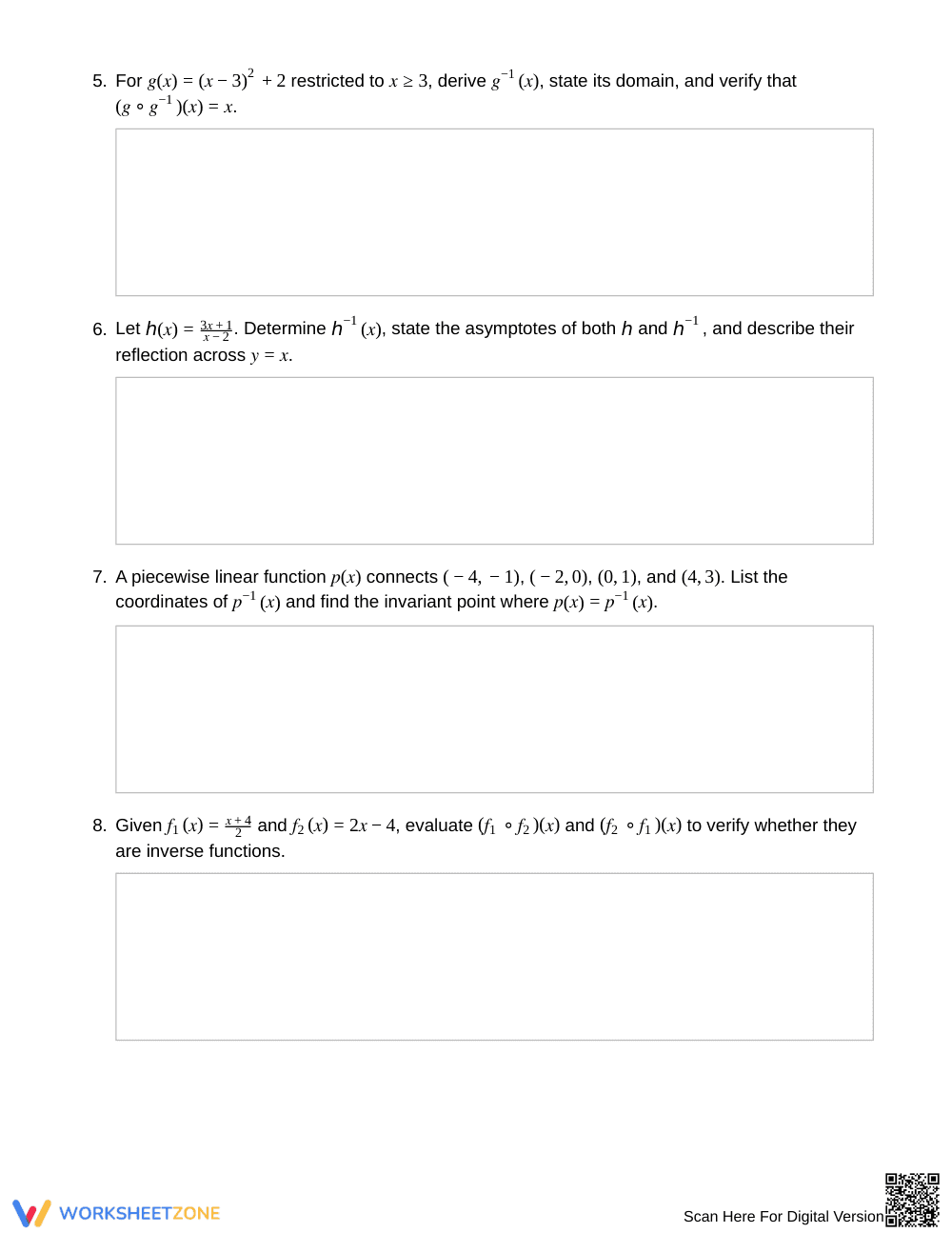
- Supported Practice (Part B, Problems 4–9): Students derive inverse formulas, calculate asymptotes, find invariant coordinates, and verify compositions algebraically.
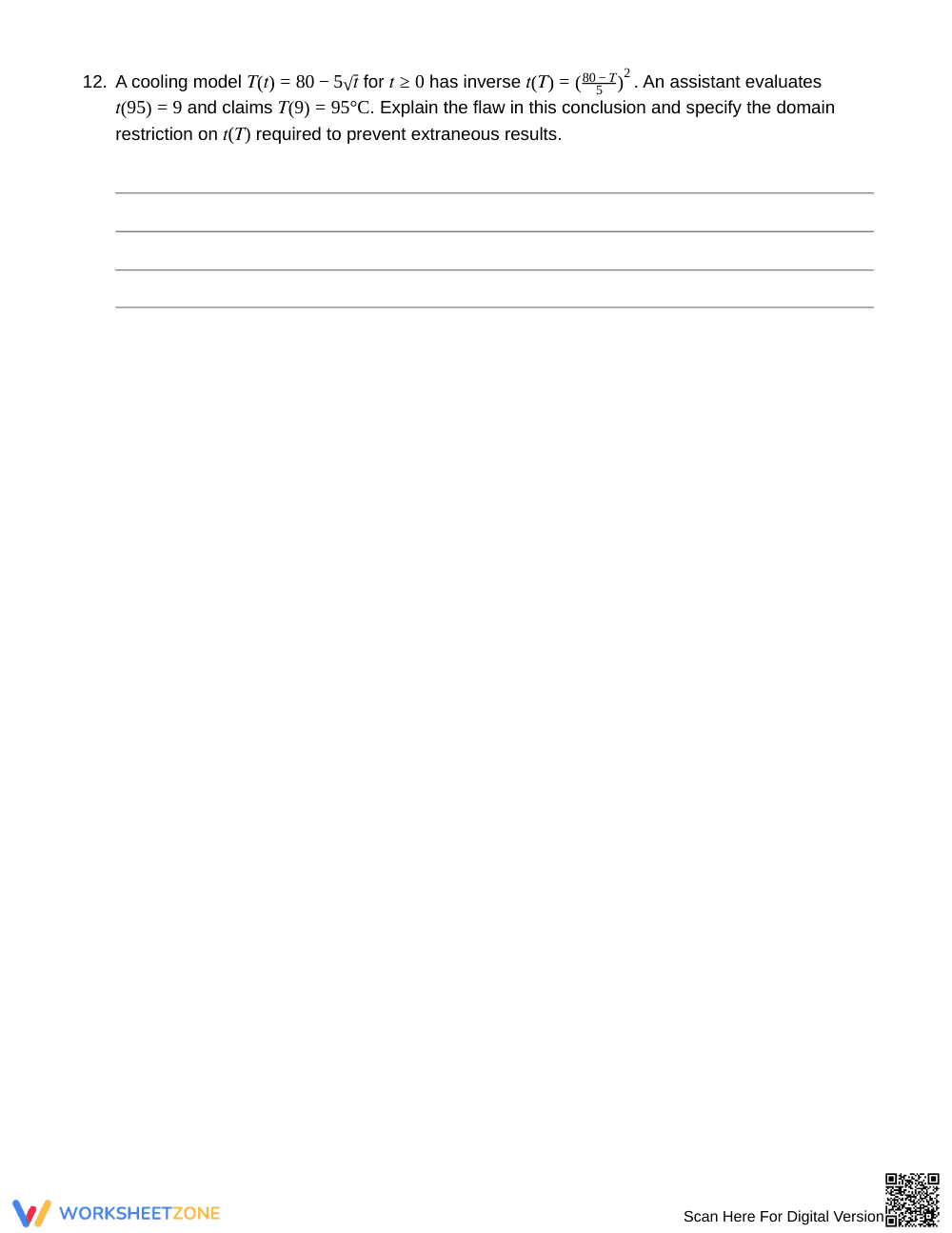
- Independent Practice (Part C, Problems 10–12): Students critique mathematical reasoning errors and justify domain restrictions in applied cooling equations.
This sequence follows a gradual-release model transitioning students from reading representations to autonomous critique.
Standards Alignment
This activity targets HSF-BF.B.4: Find inverse functions and write an expression for the inverse of an invertible function. It also supports HSF-IF.C.7 through analyzing rational and exponential graphs. Both standard codes can be copied directly into lesson plans, IEP goals, or district curriculum mapping tools.
How to Use It
Use this worksheet after direct instruction on one-to-one functions and composition checks. Alternatively, assign Part C for partner error-analysis activities. During work time, check Problem 4 to ensure students restrict radical domains before algebraic derivation. Completion time is 45 to 60 minutes.
Who It's For
This resource is built for Grade 12 Precalculus and advanced algebra students mastering inverse relations. Support emerging students with coordinate tracing paper; challenge advanced learners by exploring piecewise branch splits. Pair this worksheet with an anchor chart on domain-range coordinate reflections.
Mastery of function invertibility under standard HSF-BF.B.4 requires high school students to integrate symbolic manipulation with graphical and tabular evidence. According to Fisher & Frey (2014), structured instructional scaffolds that transition students from representational reading to analytical justification significantly deepen conceptual retention in advanced mathematics. This Precalculus worksheet reinforces the core principles of inverse relations, demanding that learners reconcile domain restrictions, verify composition properties, and identify graphical reflections across the identity line. By analyzing multi-representational models and critiquing flawed algebraic claims, students resolve common confusions between inverse operations and reciprocal values. The accompanying three-page answer key details full composition checks and coordinate transformations, providing educators with reliable formative data to diagnose procedural or conceptual gaps. This rigorous practice ensures Grade 12 students build the necessary analytical foundations for success in college-level calculus coursework.


