


























Views
Downloads




Complete Function Analysis Worksheet | Grade 12 Precalculus
Paste this activity's link or code into your existing LMS (Google Classroom, Canvas, Teams, Schoology, Moodle, etc.).
Students can open and work on the activity right away, with no student login required.
You'll still be able to track student progress and results from your teacher account.
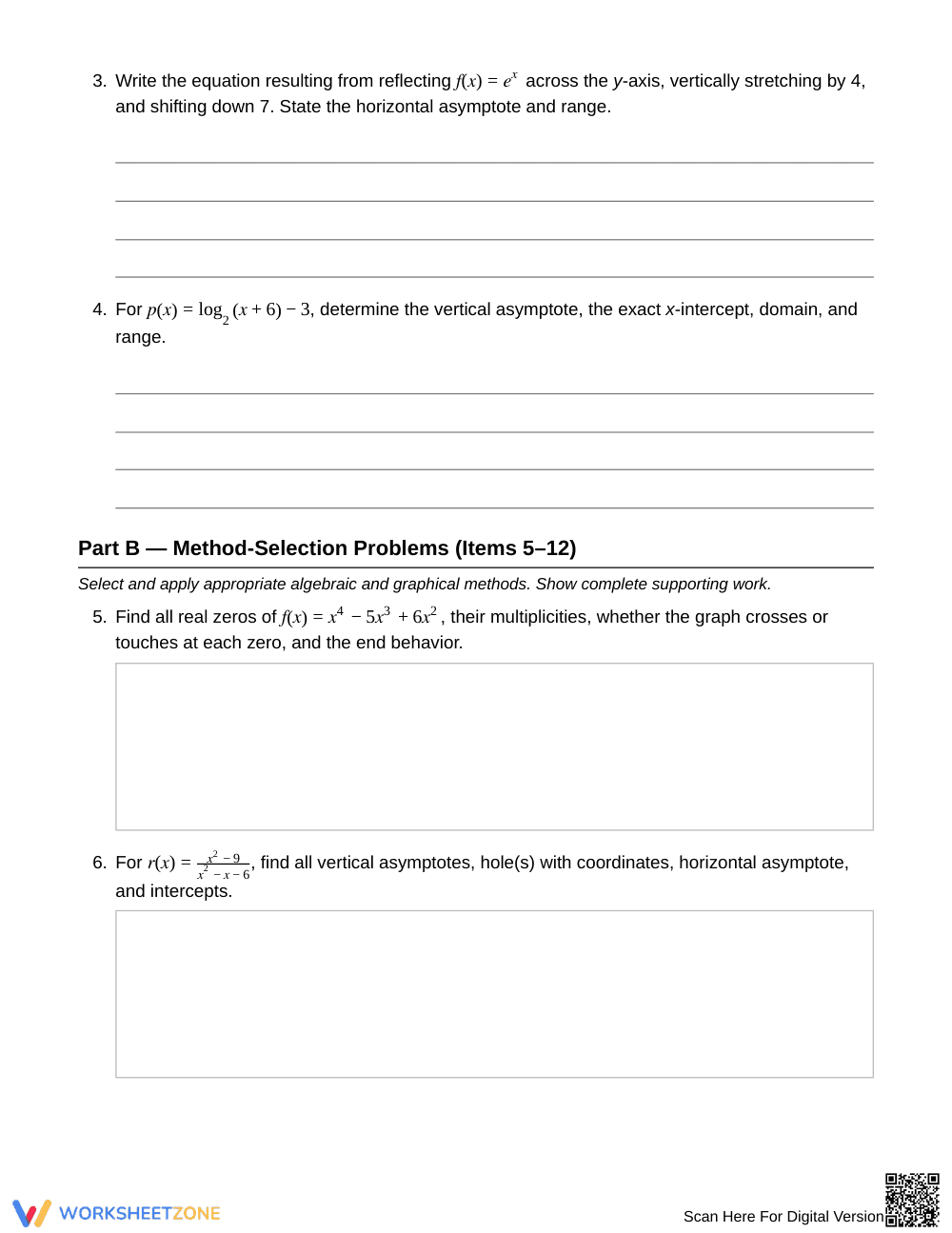
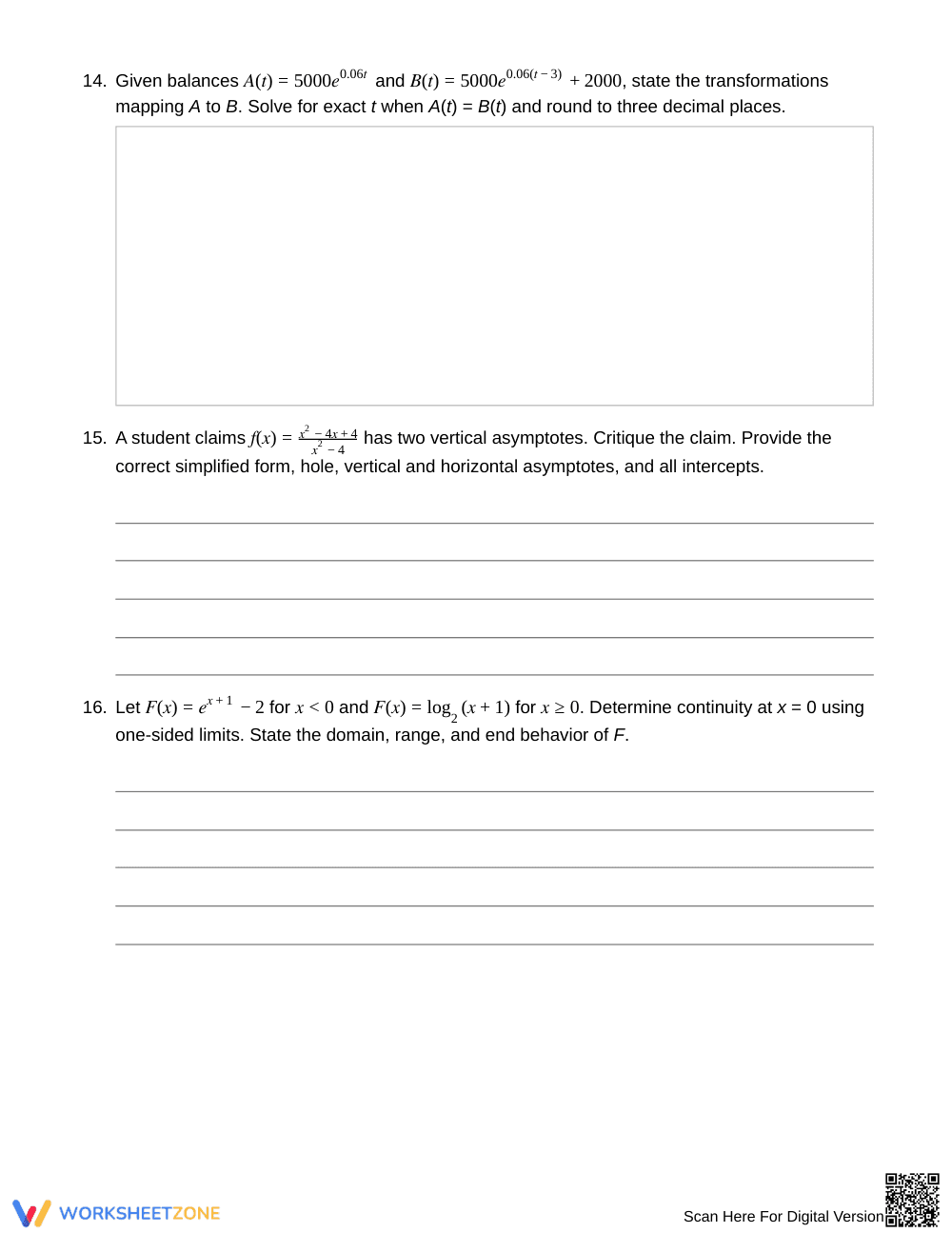
This Grade 12 Precalculus worksheet strengthens student mastery of function transformations and comprehensive global function analysis across polynomial, rational, exponential, and logarithmic families. Learners synthesize transformations, identify key graphical features, evaluate end behavior, and verify continuity, producing rigorous mathematical explanations that bridge algebraic manipulation and graphical reasoning across 16 multi-step problems.
At a Glance
- Grade: 12 · Subject: Precalculus
- Standard: Advanced Functions — Analyze function transformations and global behaviors across multiple mathematical representations
- Skill Focus: Mix Transformations and Global Function Analysis
- Format: 5 pages · 16 problems · Answer key included · PDF
- Best For: End of unit review and calculus readiness
- Time: 60–75 minutes
What's Inside
Spanning 5 student pages, this resource delivers 16 analytical tasks structured into three distinct tiers. Students encounter conventions requiring exact values, inside-out transformation notation, and formal limit notation for end behavior. The resource includes a full 3-page answer key detailing algebraic steps, factored simplifications, and piecewise continuity proofs.
Skill Progression
- Guided practice (Items 1–4): Students establish foundational mechanics by isolating parent functions, stating transformations in inside-out order, and finding essential asymptotes and domain constraints across power, rational, exponential, and logarithmic forms.
- Supported practice (Items 5–12): Learners select specialized algebraic methods to determine polynomial multiplicities, locate rational holes versus vertical asymptotes, compute oblique asymptotes, and eliminate extraneous logarithmic roots.
- Independent practice (Items 13–16): Students tackle complex synthesis, applying function behavior to rate-of-change modeling, compound interest shifts, student error analysis, and piecewise continuity proofs using one-sided limits.
This structured progression reflects the gradual-release instructional model, building analytical autonomy from baseline parent-function recognition to open-ended calculus-readiness challenges.
Standards Alignment
Aligned with advanced precalculus objectives, this problem set requires students to analyze function families, synthesize geometric transformations, and interpret asymptotic behavior using limit notation. These objectives can be copied directly into lesson plans, IEP goals, or curriculum mapping tools.
How to Use It
Administer this worksheet after direct instruction on rational and transcendental function behaviors as a culminating unit workshop or split across two days of focused review. For formative assessment, examine Item 6 and Item 15 to check whether students identify removable discontinuities through factoring before stating vertical asymptotes. Students typically complete the 16 problems within 60 to 75 minutes of engaged work.
Who It's For
This resource serves Grade 12 Precalculus and Honors Precalculus students preparing for AP Calculus. Teachers can offer graphing calculators for visual verification to support emerging learners, while pairing the worksheet with a function characteristics reference chart during independent practice.
Mastering mixed transformations and global function analysis represents a critical cognitive threshold for Grade 12 students preparing for differential and integral calculus. According to Fisher & Frey (2014), instructional frameworks that deliberately structure cognitive load through gradual release allow learners to internalize complex procedural knowledge before attempting unprompted synthesis. This worksheet implements that architecture by guiding students from inside-out transformation mechanics through method selection and piecewise limit analysis. By requiring learners to distinguish removable discontinuities from vertical asymptotes, interpret multiplicity behaviors at coordinate intercepts, and justify end behaviors with limit notation, the curriculum develops deep conceptual flexibility across polynomial, exponential, logarithmic, and rational families. Independent problem solving embedded in contextual modeling reinforces this retention, ensuring secondary mathematicians build the necessary procedural fluency, analytic precision, and representational agility demanded by collegiate mathematics benchmarks and advanced STEM coursework.


