


























Views
Downloads


Complete Friction Models Worksheet | Grade 12 Physics
Paste this activity's link or code into your existing LMS (Google Classroom, Canvas, Teams, Schoology, Moodle, etc.).
Students can open and work on the activity right away, with no student login required.
You'll still be able to track student progress and results from your teacher account.
This Grade 12 physics worksheet guides advanced students to rigorously compare predictions between ideal frictionless systems and Coulomb contact friction models. Working through inclined plane scenarios, learners calculate acceleration, evaluate static thresholds, identify normal force coupling, and test predictive models against experimental data to master classical dynamics.
At a Glance
- Grade: 12 · Subject: Physics
- Standard: Advanced Mechanics — Analyze forces, evaluate normal force constraints, and compare competing physical models
- Skill Focus: Compare Friction and Frictionless Predictions
- Format: 5 pages · 10 problems · Answer key included · PDF
- Best For: AP Physics contact mechanics practice
- Time: 45–60 minutes
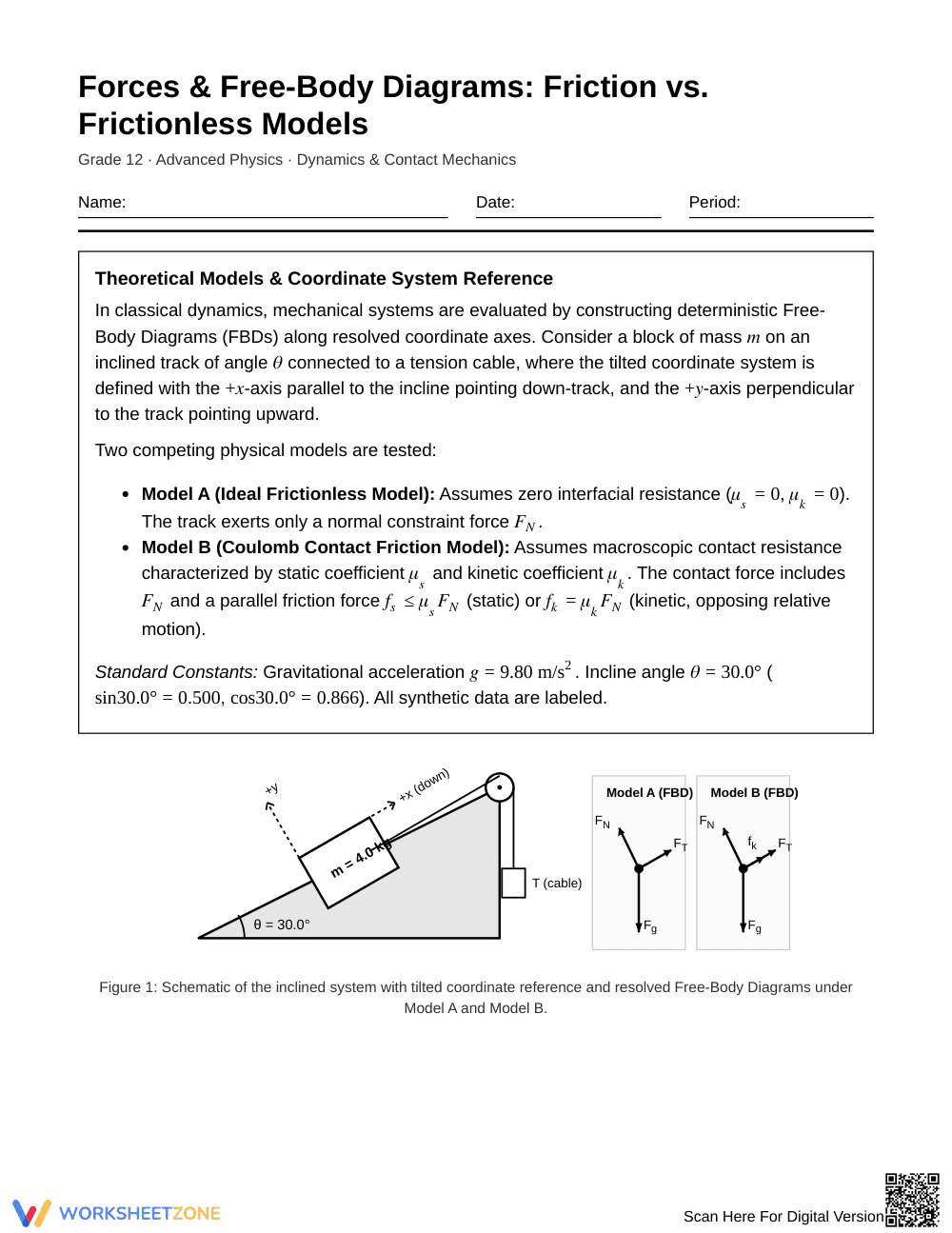
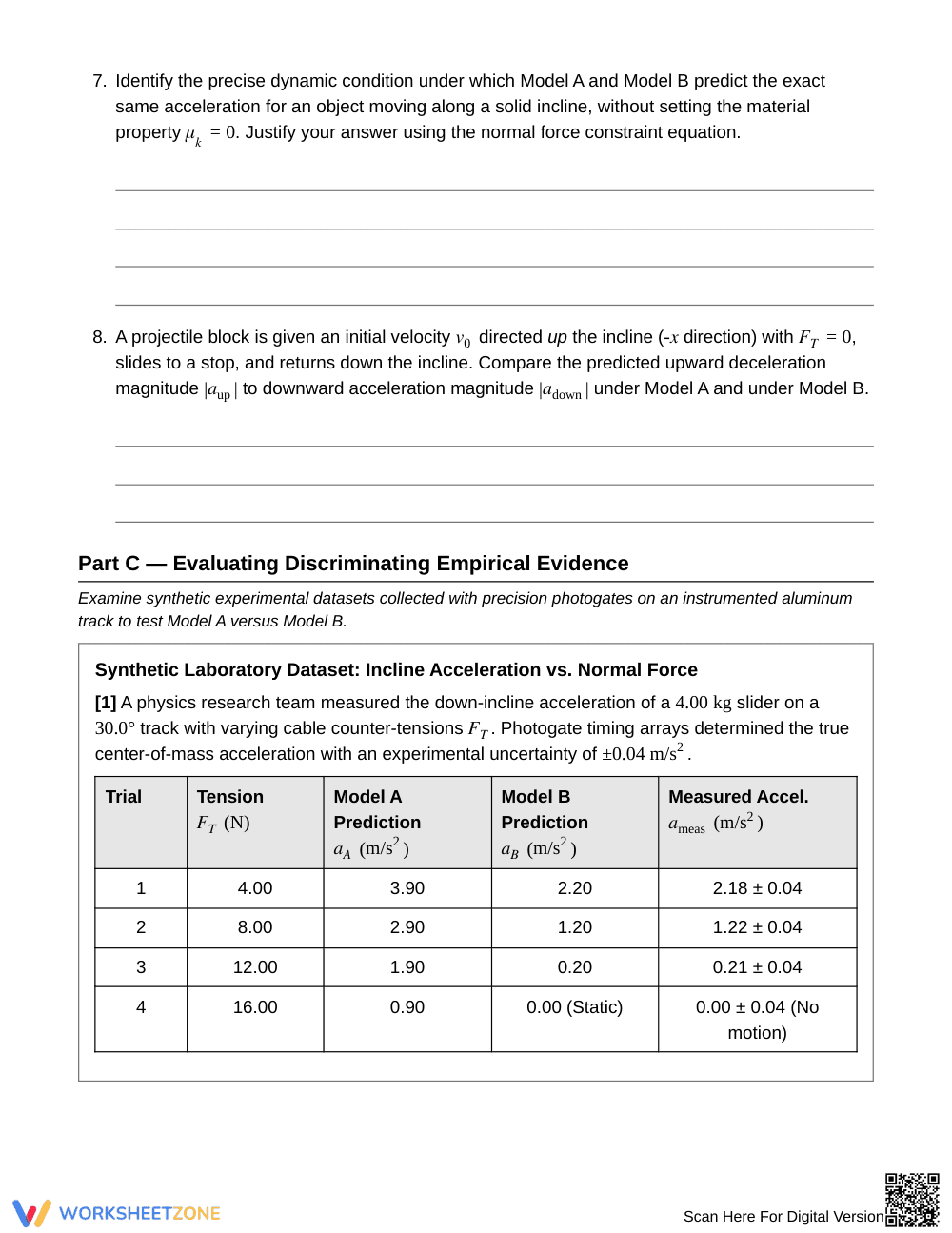
Spanning 5 student pages, this resource features 10 multi-step dynamics tasks supported by an inclined plane coordinate schematic, model definitions, and a 4-page answer key. Students work through quantitative boundary derivations, multi-variable comparative controls involving modified Atwood setups, and empirical photogate data tables that contrast theoretical models against lab observations.
Skill Progression
- Guided practice (Problems 1–2): Structured calculations establish baseline accelerations across Model A and Model B, prompting learners to apply static threshold formulas under varied cable tensions.
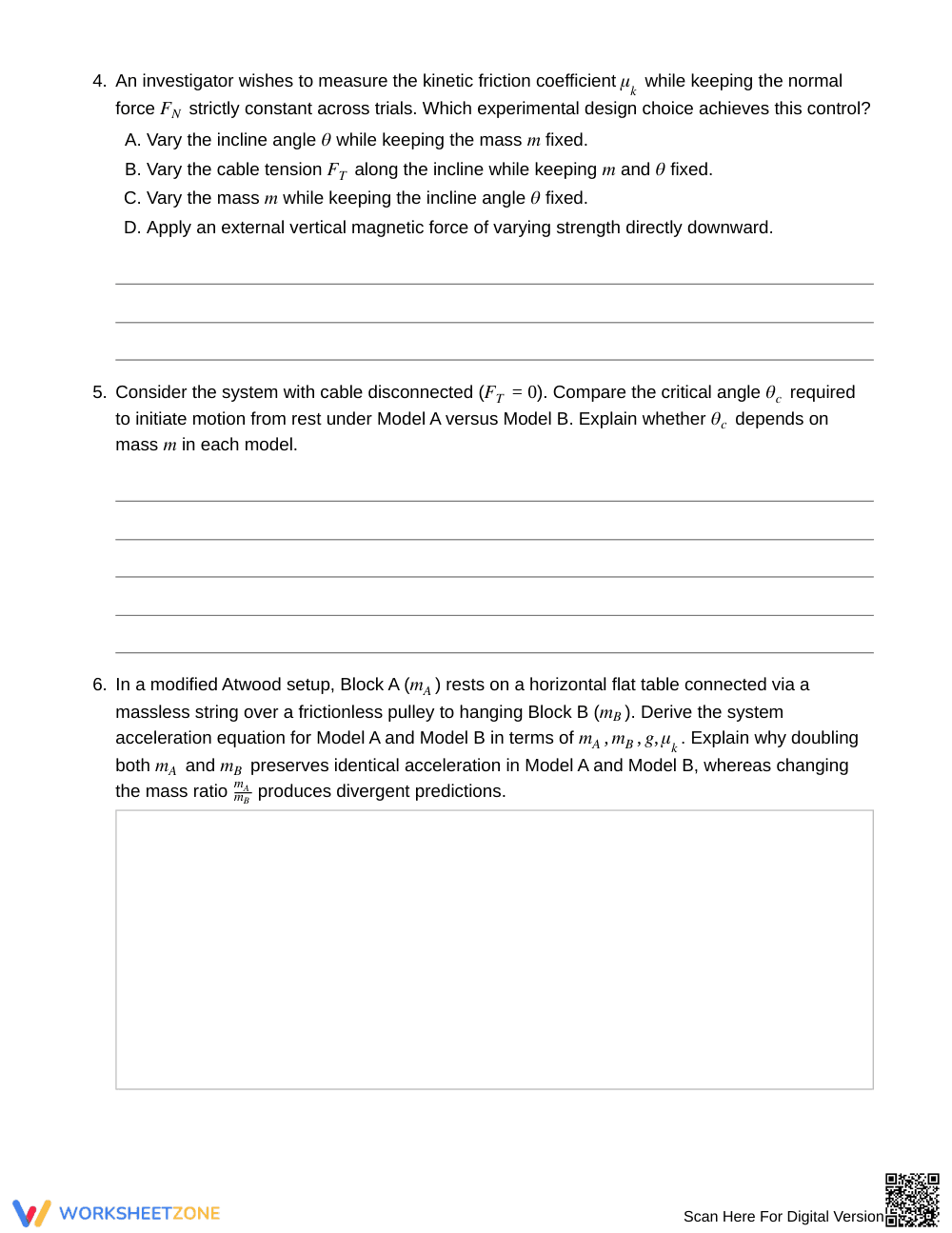
- Supported practice (Problems 3–8): Analytical derivation tasks challenge students to manipulate external push vectors, isolate friction controls, examine critical slip angles, and evaluate Atwood acceleration invariants.
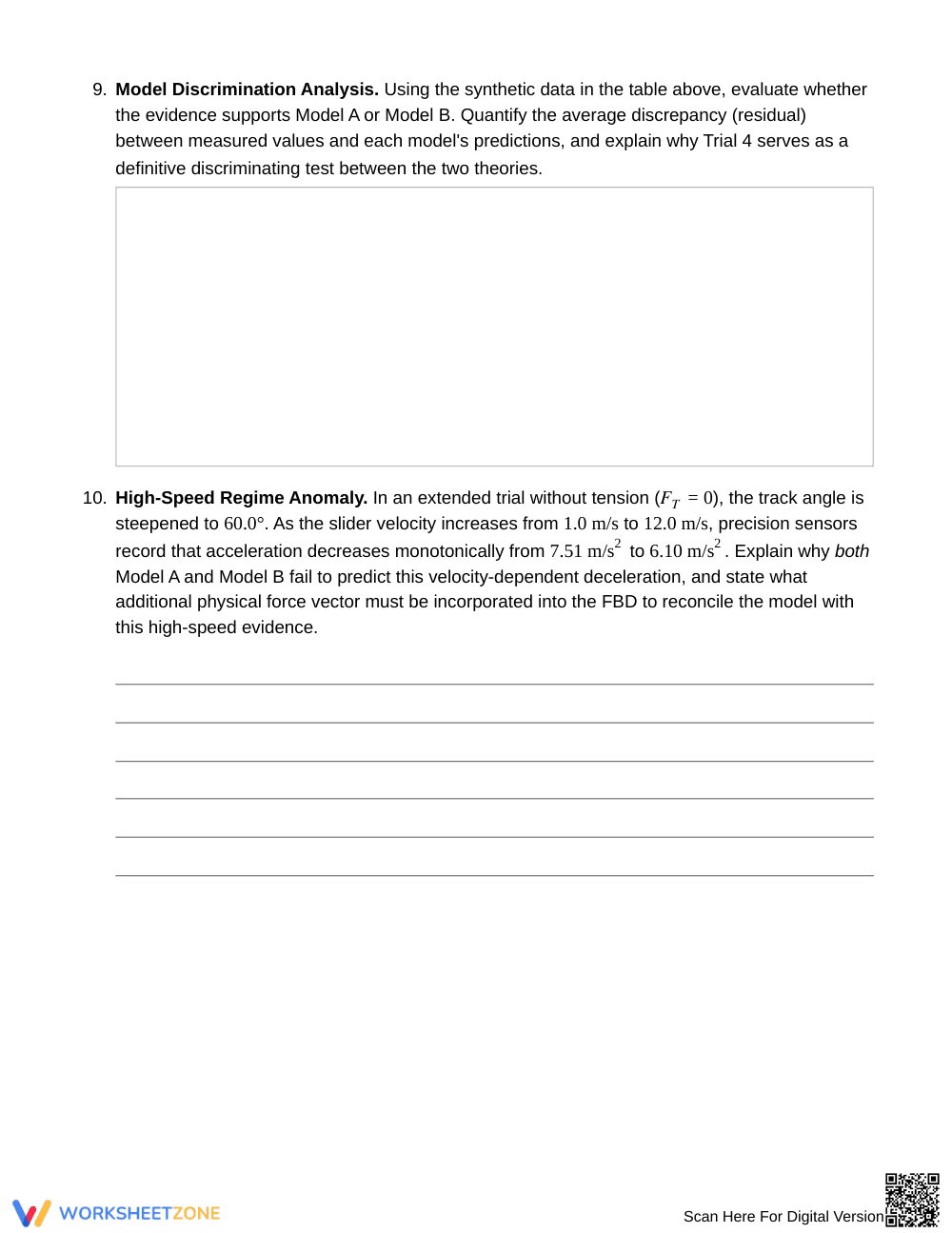
- Independent practice (Problems 9–10): Model discrimination tasks require learners to analyze synthetic photogate datasets, quantify residuals, and identify high-speed drag anomalies.
This structure embodies the gradual-release framework, moving students from scaffolded algebraic substitution to autonomous scientific evaluation and model critique.
Standards Alignment
This resource aligns with advanced mechanics and AP Physics dynamics objectives governing Newton's laws, frictional interfaces, and coordinate transformations. Students systematically derive differential accelerations and evaluate normal force constraints under variable loading. Both standard codes can be copied directly into lesson plans, IEP goals, or district curriculum mapping tools.
How to Use It
Deploy this worksheet after direct instruction on inclined planes and Coulomb friction coefficients. Use Part A and Part B as a collaborative workshop during block periods, or assign Part C as an evaluative post-lab assessment. During instruction, observe how students handle the perpendicular component of external push forces; common errors occur when failing to couple horizontal forces directly to normal force constraints. Expected completion time is 45 to 60 minutes.
Who It's For
This activity is designed for Grade 12 honors physics and AP Physics C mechanics students developing deep analytical modeling abilities. Differentiate by providing formula sheets for standard learners while challenging advanced peers to derive the high-speed air resistance vector. Pair this activity naturally with a low-friction dynamic track laboratory investigation.
Evaluating competing physical models through quantitative friction analysis represents a cornerstone of advanced secondary physics education. When students systematically contrast ideal frictionless predictions against macroscopic Coulomb contact models, they transition from passive formula memorization to authentic scientific reasoning. Research documented in Fisher & Frey (2014) emphasizes that deliberate scaffolding across guided problem solving, variable manipulation, and empirical data confrontation deepens conceptual retention and sharpens mathematical modeling proficiency. In this Grade 12 physics worksheet, learners calculate deterministic accelerations across 10 analytical problems, assess static friction thresholds, and interrogate experimental photogate residuals against theoretical expectations. Confronting edge cases such as normal force modifications from horizontal pushes and high-speed drag anomalies reinforces the explanatory limits of classical mechanical models. By engaging directly with both analytic and empirical dimensions of contact mechanics, students develop the rigorous analytical habits, spatial decomposition skills, and evidence-based argumentation required for collegiate STEM achievement.


