


























Views
Downloads



Complete Fractional Change Worksheet | Grade 12 Precalculus
Paste this activity's link or code into your existing LMS (Google Classroom, Canvas, Teams, Schoology, Moodle, etc.).
Students can open and work on the activity right away, with no student login required.
You'll still be able to track student progress and results from your teacher account.
This rigorous Precalculus worksheet equips high school students to model repeated fractional change and analyze long-term behavior using geometric sequences and series. Students formulate explicit and recursive functions from real-world contexts, calculate finite sums, evaluate infinite limits, and justify operational decisions. They transition directly from discrete proportional decay to continuous-style limiting evaluations.
At a Glance
- Grade: 12 · Subject: Precalculus
- Standard:
HSF-BF.A.2— Write geometric sequences recursively and with explicit formulas to model situations- Skill Focus: Model Repeated Fractional Change
- Format: 4 pages · 10 problems · Answer key included · PDF
- Best For: Advanced sequence and series practice
- Time: 45–60 minutes
What's Inside
The 4-page worksheet includes a targeted formula reference box, a fully worked membrane filtration model, and 10 multi-step computational problems divided into three scaffolded sections. A comprehensive 2-page answer key provides step-by-step algebraic derivations, logarithmic computations, and exact final values alongside rounded solutions.
Skill Progression
- Guided practice (Problems 1–2): Students apply core formulas with explicit multipliers to determine luminous intensity and radioactive decay intervals under direct fractional rates.
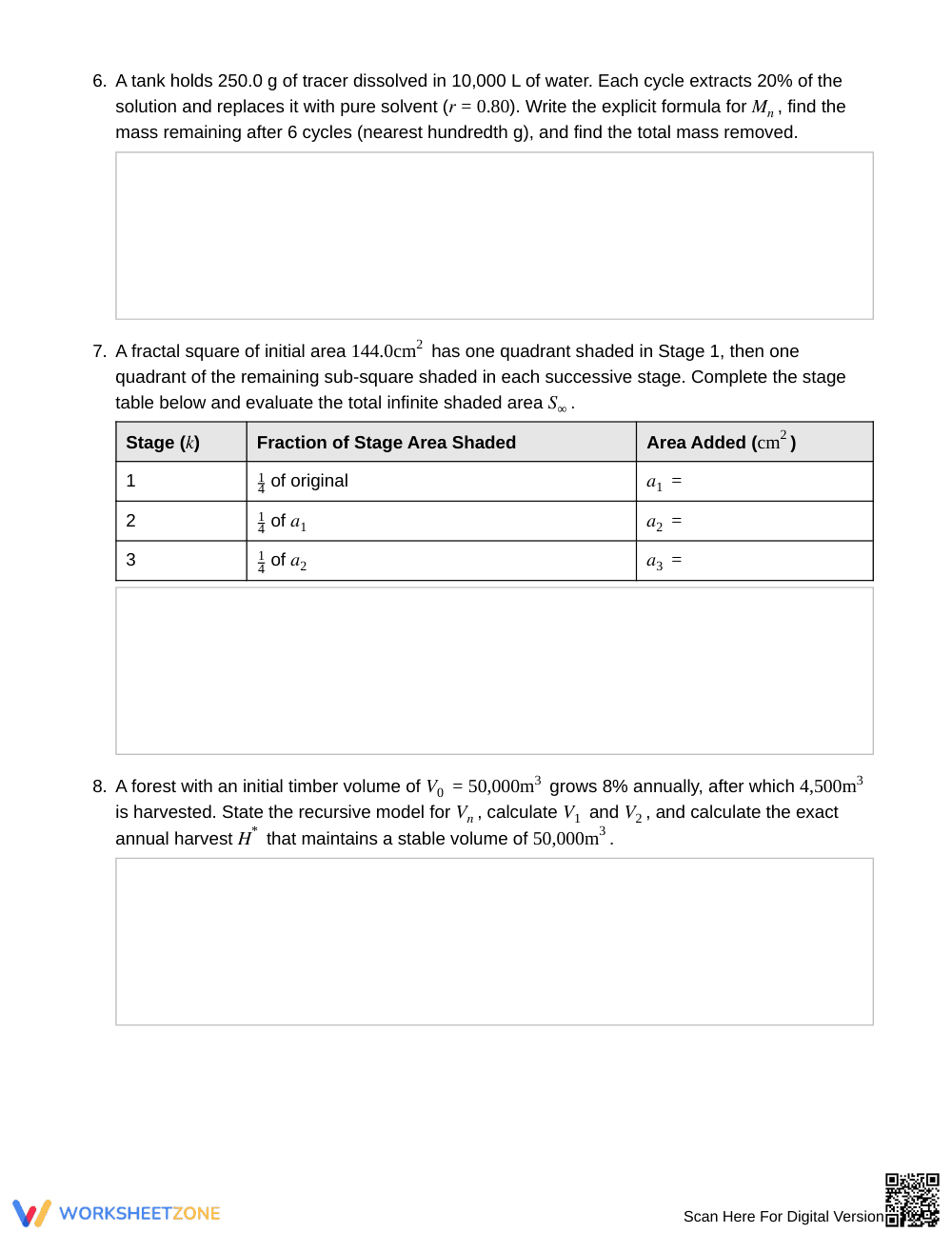
- Supported practice (Problems 3–8): Learners construct finite series, stage tables, and infinite sums for rebound heights, drug elimination, industrial scrubbers, and fractal geometry.
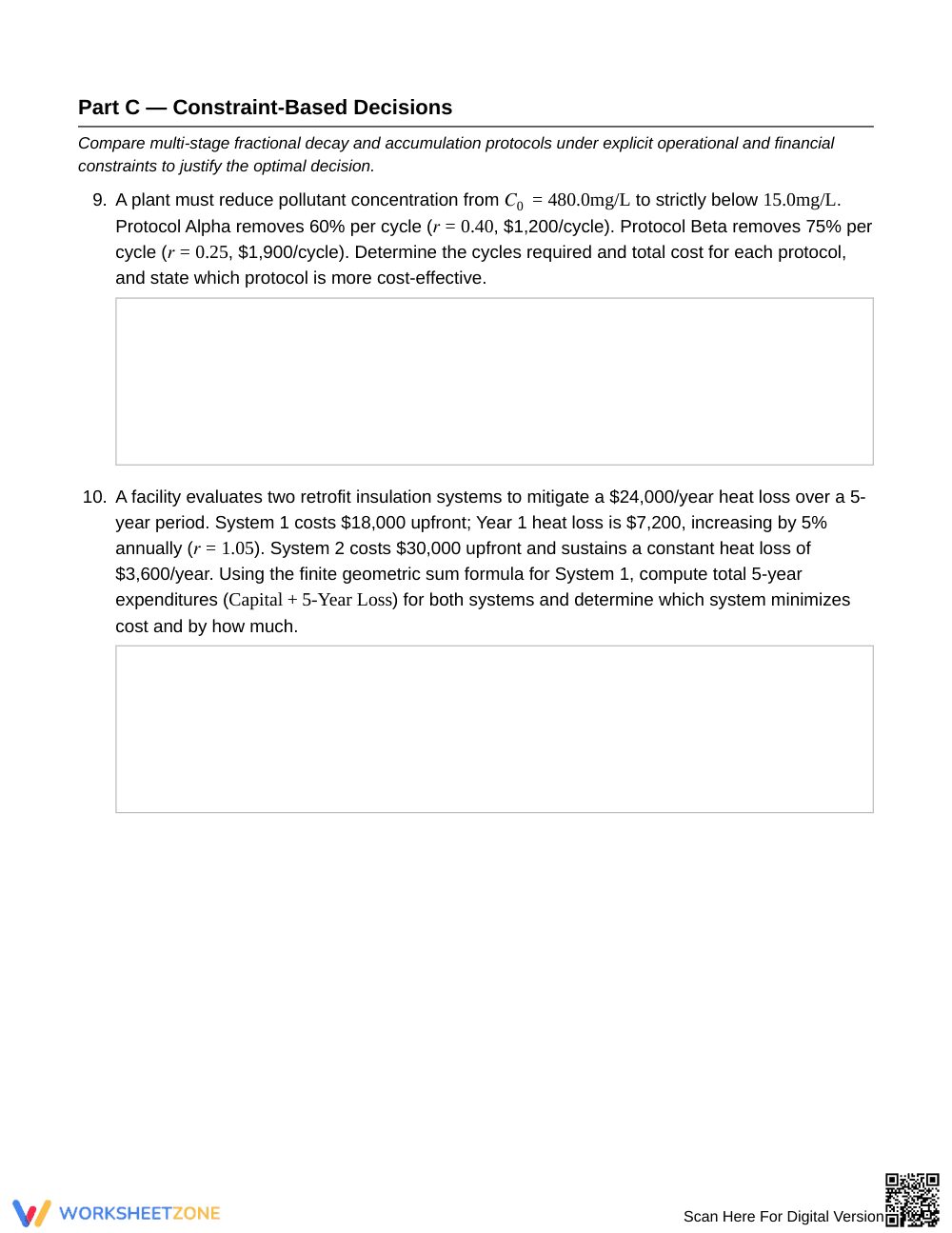
- Independent practice (Problems 9–10): Students synthesize geometric modeling with financial and environmental constraints to evaluate multi-stage remediation protocols.
This structured progression reflects the gradual-release model, transitioning students from foundational parameter identification to complex real-world decision-making.
Standards Alignment
This resource directly targets primary standard HSF-BF.A.2: Write arithmetic and geometric sequences both recursively and with an explicit formula, use them to model situations, and translate between the two forms. It reinforces modeling continuous and discrete processes through authentic parameters. Both standard codes can be copied directly into lesson plans, IEP goals, or district curriculum mapping tools.
How to Use It
Deploy this worksheet after direct instruction on geometric series to solidify conceptual connections. It functions effectively as a collaborative small-group investigation or a paired problem-solving seminar. Formative assessment tip: observe whether students correctly identify whether the initial term corresponds to index zero or one when establishing explicit formulas. Expected completion time is 45 to 60 minutes.
Who It's For
This activity is designed for Grade 12 Precalculus and advanced Algebra II students preparing for AP Calculus. Scaffolded formula references support struggling learners, while constraint-based decision prompts challenge advanced students. Pair this worksheet directly with a graphing calculator demonstration illustrating asymptotic decay and partial sum convergence.
According to Fisher & Frey (2014), purposeful instructional design relies on intentional shifts from guided modeling to independent application to secure deep mathematical transfer. This Precalculus resource operationalizes standard HSF-BF.A.2 by challenging twelfth-grade students to model repeated fractional change using both recursive and explicit geometric formulations. Learners evaluate complex scenarios involving radioactive decay, rebound trajectories, drug concentration limits, and multi-stage environmental scrubbers. By integrating finite geometric series and infinite series limits, students bridge the conceptual gap between discrete algebraic sequences and introductory calculus limits. The worksheet balances rigorous algebraic manipulation with analytical decision-making under realistic economic and physical constraints. When secondary mathematics curricula incorporate structured scaffolding alongside contextualized mathematical modeling, students demonstrate significantly higher retention and procedural fluency. This complete resource ensures high schoolers build durable competencies in modeling iterative exponential behaviors across advanced STEM applications.


