




























Views
Downloads
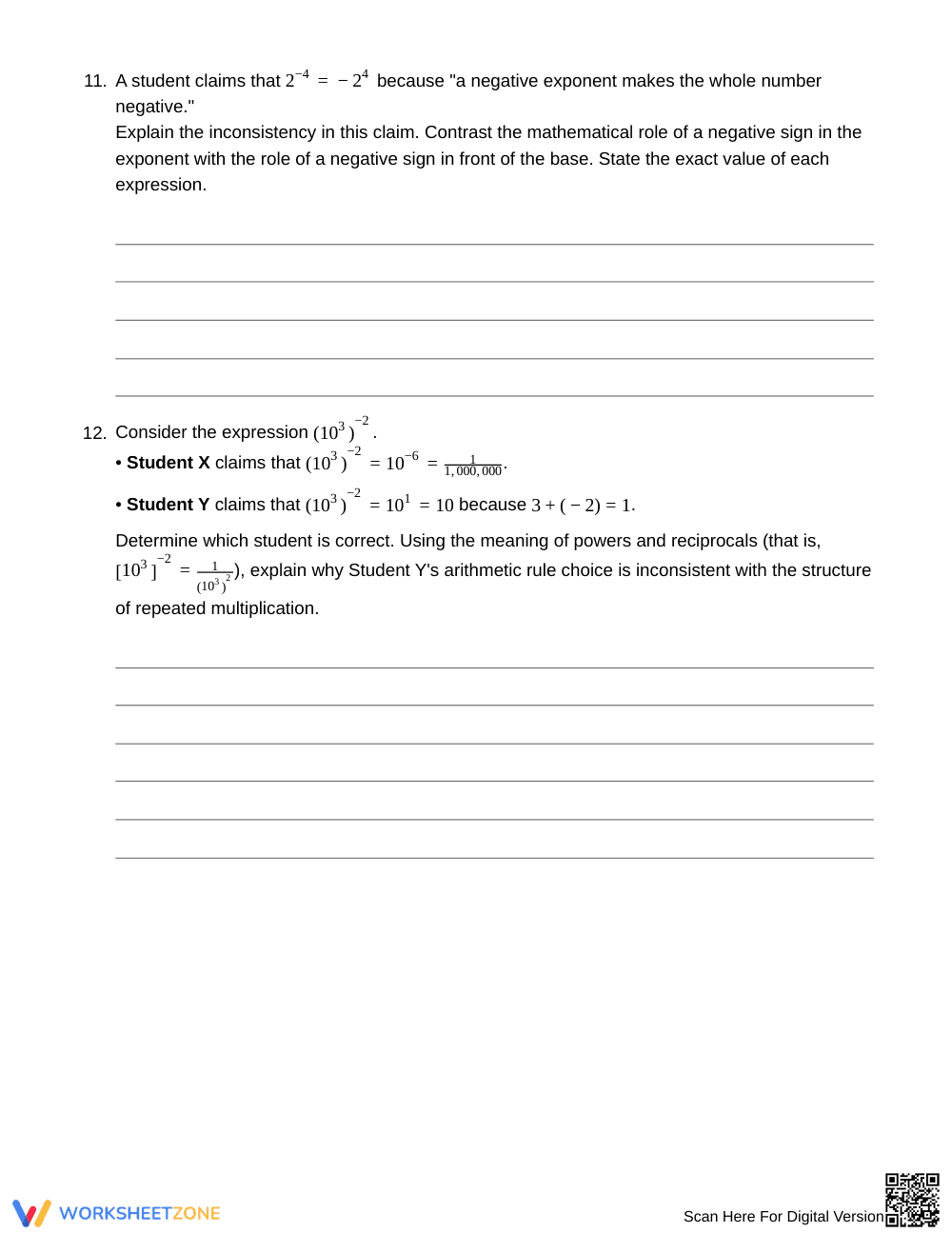

Complete Equivalent Power Forms Worksheet | Grade 8 Math

Paste this activity's link or code into your existing LMS (Google Classroom, Canvas, Teams, Schoology, Moodle, etc.).
Students can open and work on the activity right away, with no student login required.
You'll still be able to track student progress and results from your teacher account.
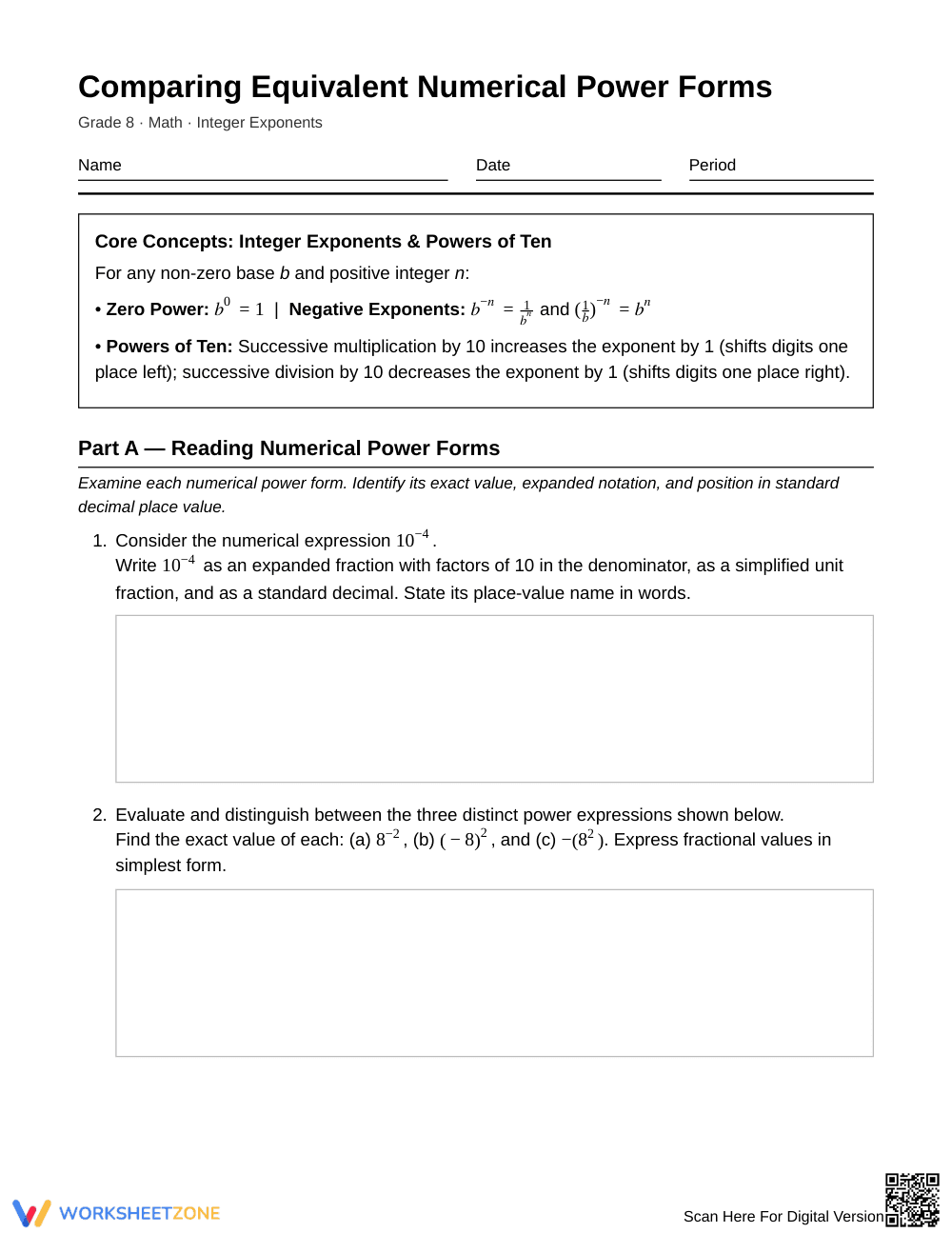
This Grade 8 mathematics worksheet builds conceptual understanding and procedural fluency with integer exponents. Students evaluate negative exponents, zero powers, and powers of ten, comparing numerical power forms across 12 structured tasks to solidify algebraic reasoning before moving on to scientific notation.
At a Glance
- Grade: 8 · Subject: Math
- Standard: Integer Exponents — Evaluate and compare expressions involving integer exponents and equivalent forms
- Skill Focus: Compare Equivalent Numerical Power Forms
- Format: 5 pages · 12 problems · Answer key included · PDF
- Best For: Core instruction, small-group remediation, partner practice
- Time: 40–50 minutes
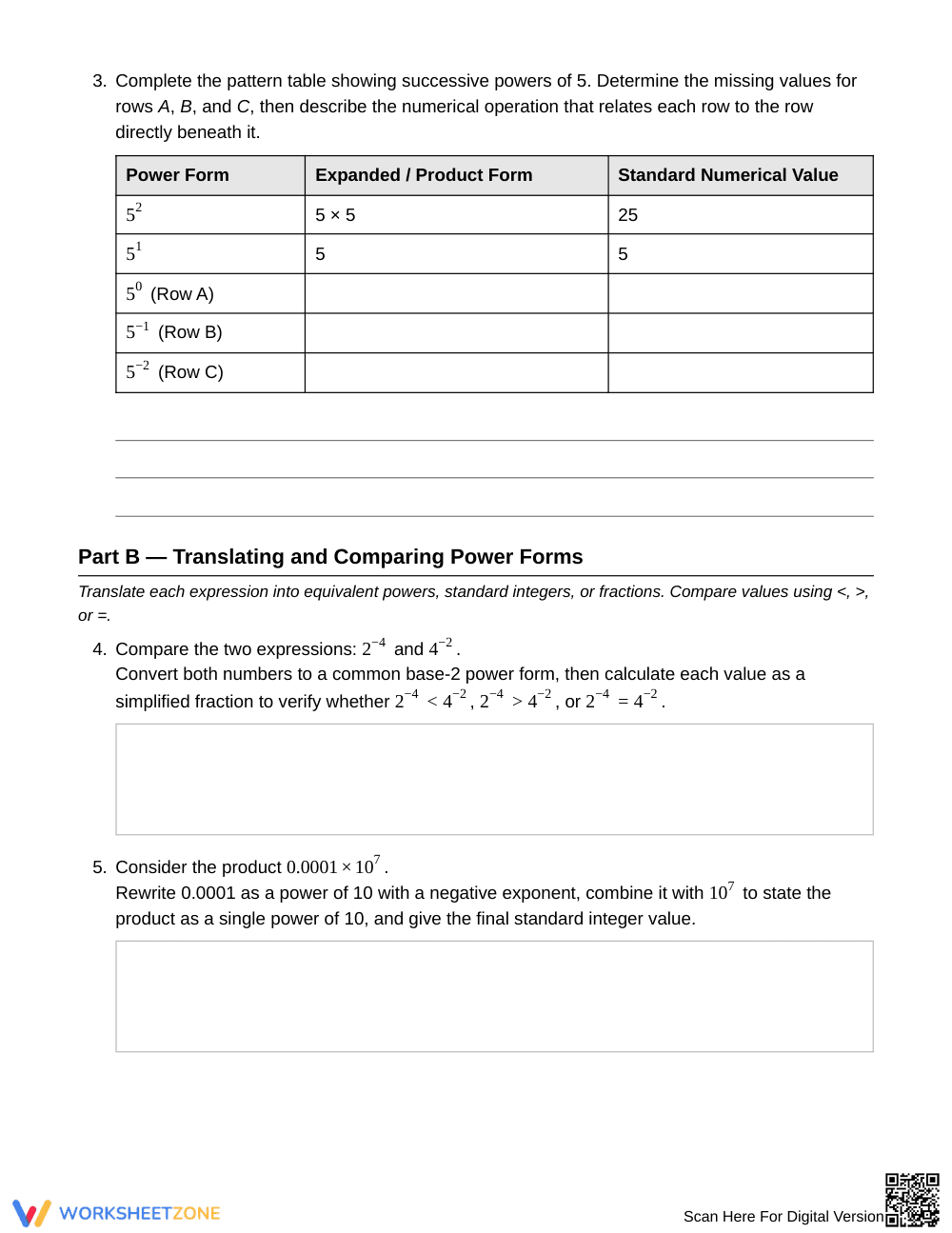
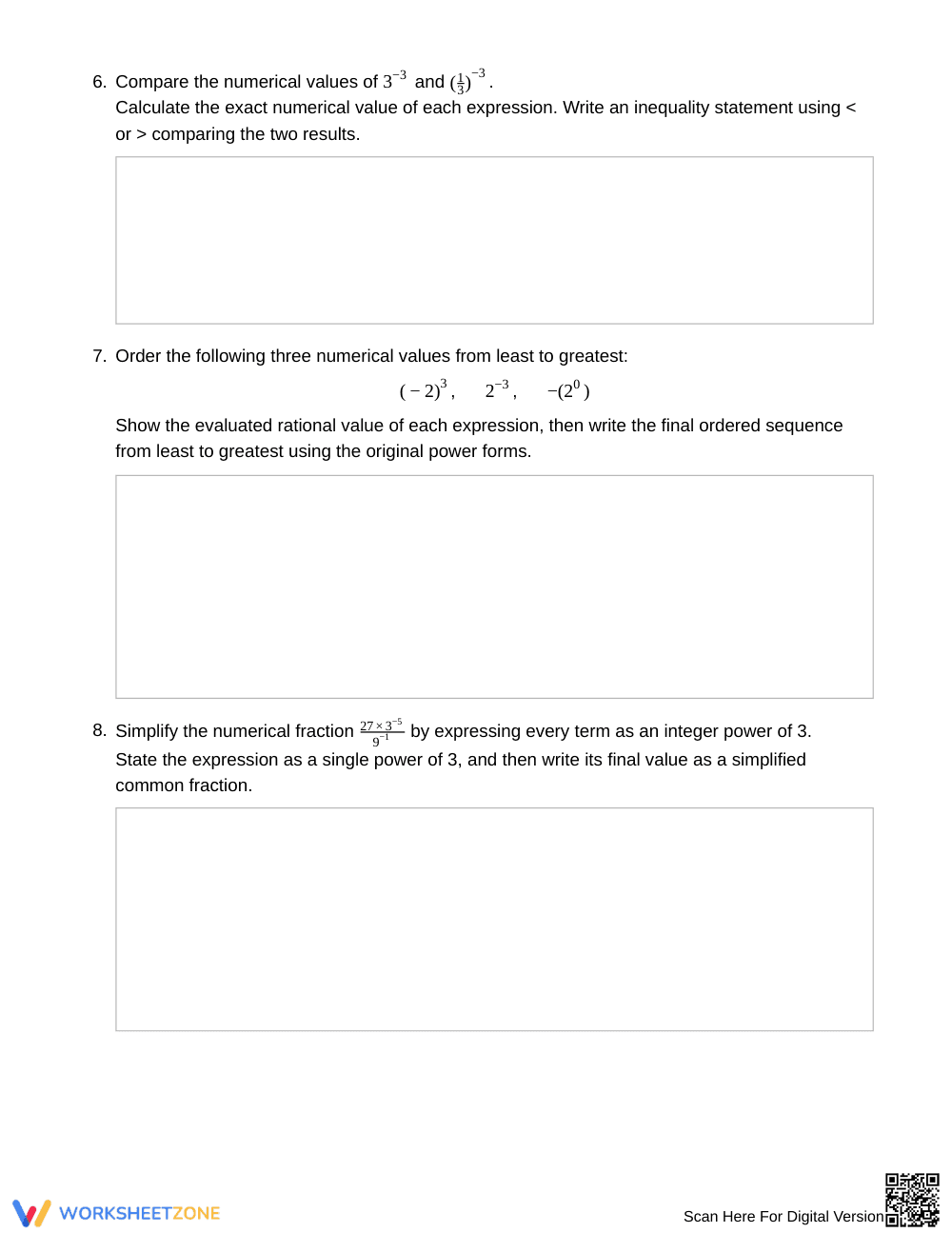
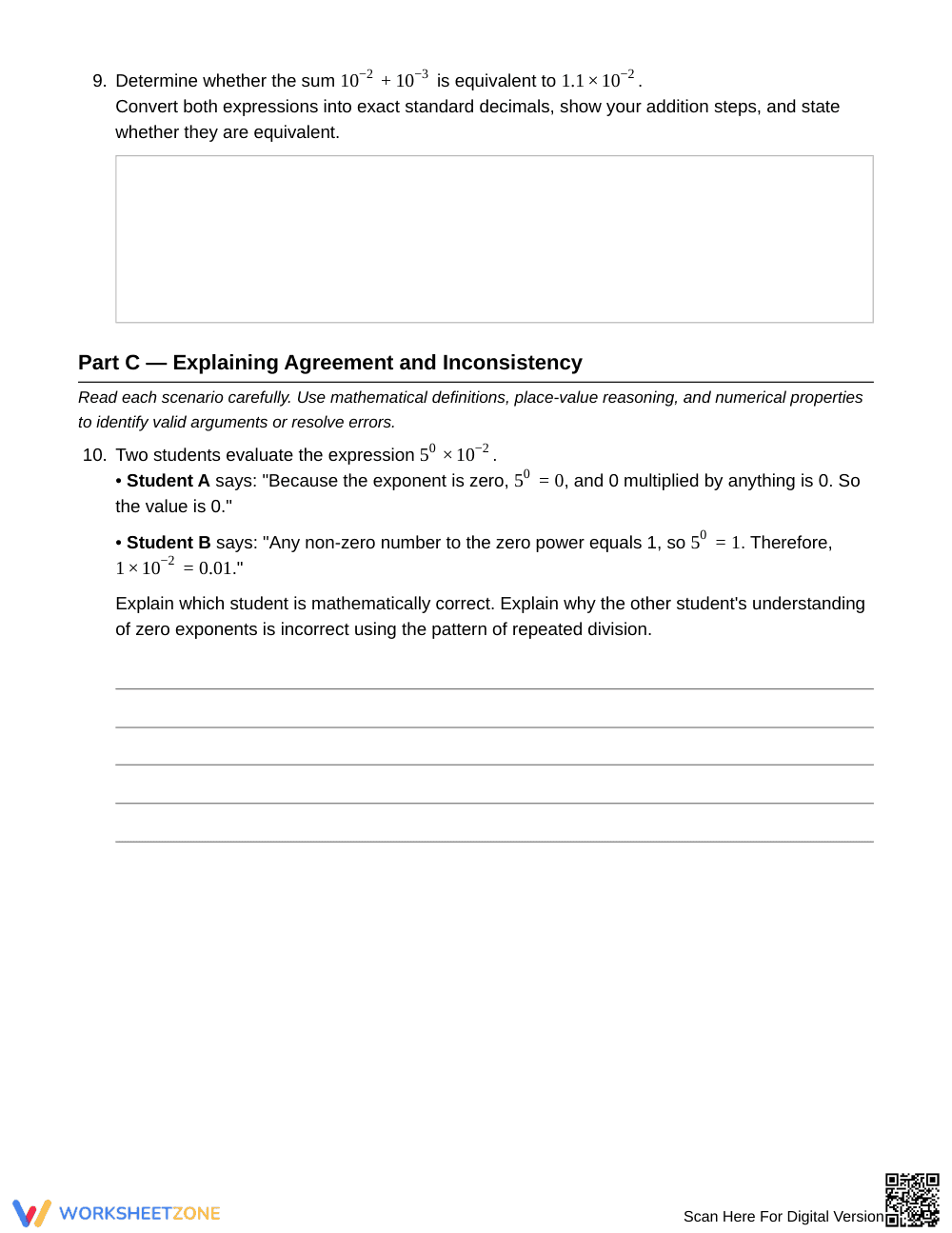
Inside this 5-page resource, students engage with 12 problems across three sections. The worksheet opens with a core concept box detailing negative exponents and powers of ten rules. It incorporates pattern tables, multi-base fraction simplification, decimal expansions, and written error-analysis prompts, supported by a 3-page step-by-step answer key.
Skill Progression
- Guided practice (Part A, Problems 1–3): Students read, expand, and tabulate numerical powers, completing a successive base-5 division table to discover zero and negative exponent rules.
- Supported practice (Part B, Problems 4–9): Students convert expressions to common bases, simplify fraction expressions using exponent properties, and order power expressions from least to greatest.
- Independent practice (Part C, Problems 10–12): Students analyze student arguments, construct mathematical proofs of equivalence, and explain common misconceptions involving negative bases versus negative exponents.
This sequence follows a gradual-release instructional model, shifting learners from foundational place-value patterns to rigorous analytical critique.
Standards Alignment
This resource aligns with Grade 8 standards requiring students to develop and apply integer exponent properties to generate equivalent numerical expressions. Students demonstrate that non-zero bases with negative exponents represent reciprocals and zero exponents equal one. Both standard descriptions can be copied directly into lesson plans, IEP goals, or district curriculum mapping tools.
How to Use It
Deploy this worksheet after direct instruction on the product and quotient rules of exponents. For partner problem-solving, have student pairs collaborate on Part B to reconcile differing base conversions, allotting 40 to 50 minutes for total completion. During classwork, observe how students handle Problem 11: check whether they confuse a negative base like (-8)^2 with an exponent rule like 8^-2 to provide immediate corrective feedback.
Who It's For
This worksheet serves Grade 8 pre-algebra and Algebra I students who need targeted practice with non-positive integer exponents. It provides structured visual supports for struggling learners while challenging advanced students through Part C justification prompts. Pair this printable with an exponent rules anchor chart or an interactive number-line demonstration for optimal instructional impact.
Mastering equivalent numerical power forms establishes the foundational algebraic framework necessary for advanced high school mathematics and scientific notation. According to Fisher & Frey (2014), structured instructional progression through guided modeling, collaborative problem-solving, and independent justification substantially improves conceptual retention and procedural fluency in adolescent math learners. This worksheet systematically targets the vital cognitive shift from viewing exponents solely as repeated multiplication to understanding negative exponents as repeated division and reciprocal relationships. By providing 12 purposeful tasks spanning computation, pattern generation, decimal equivalence, and mathematical critique, the material ensures Grade 8 students build enduring numeracy with integer exponents and power rules. Educators can reliably utilize these 5 pages of practice and detailed answer keys to diagnose persistent exponent sign misconceptions, support individualized learning goals, and reinforce standards-aligned mathematical reasoning across diverse middle school classroom environments.


