


























Views
Downloads

Complete Domain Restrictions Worksheet | Grade 9 Algebra I
Paste this activity's link or code into your existing LMS (Google Classroom, Canvas, Teams, Schoology, Moodle, etc.).
Students can open and work on the activity right away, with no student login required.
You'll still be able to track student progress and results from your teacher account.
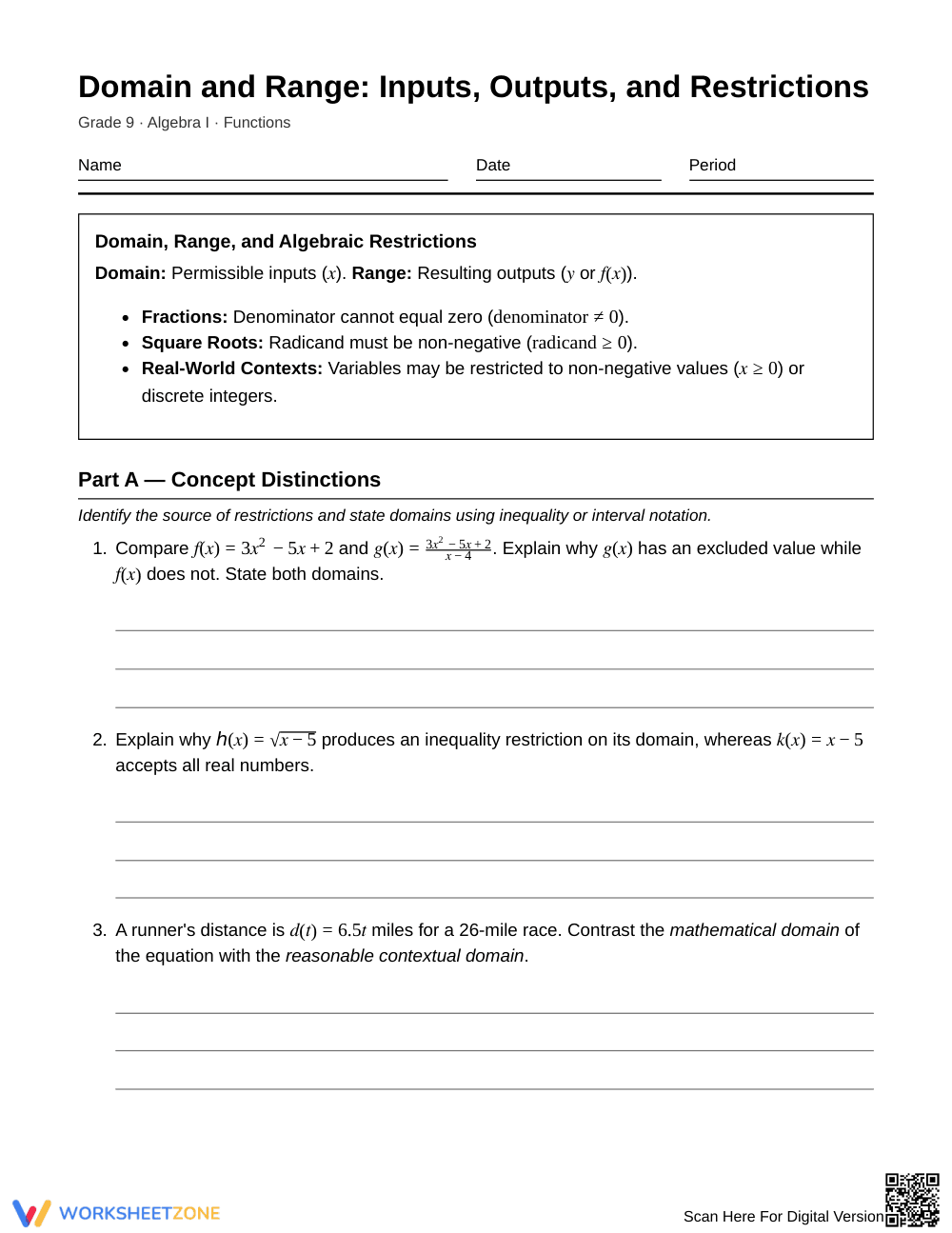
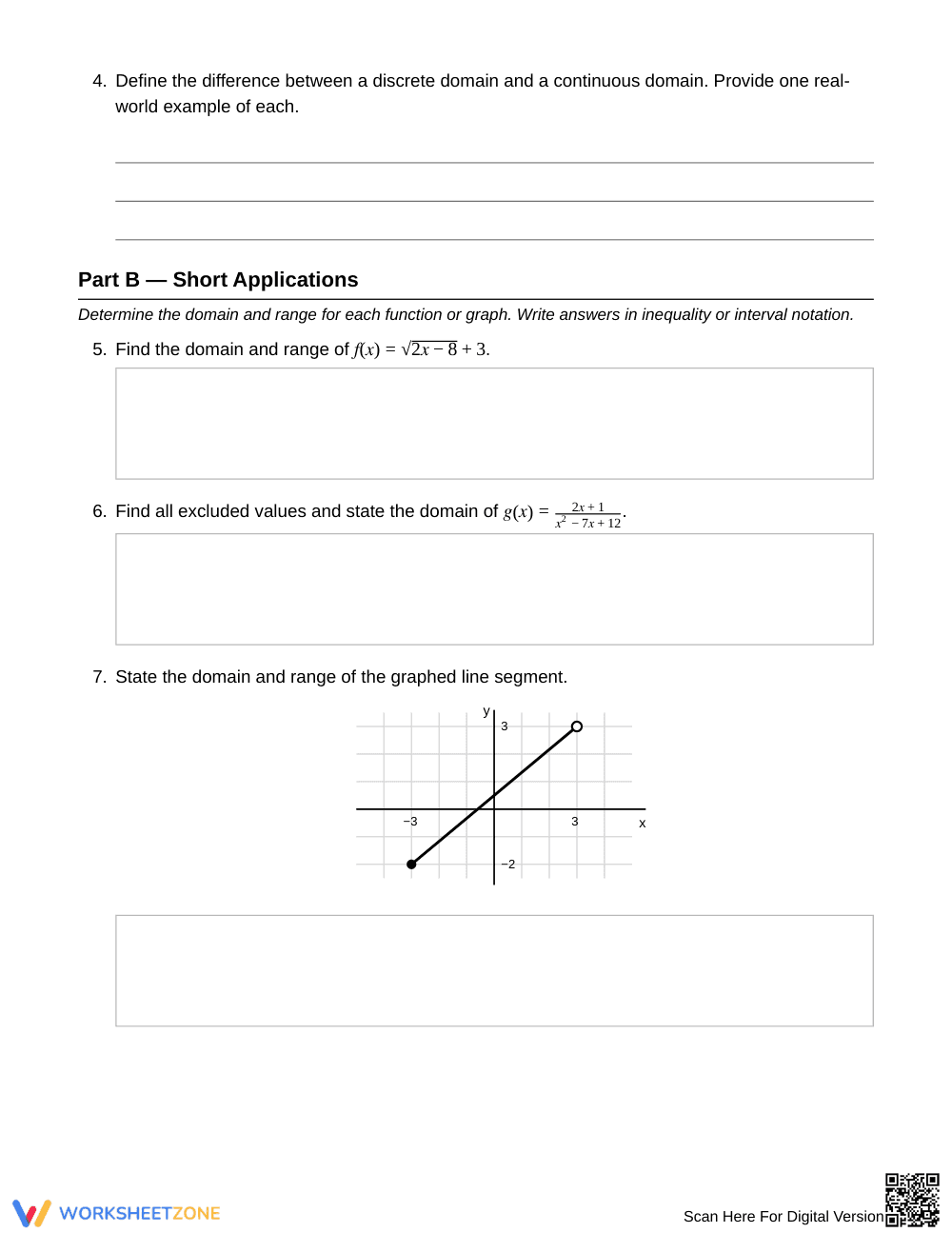
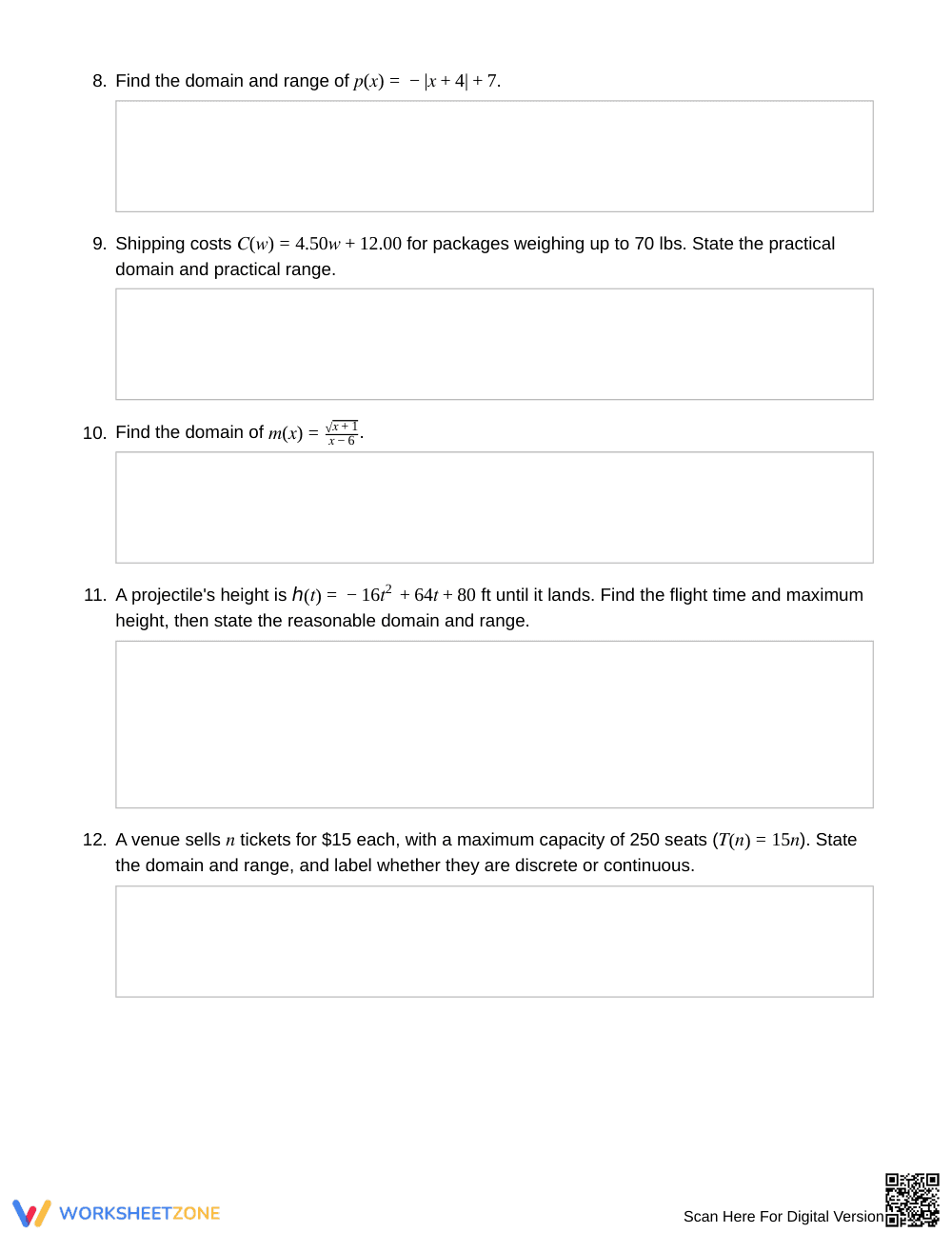
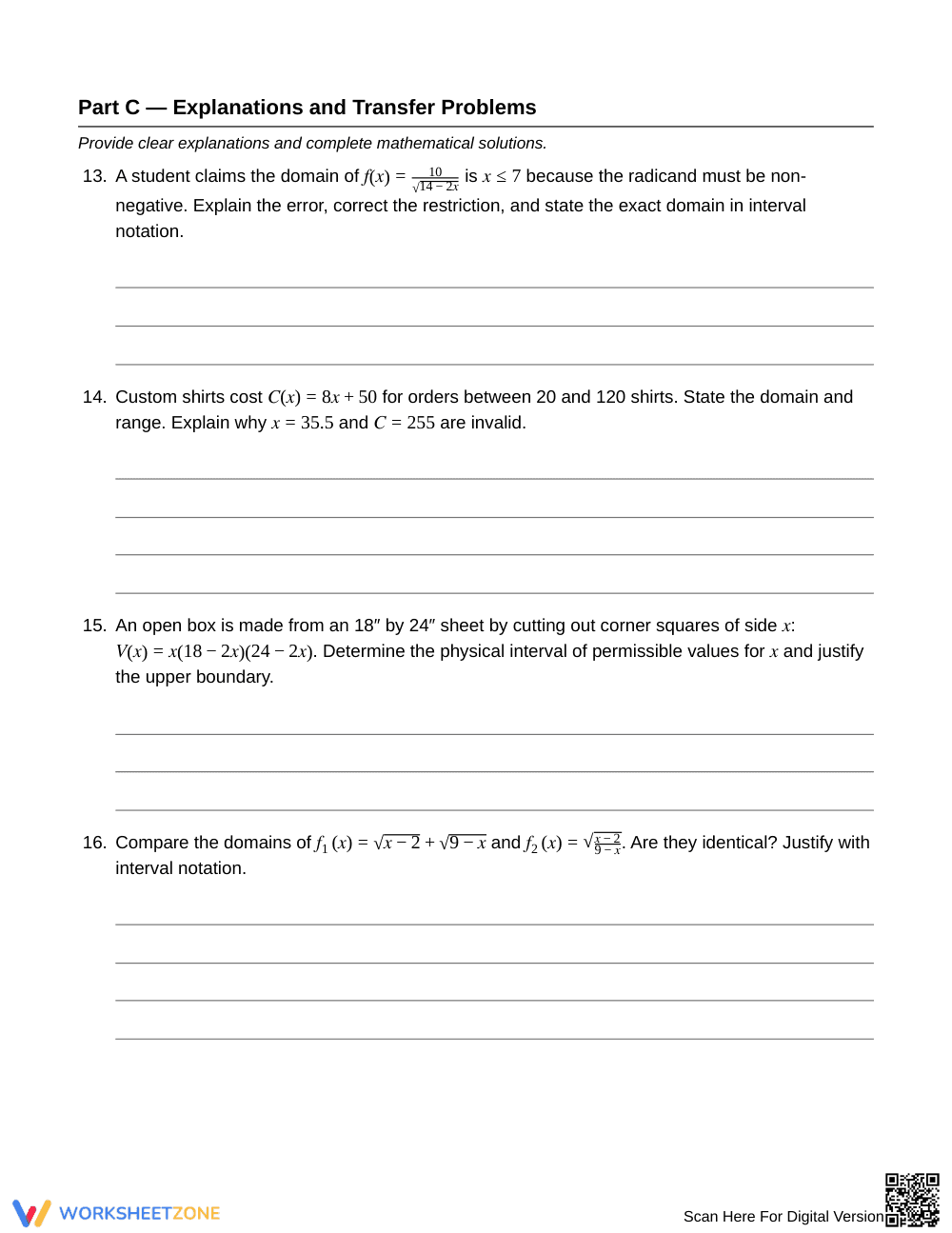
This comprehensive Algebra I worksheet builds student mastery in identifying domain, range, and functional restrictions. High school mathematicians analyze fraction denominators, square root radicands, and real-world boundary constraints across 16 structured problems, reinforcing essential algebraic reasoning for advanced function modeling and higher mathematics.
At a Glance
- Grade: 9 · Subject: Algebra I
- Standard: Determine domain and range restrictions for algebraic and contextual functions
- Skill Focus: Inputs, Outputs, and Restrictions
- Format: 4 pages · 16 problems · Answer key included · PDF
- Best For: Core practice and conceptual reinforcement
- Time: 45–60 minutes
What's Inside
This 4-page printable worksheet opens with a concise reference guide reviewing fraction and radicand constraints alongside discrete domain rules. Students complete 16 varied tasks across three scaffolded sections, supported by a 3-page teacher answer key containing complete mathematical justifications.
Skill Progression
The worksheet follows a research-backed gradual-release progression:
- Guided practice (Part A, 4 problems): Conceptual prompts require students to compare function types and contrast mathematical domains with contextual limitations.
- Supported practice (Part B, 8 problems): Computational exercises prompt learners to state domains and ranges using interval and inequality notation for algebraic, graphic, and contextual functions.
- Independent practice (Part C, 4 problems): High-demand transfer tasks challenge students with error analysis, discrete modeling, optimization intervals, and compound radical comparisons.
This scaffolded design guides students through the classic I Do, We Do, You Do instructional sequence.
Standards Alignment
This resource aligns with high school Algebra I standards for interpreting function domains, emphasizing the relationship between algebraic restrictions, practical boundaries, and real-world quantitative contexts. Both standard references can be copied directly into lesson plans, IEP goals, or district curriculum mapping tools.
How to Use It
Assign this worksheet following direct instruction on function boundaries. Facilitate Part A as whole-group discussion, then transition students to Part B for collaborative practice. Watch for learners confusing discrete counts with continuous intervals during formative check-ins. Reserve Part C for independent demonstration of mastery during a 45 to 60 minute class period.
Who It's For
This practice set serves Grade 9 Algebra I students mastering functions and upper-grade students needing targeted prerequisite review. The introductory rule box supports struggling learners, while the optimization prompts challenge advanced thinkers. Pair this worksheet directly with a coordinate graphing lesson or algebraic relations anchor chart.
According to research by Fisher & Frey (2014) on the gradual release of responsibility, scaffolded learning progressions that move systematically from conceptual comparison to independent problem solving significantly enhance algebraic retention and transfer. This Grade 9 worksheet operationalizes that framework to develop deep student proficiency in analyzing inputs, outputs, and function restrictions across core algebra curricula. By first establishing why algebraic constraints such as non-zero denominators and non-negative radicands occur, learners build durable mental schemas before applying their understanding to multi-step projectile motion, geometric box optimization, and discrete commercial scenarios. Explicitly separating continuous intervals from discrete integer domains ensures students avoid persistent misconceptions when interpreting quantitative models. The structured 16-task sequence provides educators with targeted formative evidence to verify whether students truly comprehend functional limitations or merely apply rote procedural formulas during core high school mathematics instruction.


