




























Views
Downloads




Complete Contextual Equation Worksheet | Grade 7 Math

Paste this activity's link or code into your existing LMS (Google Classroom, Canvas, Teams, Schoology, Moodle, etc.).
Students can open and work on the activity right away, with no student login required.
You'll still be able to track student progress and results from your teacher account.
This Grade 7 math worksheet teaches students to translate real-world scenarios into one-variable equations, solve them algebraically, and interpret results in context. Across six structured problems, learners move from scaffolded constraint tables to fully independent equation construction, building the foundational reasoning skills that standard 7.EE.B.4 demands.
At a Glance
- Grade: 7 · Subject: Math
- Standard:
7.EE.B.4— Construct and solve equations from word problems with rational numbers- Skill Focus: Constructing equations from contextual constraints
- Format: 5 pages · 6 problems · Answer key included · PDF
- Best For: Guided practice during an equations unit
- Time: 30–45 minutes
What's Inside
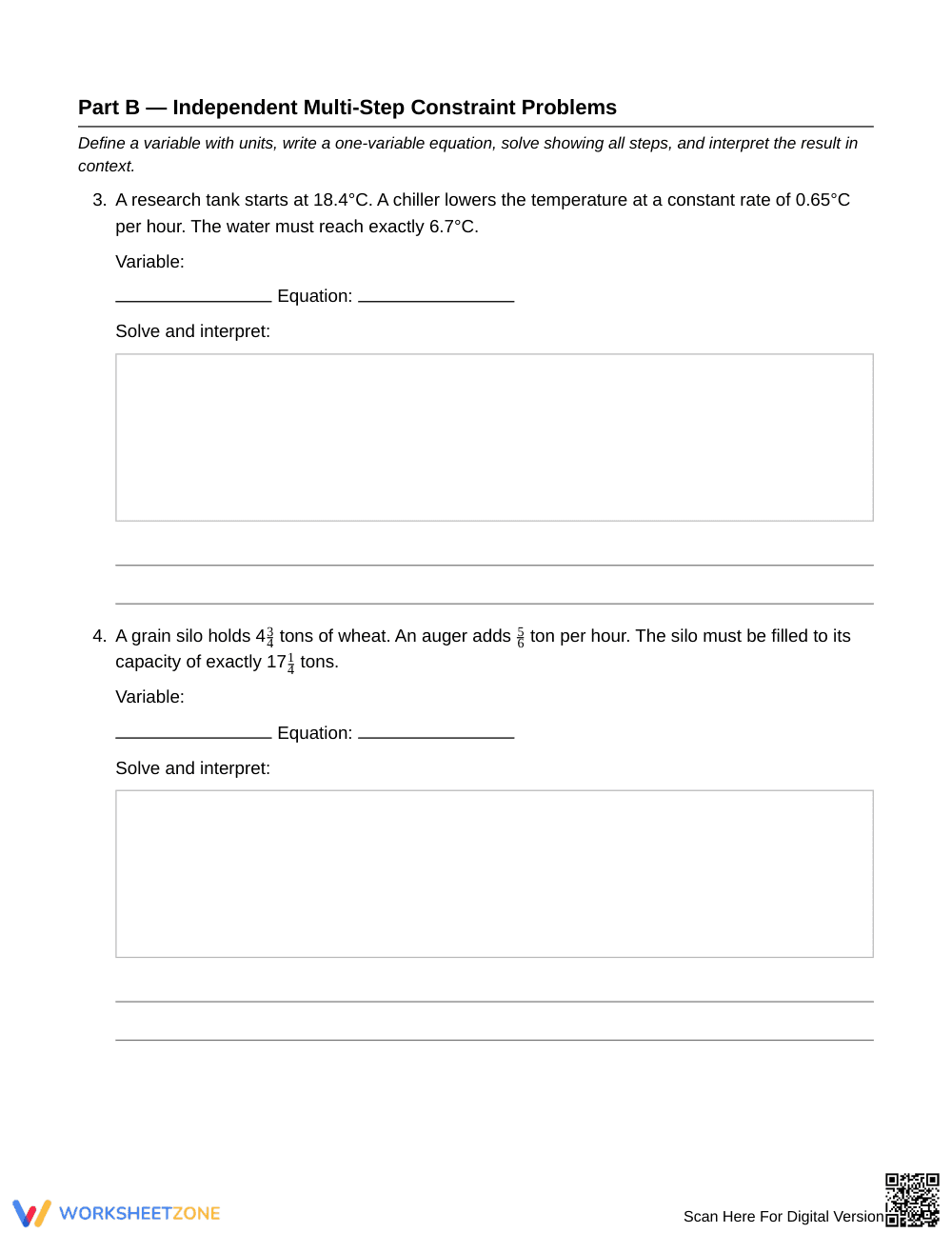
The worksheet spans five student-facing pages plus a complete answer key. A reference box at the top introduces two key equation forms—px + q = r and p(x + q) = r—with clear explanations. In Part A, students complete supported problems with pre-filled constraint tables that map words to algebra. Part B presents three multi-step problems where students define variables, write equations, and solve. Part C provides a justification task comparing algebraic and arithmetic solution paths.
Skill Progression
- Guided practice (Part A, 2 problems): Constraint tables break each scenario into unknown, rate, constant, and total, helping students build equations with structural support.
- Supported practice (Part B, 3 problems): Scaffolds are removed so students independently define variables with units, select the correct equation form, and solve multi-step contextual problems.
- Independent practice (Part C, 1 problem): Students evaluate two competing equation models, identify structural errors, solve algebraically, and verify their results arithmetically.
Standards Alignment
Every problem targets 7.EE.B.4 by requiring students to construct and solve equations from real-world contexts, while also reinforcing 7.NS.A.3 through operations with decimals, fractions, and negative rational numbers.
How to Use It
Assign Part A immediately following direct instruction to check conceptual understanding of rates and constants. Parts B and C work well for collaborative group work, independent practice, or homework. The full worksheet takes approximately 30 to 45 minutes to complete.
Who It's For
Designed for on-grade seventh-graders learning one-variable linear equations, this resource also provides targeted support for intervention groups and math stations needing structured problem-solving scaffolds.
Constructing equations from contextual constraints is the central demand of standard 7.EE.B.4, which asks students to represent real-world quantities with variables and form equations that model problem conditions. This five-page worksheet addresses that demand through six problems spanning decimals, fractions, and negative rational numbers. Research from Fisher & Frey (2014) confirms that a gradual-release instructional model—moving from guided to collaborative to independent tasks—produces stronger transfer to novel problem types than massed practice alone. The three-part architecture here replicates that progression: constraint tables scaffold initial attempts, middle problems remove supports, and the final justification task requires students to evaluate competing models and defend their reasoning. Teachers can use the included answer key for immediate scoring or as a self-check station, making the resource practical for both whole-class instruction and independent review aligned to 7.EE.B.4.


