


























Views
Downloads
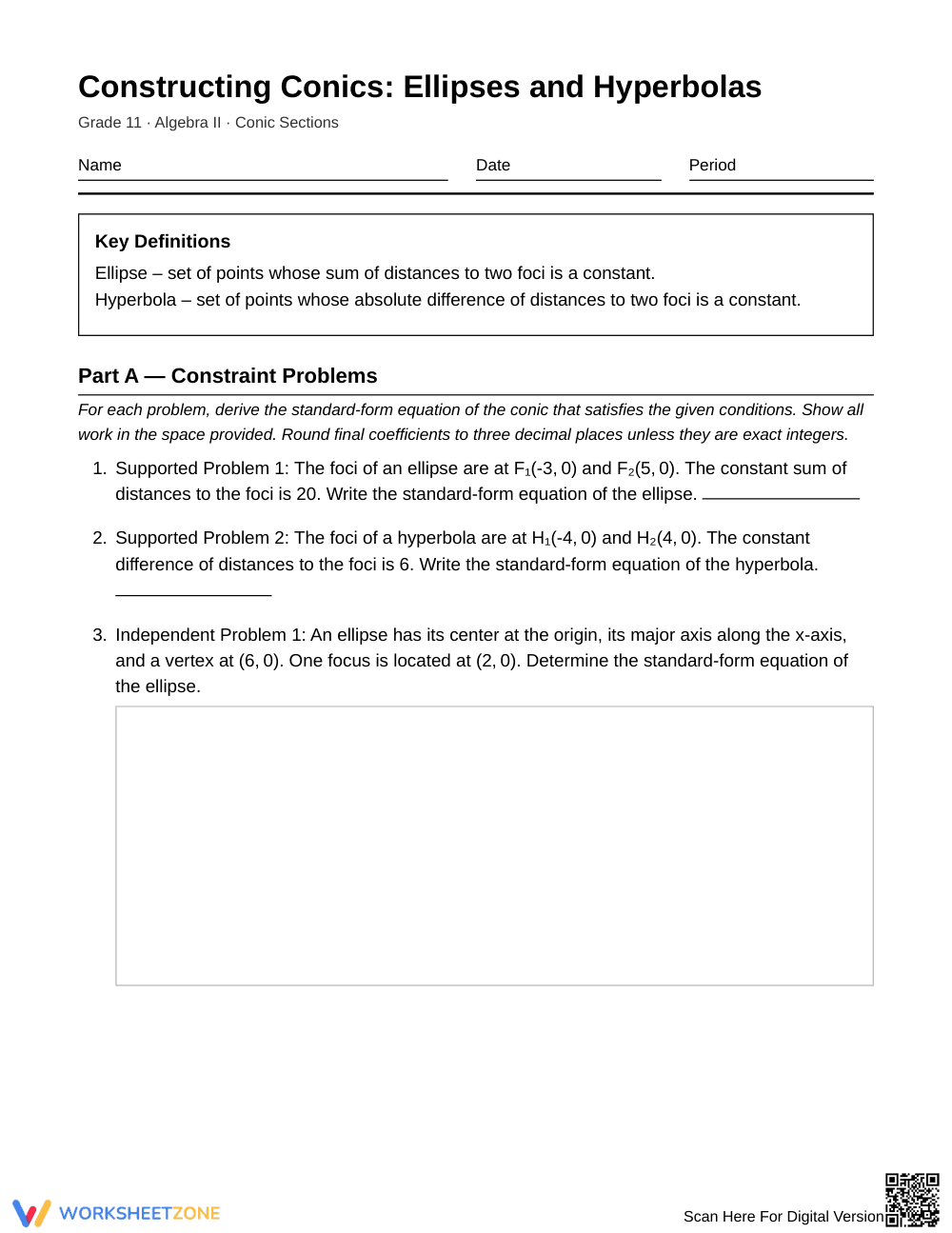



Complete Conic Construction Worksheet | Grade 11 Algebra II
Paste this activity's link or code into your existing LMS (Google Classroom, Canvas, Teams, Schoology, Moodle, etc.).
Students can open and work on the activity right away, with no student login required.
You'll still be able to track student progress and results from your teacher account.
This Algebra II worksheet equips Grade 11 students to construct conics and derive standard-form equations for ellipses and hyperbolas from basic focal features. Students transition from analyzing focal distance constants to synthesizing geometric definitions algebraically, ensuring complete conceptual mastery of conic sections before entering advanced precalculus courses.
At a Glance
- Grade: 11 · Subject: Algebra II
- Standard:
HSG-GPE.A.3— Derive equations of ellipses and hyperbolas given foci using constant distance relationships- Skill Focus: Construct a Conic from Specified Basic Features
- Format: 4 pages · 6 problems · Answer key included · PDF
- Best For: Core instruction and geometric modeling practice
- Time: 45–60 minutes
What's Inside
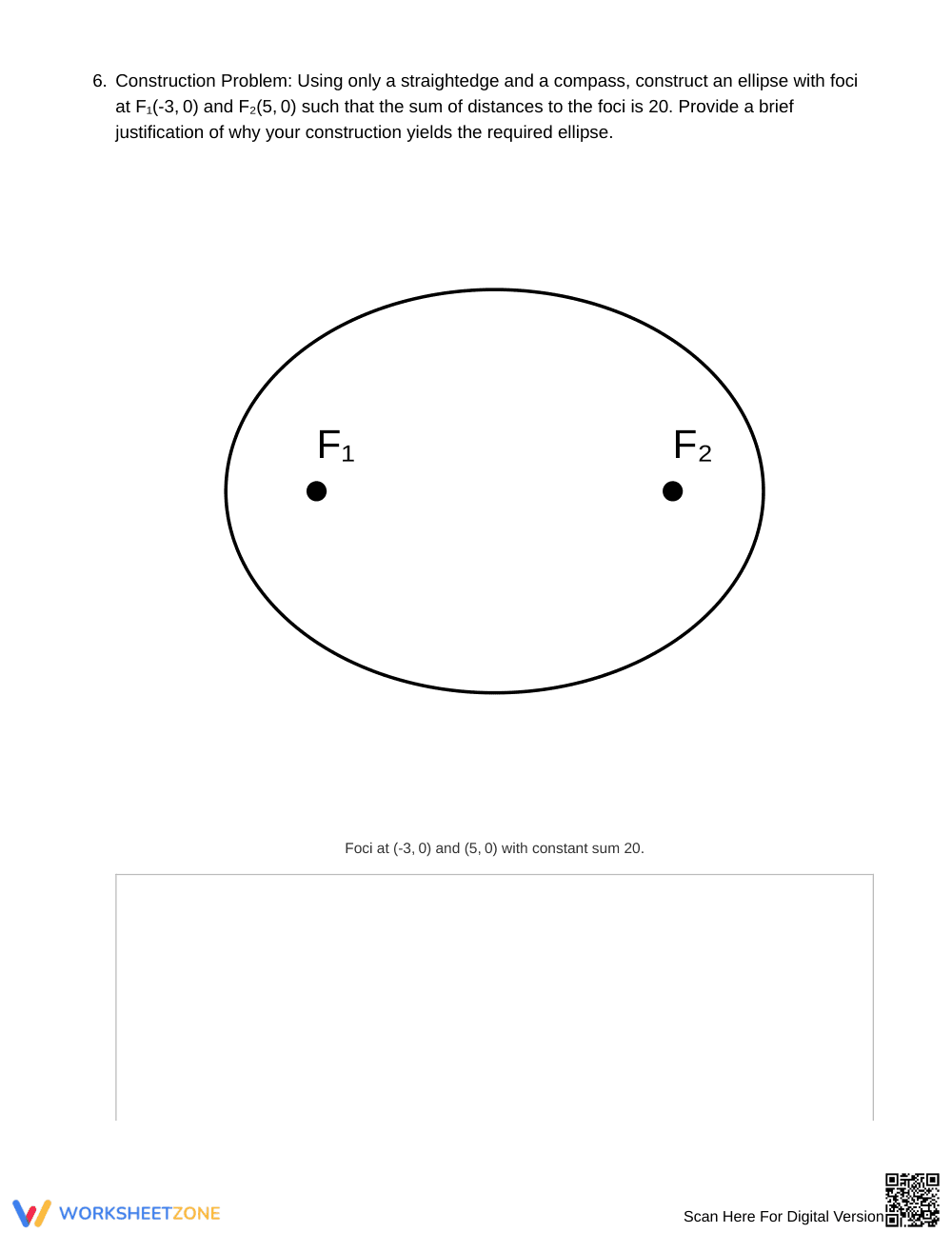
This 4-page printable document features 6 rigorous analytical and geometric problems paired with a complete 2-page answer key. The worksheet provides foundational definitions establishing ellipses and hyperbolas via locus distances, guiding students through coordinate derivations and a straightedge and compass geometric construction requiring written mathematical justification.
Skill Progression
- Guided practice: Two supported problems establish direct application of focal definitions, guiding students to use constant sums for ellipses and differences for hyperbolas with given focal coordinates.
- Supported practice: Three independent problems introduce non-origin centers, orientation shifts, vertices, and boundary points, prompting students to solve for geometric parameters algebraically.
- Independent practice: One authentic construction problem tasks students with constructing an ellipse using straightedge and compass tools, concluding with geometric justification.
This progression mirrors the gradual-release framework, transferring cognitive ownership from guided algebraic modeling to independent geometric synthesis.
Standards Alignment
This resource directly aligns to HSG-GPE.A.3: Derive the equations of ellipses and hyperbolas given the foci, using the fact that the sum or difference of distances to the foci is constant. It also supports HSG-CO.D.12 by incorporating formal geometric constructions with compass and straightedge. Both standard codes can be copied directly into lesson plans, IEP goals, or district curriculum mapping tools.
How to Use It
Use this worksheet after direct instruction on locus definitions or as a collaborative mid-unit task. During the compass construction, verify that students identify radii whose sum matches the major axis rather than measuring arbitrary chords. Plan for 45 to 60 minutes of instructional time.
Who It's For
Designed for Grade 11 Algebra II or Precalculus students, this resource benefits learners developing spatial and analytic fluency. For differentiation, provide coordinate grids and string loops to support visual learners before equation derivation. Pair this worksheet with dynamic graphing software demonstrations of focal distances.
Grounded in the instructional architecture described by Fisher & Frey (2014), this Algebra II resource implements purposeful gradual release to help Grade 11 students master standard HSG-GPE.A.3. Learners develop deep mathematical reasoning by moving systematically from definition-driven constraint equations to independent compass and straightedge geometric constructions. By requiring students to construct conics and derive standard-form equations from foci and constant distance properties, the worksheet bridges abstract locus definitions with rigorous coordinate geometry. Structured analytical tasks prevent superficial formula memorization, compelling students to calculate focal parameters, identify symmetry axes, and justify why their constructions preserve geometric invariance. Fisher & Frey (2014) demonstrate that structuring tasks through supported and independent tiers yields measurable gains in procedural accuracy and higher-order spatial synthesis. Consequently, this worksheet offers verifiable evidence of conceptual mastery across diverse high school secondary mathematics classrooms.


