




























Views
Downloads
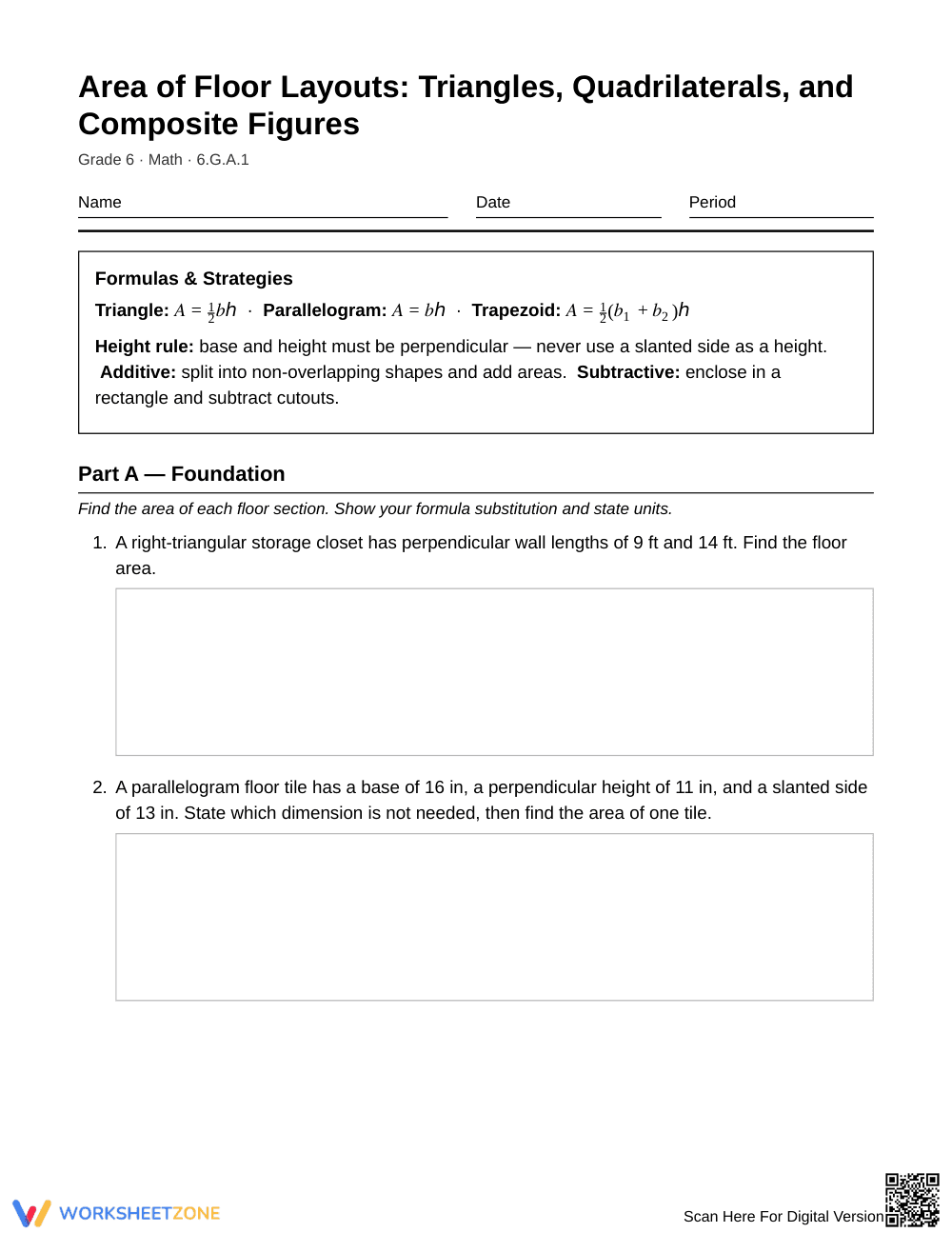
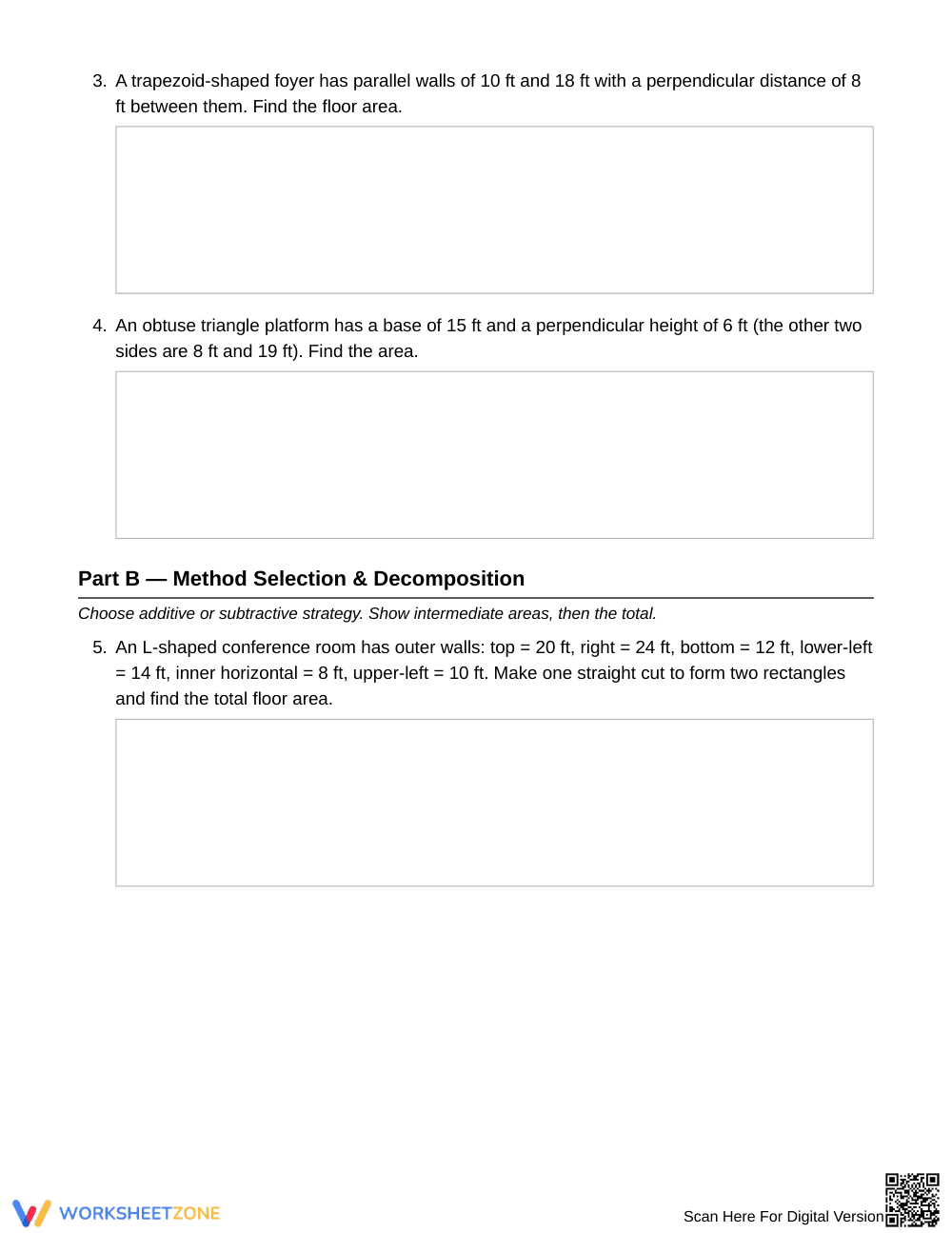
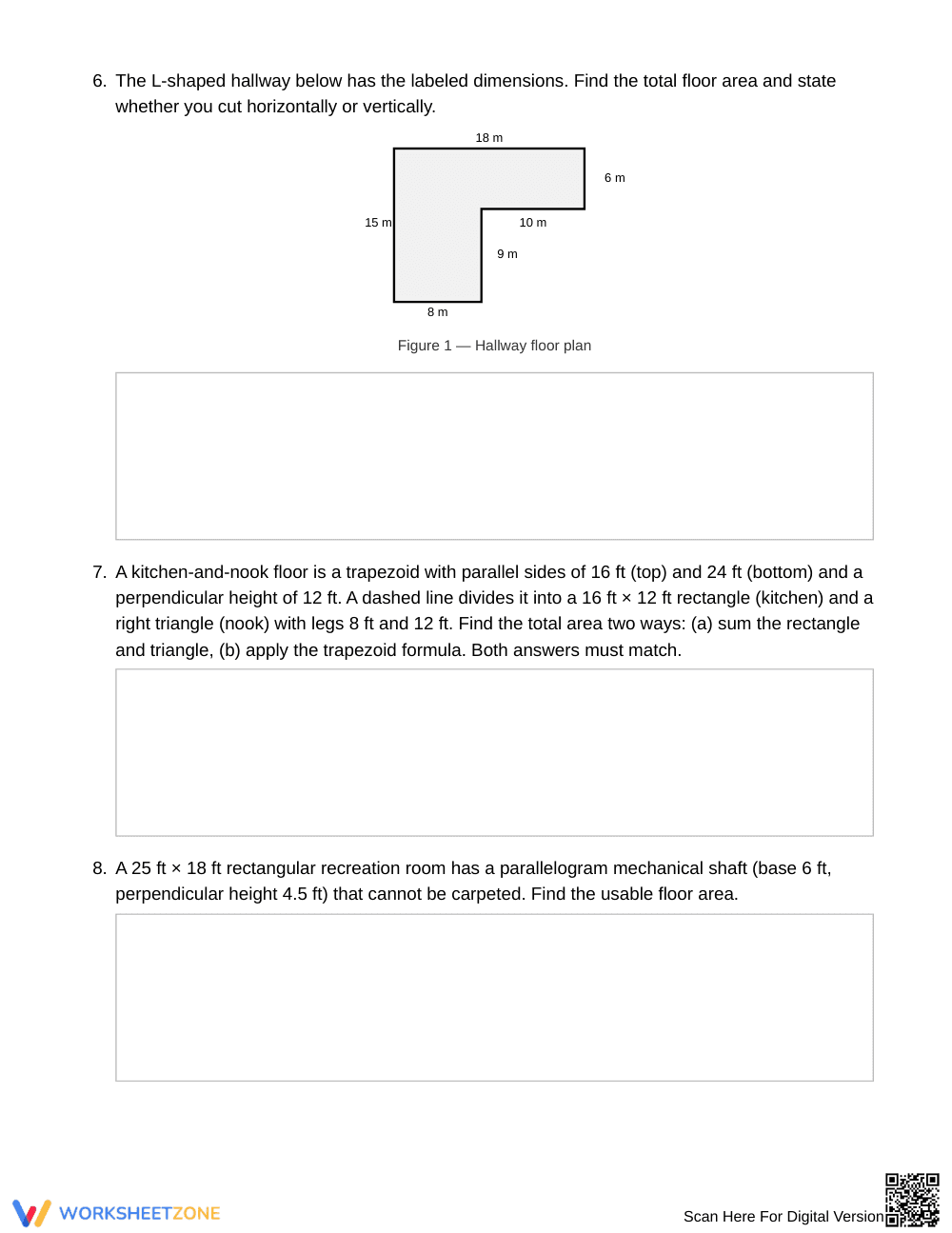


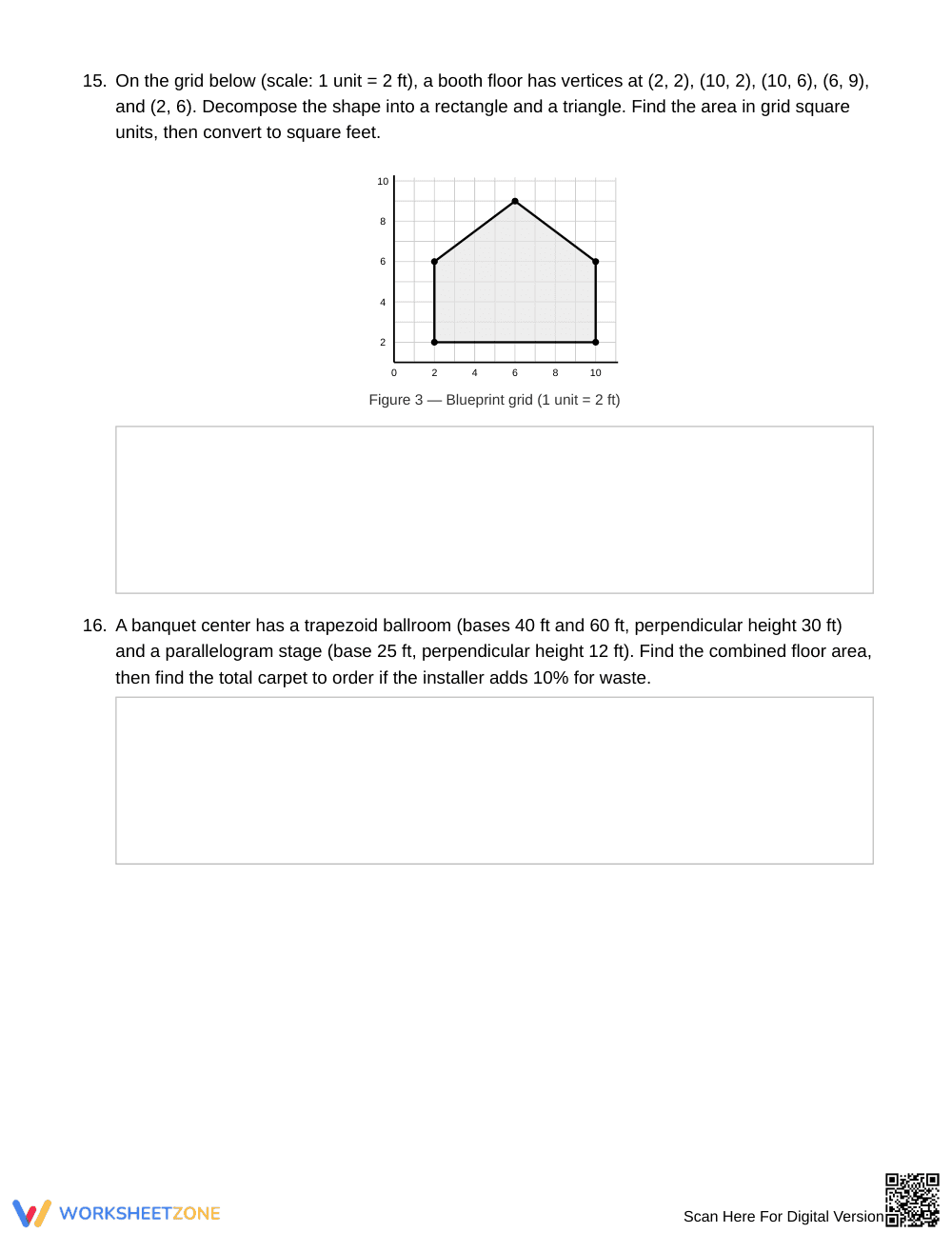

Complete Composite Figures Area Worksheet | Grade 6 Math

Paste this activity's link or code into your existing LMS (Google Classroom, Canvas, Teams, Schoology, Moodle, etc.).
Students can open and work on the activity right away, with no student login required.
You'll still be able to track student progress and results from your teacher account.
Build spatial reasoning and geometry fluency with this comprehensive area worksheet. Students calculate the area of right triangles, other triangles, special quadrilaterals, and composite figures by composing rectangles or decomposing shapes into familiar polygons. Designed for sixth-grade math learners, this resource reinforces geometric problem-solving through real-world layout contexts.
At a Glance
- Grade: 6 · Subject: Math
- Standard:
6.G.A.1— Find the area of triangles, special quadrilaterals, and polygons by composing or decomposing- Skill Focus: Mix Triangles, Quadrilaterals, and Composites
- Format: 6 pages · 16 problems · Answer key included · PDF
- Best For: Geometry skill practice and composite area mastery
- Time: 45–60 minutes
What's Inside
This 6-page math resource features a reference formula box, 16 multi-step word and diagram problems across three structured sections, and a complete 3-page answer key showing full calculations. Students interact with floor plan diagrams, coordinate grid blueprints, distractor dimensions, and strategy selection questions requiring additive and subtractive area decomposition.
Skill Progression
- Guided Practice (Part A — Foundation): 4 foundational items where students apply standard formulas to right triangles, parallelograms, trapezoids, and obtuse triangles while identifying perpendicular heights and filtering out distractor measurements.
- Supported Practice (Part B — Method Selection & Decomposition): 8 visual and contextual problems prompting learners to choose additive or subtractive methods for L-shaped, pentagonal, and U-shaped floor plans.
- Independent Practice (Part C — Integrated Applications): 4 rigorous multi-step applications requiring coordinate grid conversions, flooring cost estimations, and multi-zone commercial layouts.
This scaffolded structure follows the gradual-release model, transitioning students from single-formula computation to complex geometric synthesis.
Standards Alignment
This worksheet is aligned to primary standard 6.G.A.1: Find the area of right triangles, other triangles, special quadrilaterals, and polygons by composing into rectangles or decomposing into triangles and other shapes; apply these techniques in the context of solving real-world and mathematical problems. Supporting standard 6.EE.A.2 connects formula evaluation to algebraic substitution. Both standard codes can be copied directly into lesson plans, IEP goals, or district curriculum mapping tools.
How to Use It
Deploy this activity during the middle of a 2D geometry unit after introducing basic polygon formulas, or assign Part C as a collaborative small-group challenge. During guided practice, observe whether students identify perpendicular height rather than slant height on parallelograms and trapezoids. Expected completion time is 45 to 60 minutes.
Who It's For
This resource serves general education Grade 6 math classrooms, middle school remediation groups, and accelerated Grade 5 learners seeking extension. Pair this worksheet with an anchor chart detailing polygon area formulas and decomposition strategies for optimal student support.
According to research highlighted by Fisher & Frey (2014) on guided instruction, structured scaffolding across visual and contextual tasks significantly improves procedural fluency and conceptual understanding in middle school geometry. Standard 6.G.A.1 targets students' ability to find the area of triangles, special quadrilaterals, and composite polygons by composing rectangles or decomposing regions into familiar shapes. This 16-task worksheet operationalizes these principles through a clear three-stage instructional sequence. Students first isolate relevant perpendicular dimensions in basic polygons, select appropriate additive or subtractive strategies on composite floor plans, and ultimately solve integrated multi-step problems involving unit rates and coordinate grids. By embedding architectural floor plans, distractor dimensions, and reference formulas, this instructional tool bridges abstract area formulas and concrete geometric decomposition, providing math educators with an effective resource for formative assessment and targeted standards-based intervention.


