


























Views
Downloads



Complete Choice of Ratio Worksheet | Grade 10 Geometry
Paste this activity's link or code into your existing LMS (Google Classroom, Canvas, Teams, Schoology, Moodle, etc.).
Students can open and work on the activity right away, with no student login required.
You'll still be able to track student progress and results from your teacher account.
This high school geometry worksheet strengthens students' conceptual understanding of right triangle trigonometry by requiring them to justify ratio selections rather than merely calculating values. Across 8 rigorous tasks, learners evaluate mathematical arguments, explain ratio efficiency, and identify domain boundaries using geometric similarity principles.
At a Glance
- Grade: 10 · Subject: Geometry
- Standard:
HSG-SRT.C.6— Define trigonometric ratios using side ratios in similar right triangles- Skill Focus: Justify the Choice of Ratio
- Format: 4 pages · 8 problems · Answer key included · PDF
- Best For: Conceptual practice after ratio definitions
- Time: 40–50 minutes
What's Inside
This 4-page student activity contains 8 multi-part analytical problems divided into three structured sections, accompanied by a complete 2-page answer key showing step-by-step mathematical reasoning. Students encounter a foundational reference box with core trigonometric definitions and similarity properties, geometric triangle diagrams, applied surveyor scenarios, and claim-evaluation prompts that require formal written explanations alongside numerical computations.
Skill Progression
- Guided practice (Part A · 2 problems): Students critique student claims regarding scale factors and complementary angle relationships, using AA similarity and sine-cosine identities to validate or refute reasoning.
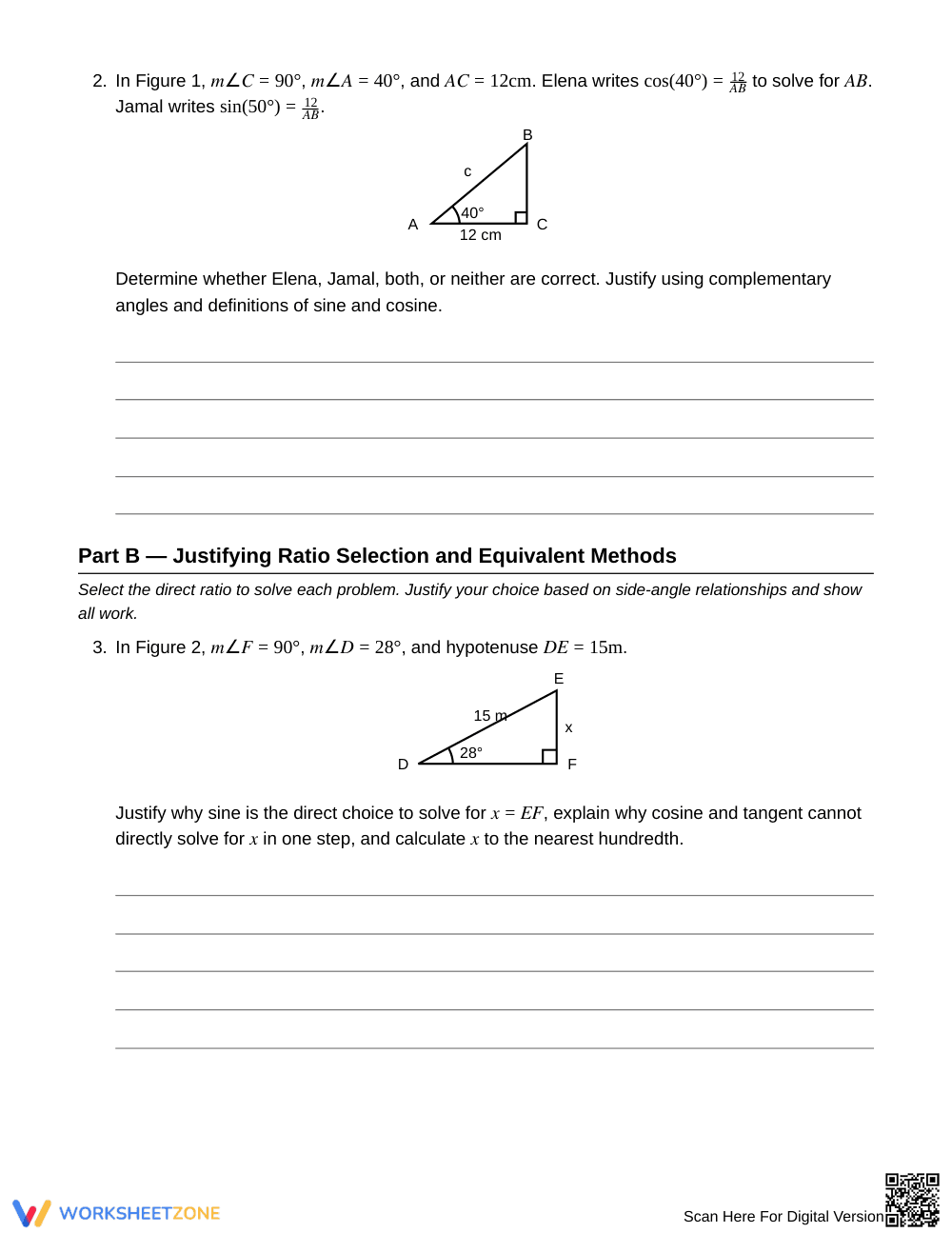
- Supported practice (Part B · 4 problems): Learners justify why sine, cosine, or tangent represents the direct method for solving unknown dimensions, evaluate alternative equations, and calculate exact and rounded measures.
- Independent practice (Part C · 2 problems): Students analyze geometric validity conditions for non-right triangles and construct numerical counterexamples to disprove common algebraic misconceptions.
This sequence follows a gradual-release instructional model, moving from error analysis to direct selection and finally to theoretical domain analysis.
Standards AlignmentHSG-SRT.C.6: Understand that by similarity, side ratios in right triangles are properties of the angles in the triangle, leading to definitions of trigonometric ratios for acute angles. Both standard codes can be copied directly into lesson plans, IEP goals, or district curriculum mapping tools.
How to Use It
Deploy this resource during mid-unit instruction after introducing sine, cosine, and tangent ratios to shift student focus from formula memorization to geometric reasoning. During classwork, check whether students justify ratio choices based on given and target side placements relative to the reference angle. Plan for 40 to 50 minutes of individual or paired problem-solving.
Who It's For
This worksheet is designed for Grade 10 Geometry students mastering right triangle trigonometry, honors students analyzing ratio invariance, and learners preparing for advanced trigonometry. Pair this resource with dynamic geometry software demonstrations illustrating triangle dilation invariance.
According to Fisher & Frey (2014), structured opportunities for students to evaluate mathematical claims and justify procedural steps deepen conceptual retention far beyond repetitive calculation. This worksheet operationalizes standard HSG-SRT.C.6 by grounding right triangle trigonometric ratios in geometric similarity rather than rote algorithmic application. Across 8 rigorous tasks, Grade 10 students actively construct proofs, analyze non-right triangle domain limitations, and explain why trigonometric ratios remain constant under scale dilation factors. By engaging in both error analysis and algebraic counterexamples, learners build robust mathematical communication skills essential for advanced precalculus coursework. The included 2-page teacher answer key provides full written justifications and intermediate steps, giving educators a reliable benchmark for evaluating geometric argumentation and formative student mastery.


