




























Views
Downloads


Complete Capacity Constraint Worksheet | Grade 6 Math

Paste this activity's link or code into your existing LMS (Google Classroom, Canvas, Teams, Schoology, Moodle, etc.).
Students can open and work on the activity right away, with no student login required.
You'll still be able to track student progress and results from your teacher account.
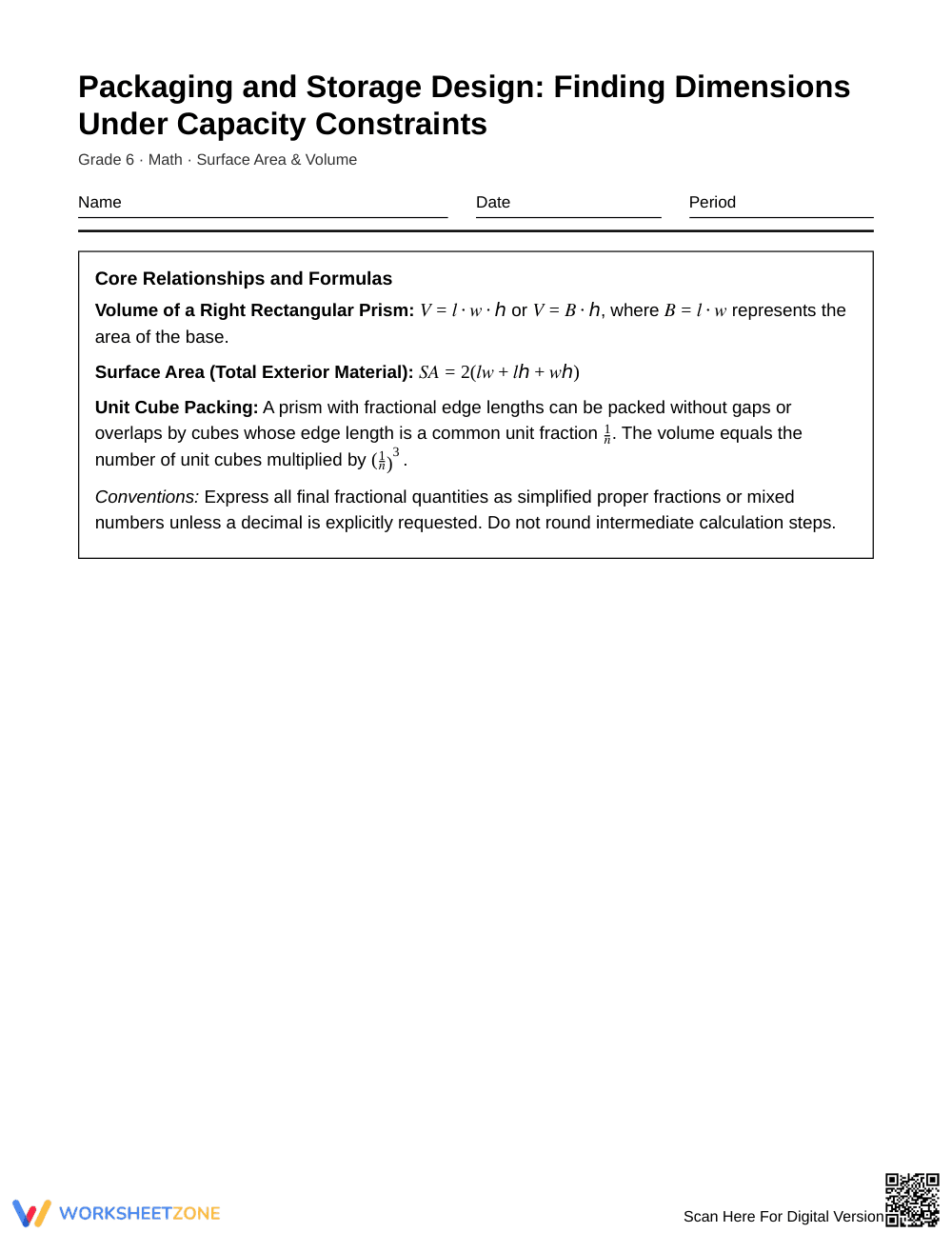
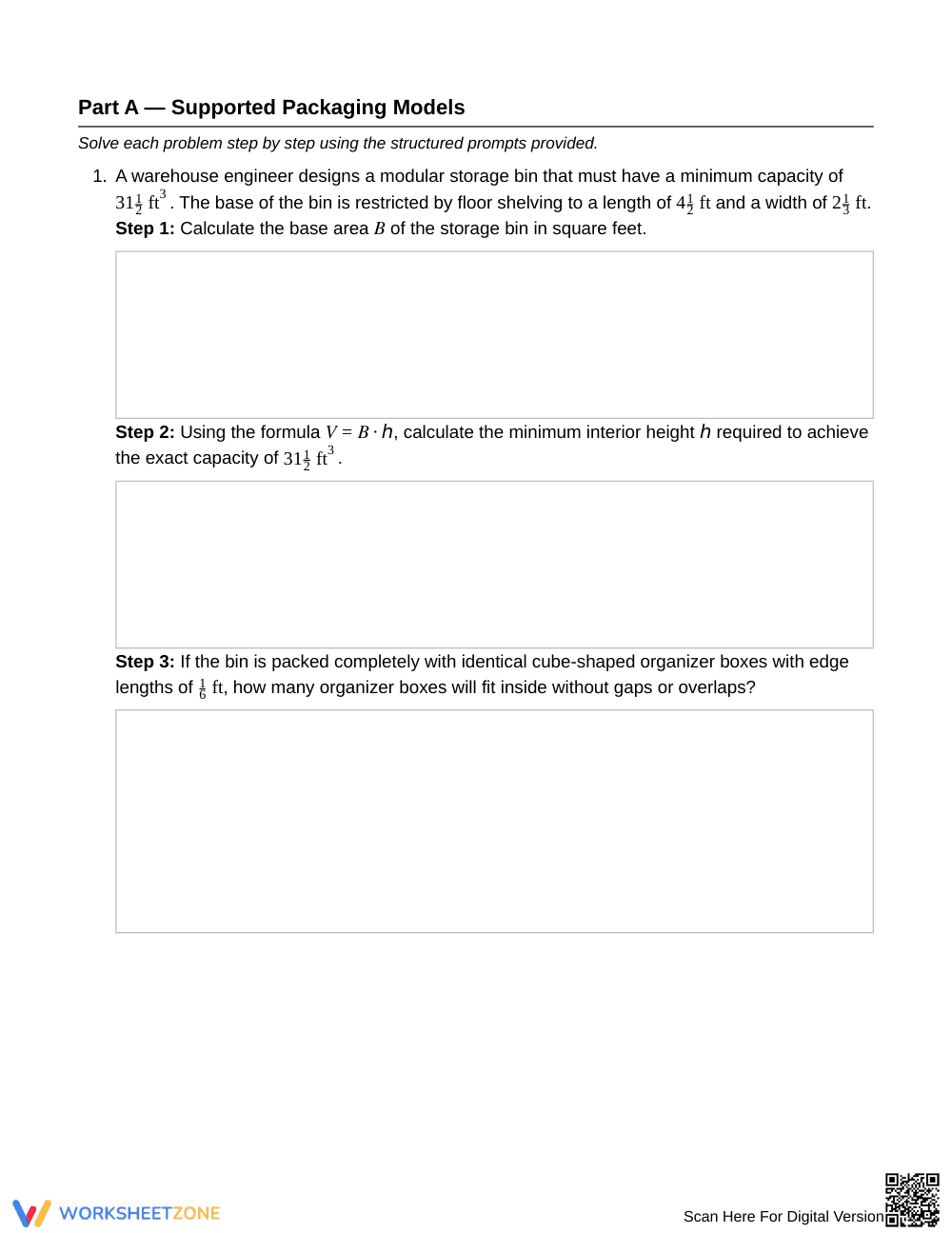
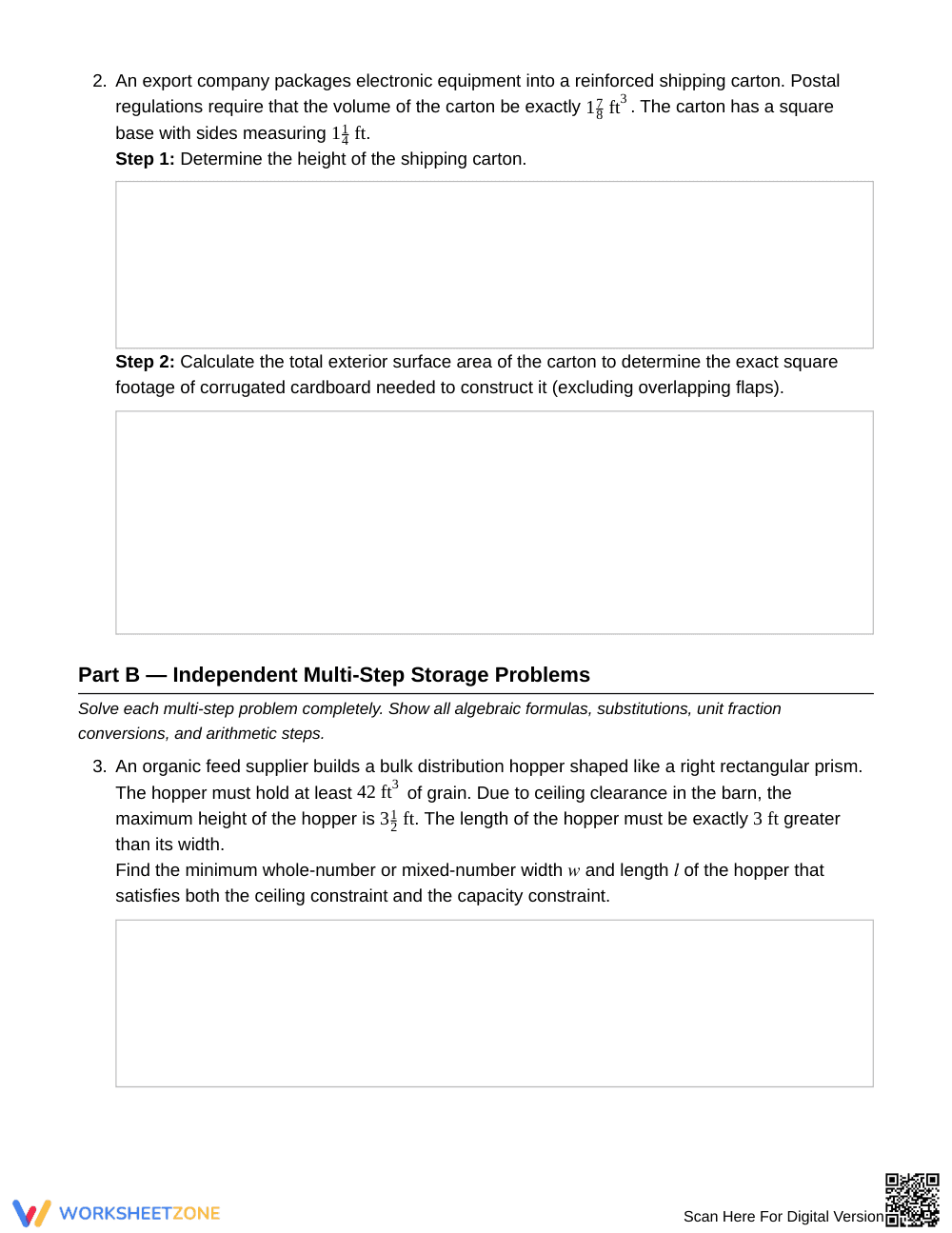
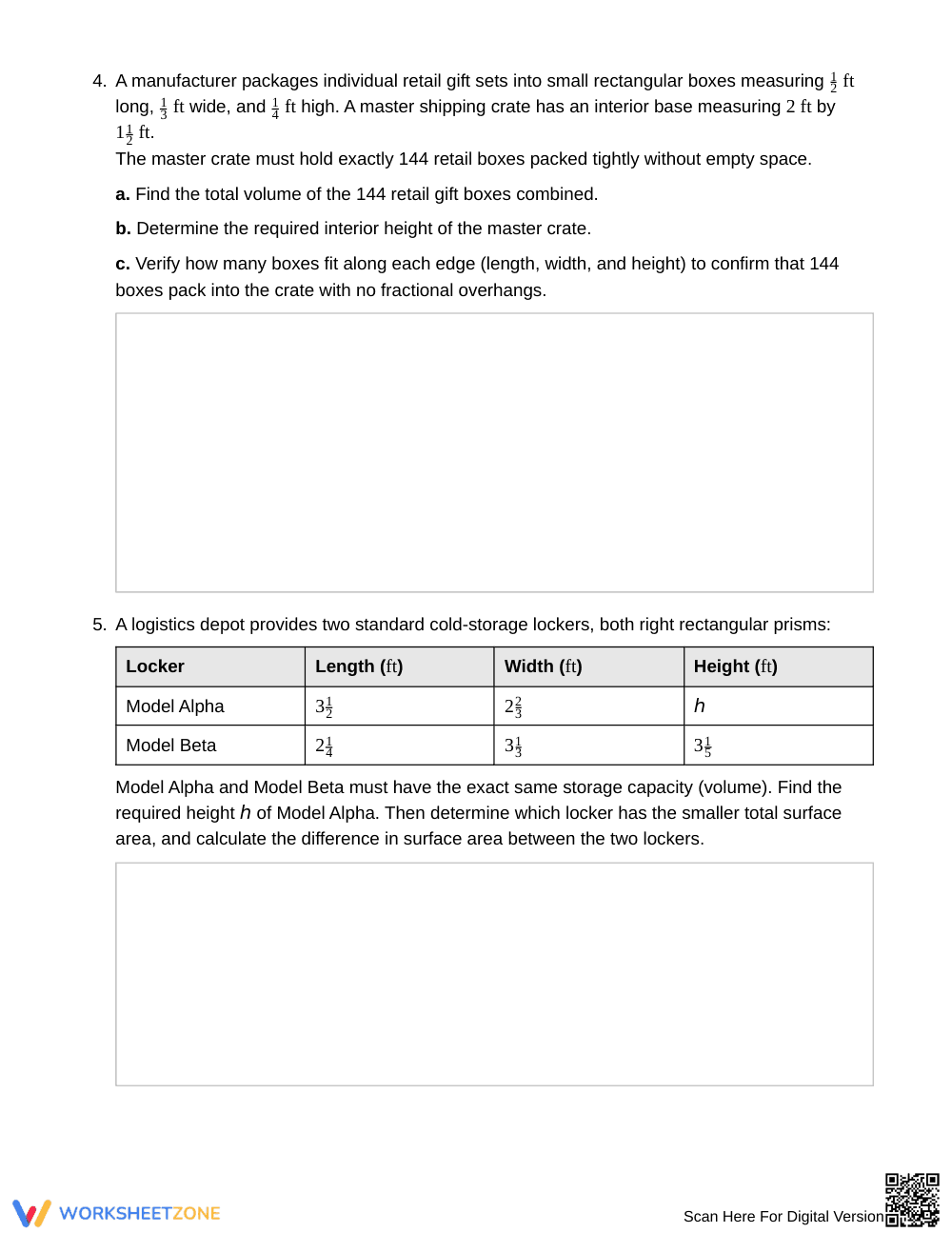
This Grade 6 math worksheet gives students structured practice finding unknown dimensions of right rectangular prisms when volume or packing constraints are fixed. Across six problems in packaging contexts, students apply V = l · w · h and SA = 2(lw + lh + wh) with fractional edge lengths, building fluency with 6.G.A.2.
At a Glance
- Grade: 6 · Subject: Math
- Standard:
6.G.A.2— Volume of prisms with fractional edge lengths- Skill Focus: Find dimensions under a capacity constraint
- Format: 5 pages · 6 problems · Answer key included · PDF
- Time: 35–50 minutes
What's Inside
The worksheet opens with a reference box listing formulas and unit-cube packing rules. Six problems span three sections: Part A offers two scaffolded problems; Part B presents three multi-step scenarios requiring algebraic solutions; Part C provides an open-ended design challenge. A complete four-page answer key includes step-by-step solutions.
Skill Progression
- Guided practice (Part A, Problems 1–2): Scaffolded prompts guide students through computing base areas, solving for unknown heights, and finding surface area with fractional edges.
- Supported practice (Part B, Problems 3–5): Students independently set up multi-step equations to determine missing dimensions and verify unit-cube packing without overhangs.
- Independent practice (Part C, Problem 6): An optimization challenge requires students to design competing prisms meeting an 18 ft³ volume constraint and evaluate surface area.
How to Use It
Assign Part A after initial instruction on fractional volume for a quick formative check. Use Parts B and C the next day for independent practice, paired work, or a performance task. Expected time is 35–50 minutes.
Who It's For
This resource supports sixth graders learning geometry standards. Guided steps help struggling learners, while the open-ended design challenge extends advanced students.
This five-page, six-problem worksheet aligned to 6.G.A.2 targets a skill that national data show many sixth graders find difficult: computing volume when edge lengths are fractions and using that volume to solve for an unknown dimension. According to NAEP, only about 38 percent of eighth graders demonstrate solid proficiency with multi-step geometric measurement tasks, underscoring the need for structured practice well before middle-school exit assessments. Research by Fisher & Frey (2014) confirms that a gradual-release instructional model—moving from guided to independent tasks within one assignment—significantly improves transfer on procedural-conceptual skills like these. The worksheet embeds real-world packaging and storage contexts across all six problems, requiring students to find unknown heights, verify unit-cube packing, and compare surface areas under capacity constraints. A complete four-page answer key supports self-checking or teacher scoring. Print and assign to strengthen fractional volume reasoning in any Grade 6 math classroom.


