




























Views
Downloads


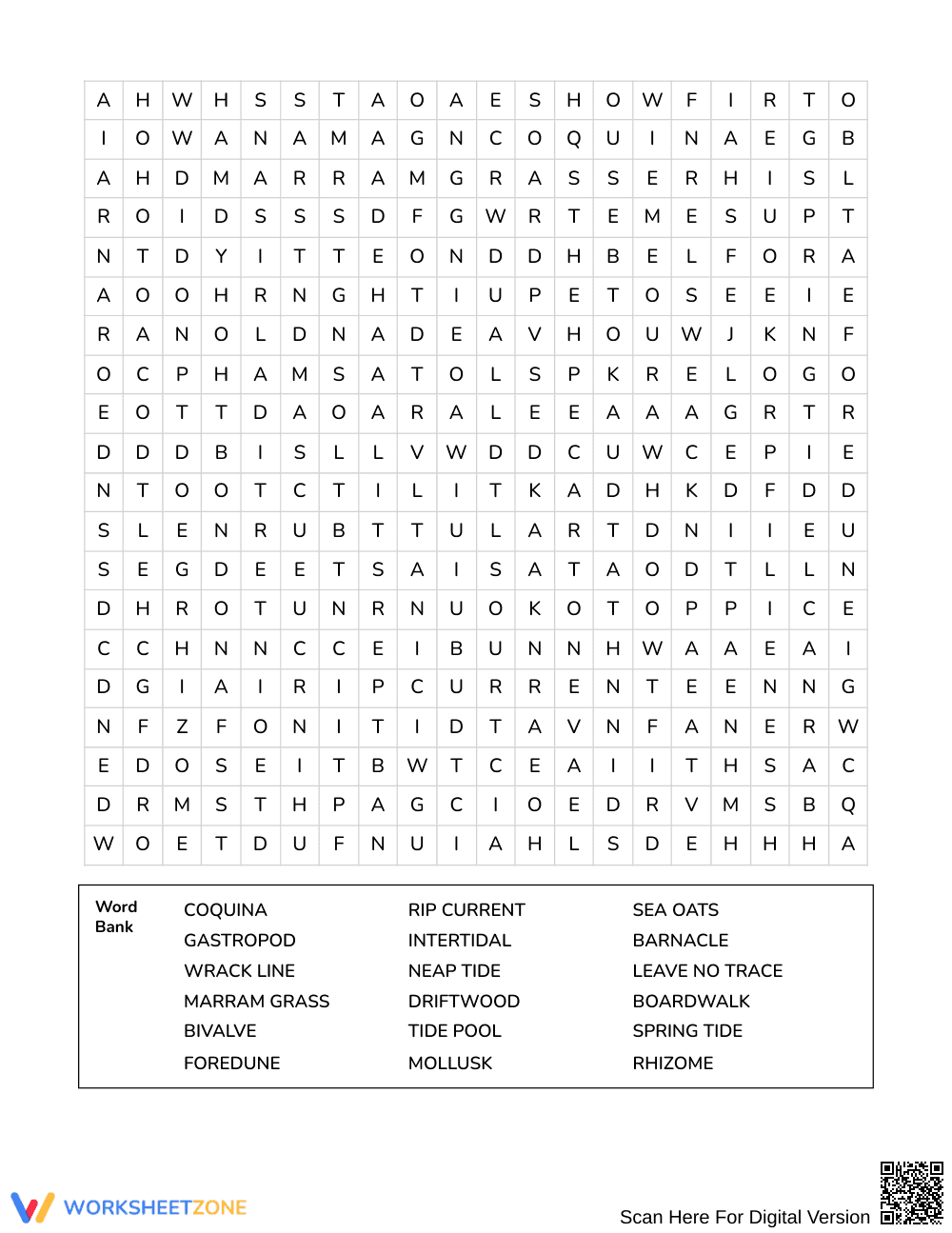

Complete Beach Habitats Word Search | Grades 7–8 Science

Paste this activity's link or code into your existing LMS (Google Classroom, Canvas, Teams, Schoology, Moodle, etc.).
Students can open and work on the activity right away, with no student login required.
You'll still be able to track student progress and results from your teacher account.
This Grades 7–8 coastal science word search reinforces foundational oceanography and shoreline ecology vocabulary through active recall. Students read 18 precise scientific clues to identify key terms, then locate them across a dense letter grid. It strengthens understanding of tide cycles, dune structures, marine invertebrates, and coastal conservation principles in an engaging format.
At a Glance
- Grade: Grades 7–8 · Subject: Middle School Science
- Standard: Not standards-assessed — vocabulary enrichment and review
- Skill Focus: Coastal habitats, tidal dynamics, shore organisms, and visitor ethics
- Format: 3 student pages · 18 hidden words · Full answer key included · Printable PDF
- Best For: Unit wrap-up, bell ringer review, or substitute plans
- Time: 20–35 minutes total completion time
What's Inside
The 3-page printable activity delivers a comprehensive vocabulary challenge containing 18 hidden coastal science terms. The document features an organized clue list with rigorous definitions for concepts like spring tides, foredunes, and bivalves alongside a shuffled word bank. A comprehensive answer key highlights exact word placements on the grid for rapid grading.
Puzzle Mechanics and Structure
Students search across a substantial 20 by 20 grid to locate all 18 vocabulary words. Hidden terms run in eight distinct directions: north, northeast, east, southeast, south, southwest, west, and northwest. Students read descriptive context clues or consult the shuffled word bank to solve each term before scanning the letter array.
Standards Alignment
This learning activity provides standalone vocabulary enrichment and cumulative review. It is not aligned to a formal state or national content standard, functioning instead to reinforce domain-specific environmental science literacy, ecological concepts, and responsible conservation awareness across general middle school science units.
How to Use It
Deploy this word search during an oceanography unit as a cumulative vocabulary review after direct instruction on tidal systems and shore dynamics. Alternatively, assign it as a meaningful, low-stress independent activity during emergency substitute days. As students work, circulate to observe whether they solve clues conceptually from memory or rely solely on letter scanning. Expect 20 to 30 minutes for completion.
Who It's For
This resource is designed for Grades 7–8 science students expanding their life science and earth science vocabularies. It supports visual learners through spatial pattern recognition and benefits striving readers by pairing scientific definitions with word forms. Pair this activity with an informational reading passage on barrier islands or tidal ecology.
Integrating structured vocabulary enrichment into secondary science instruction strengthens disciplinary literacy and enhances content comprehension. According to Fisher & Frey (2014), intentional exposure to domain-specific terminology through varied contextual tasks helps adolescent learners internalize complex academic language. This coastal science word search supports vocabulary retention by connecting 18 technical definitions—spanning marine biology, geological dune formations, lunar tidal cycles, and human stewardship—directly to active word retrieval. By requiring students to interpret scientific clues before locating terms hidden across an eight-directional grid, the activity reinforces orthographic recognition and conceptual memory. Rather than memorizing isolated glossary terms, middle school learners engage in meaningful contextual association. The accompanying answer key facilitates immediate corrective feedback, cementing student understanding of fragile shoreline ecosystems, intertidal zones, and conservation ethics. Consequently, this supplementary enrichment serves as an effective, low-stakes tool for sustaining engagement and bolstering terminology mastery within comprehensive middle school earth and life science curricula.


