




























Views
Downloads

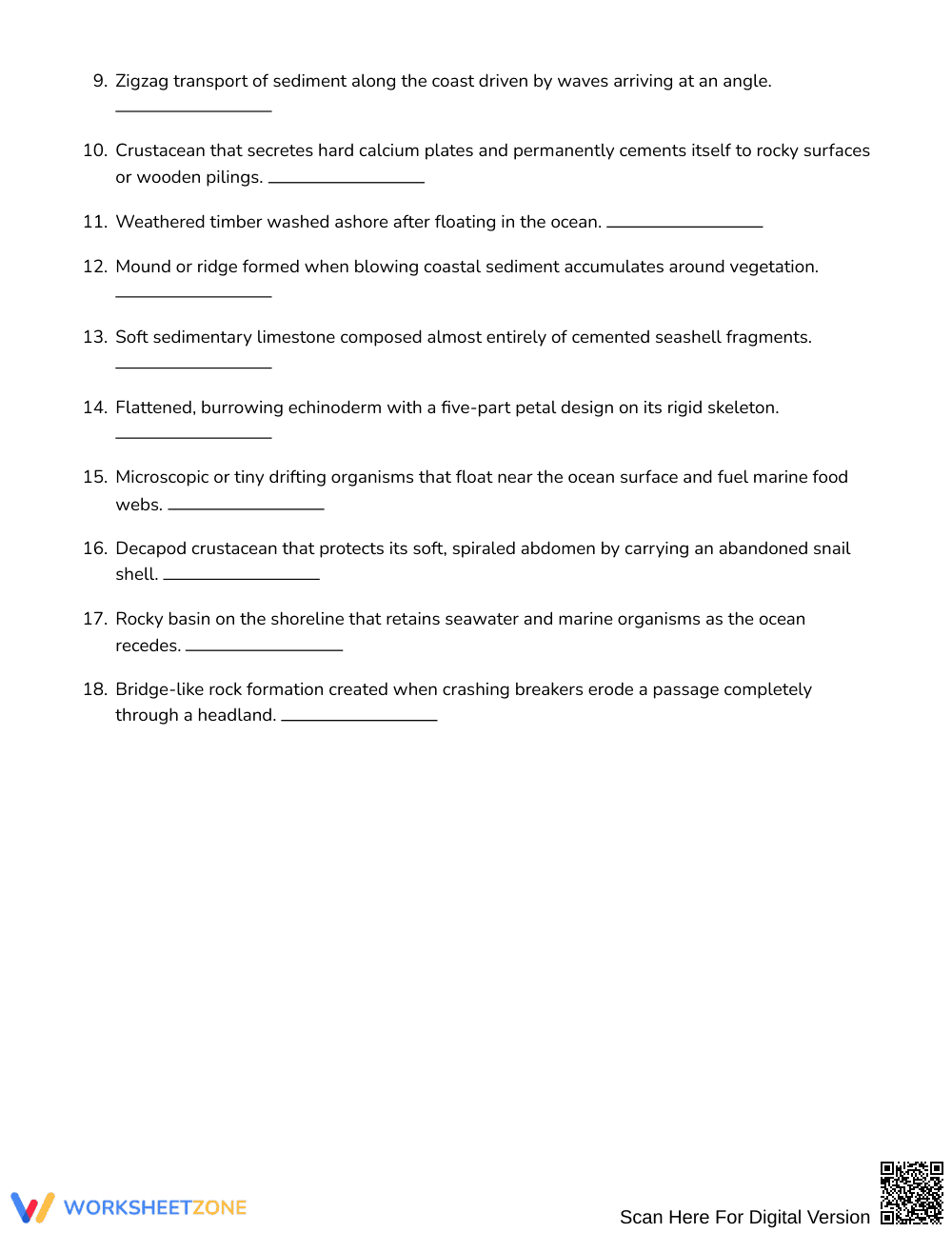


Complete Beach Features Word Search | Grades 7–8 Science

Paste this activity's link or code into your existing LMS (Google Classroom, Canvas, Teams, Schoology, Moodle, etc.).
Students can open and work on the activity right away, with no student login required.
You'll still be able to track student progress and results from your teacher account.
Help middle school science students reinforce their understanding of coastal ecosystems with this engaging clue-based word search. Learners define and identify 18 biotic and abiotic shoreline features by analyzing descriptive science clues before locating each term in the puzzle grid, deepening their retention of essential coastal ecology and earth science concepts.
At a Glance
- Grade: Grades 7–8 · Subject: Science
- Standard: Not standards-assessed — vocabulary enrichment
- Skill Focus: Living and nonliving beach features
- Format: 3 pages · 18 words · Answer key included · PDF
- Best For: Cumulative vocabulary review and unit reinforcement
- Time: 20–35 minutes
What's Inside
This 3-page science resource features 18 hidden vocabulary terms across a shoreline theme. Rather than scanning an ordinary word list, students read science clues describing marine organisms and physical coastal landforms to confirm each target word. A shuffled word bank provides spelling support, while the 4-page answer key provides visual grid solutions highlighting every hidden term for rapid grading.
Puzzle Structure
The puzzle features a 20-by-20 grid designed to challenge pattern recognition and focus. Words run in eight directions: north, northeast, east, southeast, south, southwest, west, and northwest. By requiring students to connect rigorous definitions—such as coquina, rip currents, and ghost crabs—with spatial searching, the activity reinforces foundational academic vocabulary across life and earth science.
Standards Alignment
This word search serves as a vocabulary enrichment resource and is not aligned to a formal state standard. It provides supplementary practice to strengthen content-area literacy within middle school life science and earth science units exploring coastal environments, living organisms, and nonliving landforms.
How to Use It
Deploy this activity after direct instruction on biotic and abiotic factors to consolidate student mastery. First, use it as a collaborative review where partners read clues aloud and determine whether each feature is living or nonliving before searching the grid. Second, utilize it as an independent practice station or sub plan. Formative assessment tip: Check whether students correctly identify terms from the clue definitions prior to circling them. Expected completion time is 20 to 35 minutes.
Who It's For
This resource is tailored for Grades 7–8 science students studying ecology, marine biomes, and coastal processes. For students needing support, pair the activity with an illustrated anchor chart showing coastal landforms. Pair this puzzle with a hands-on sand sorting lab or coastal food web diagram for a complete learning sequence.
According to Fisher & Frey (2014), intentional content-area vocabulary acquisition requires students to interact with domain-specific terms across varied instructional contexts, including identifying defining features and recognizing specialized terminology in novel formats. This vocabulary enrichment activity reinforces 18 essential living and nonliving beach features for Grades 7–8 science learners without relying on isolated, rote memorization drills. By challenging students to connect descriptive clues detailing biological adaptations, tidal dynamics, and coastal depositional processes with an 8-directional search puzzle, students consolidate deep conceptual knowledge of marine shorelines. Although this activity is not standards-assessed, integrating structured vocabulary retrieval into middle school science instruction significantly bolsters reading comprehension of informational scientific texts, supports expressive scientific discourse, and enhances long-term retention of core ecological principles across diverse student populations. Such active vocabulary engagement prepares middle schoolers to analyze complex marine systems effectively during subsequent laboratory investigations and assessments.


