


























Views
Downloads


Complete Acid Neutralization Worksheet | Grade 11 Chemistry
Paste this activity's link or code into your existing LMS (Google Classroom, Canvas, Teams, Schoology, Moodle, etc.).
Students can open and work on the activity right away, with no student login required.
You'll still be able to track student progress and results from your teacher account.
This advanced chemistry worksheet equips Grade 11 learners to calculate analytical concentrations from constrained neutralization titrations. Students evaluate multi-stage stoichiometric data, distinguish acid strength from concentration, and invalidate incorrect chemical models. Through rigorous volumetric analysis, high school chemists master quantitative neutralization reasoning across six complex laboratory scenarios.
At a Glance
- Grade: 11 · Subject: Chemistry
- Standard: Apply stoichiometric mole ratios and equilibrium constraints to calculate unknown solution concentrations
- Skill Focus: Infer Initial Concentration from a Constrained Neutralization
- Format: 4 pages · 6 complex problems · Complete answer key included · PDF
- Best For: Advanced quantitative titration problem-solving and rigorous exam preparation
- Time: 45–60 minutes
What's Inside
Across four student-facing pages, this resource presents six multi-part quantitative problems accompanied by an analytical reference guide specifying dissociation constants, water equilibrium constraints, and the five-percent ionization threshold. Students engage with strong diprotic neutralizations, back-titration protocols, weak monoprotic equilibria, and multiprotic inflection analysis. The packet concludes with a two-page, fully worked answer key detailing complete mole balances, ICE tables, and mathematical justifications.
Skill Progression
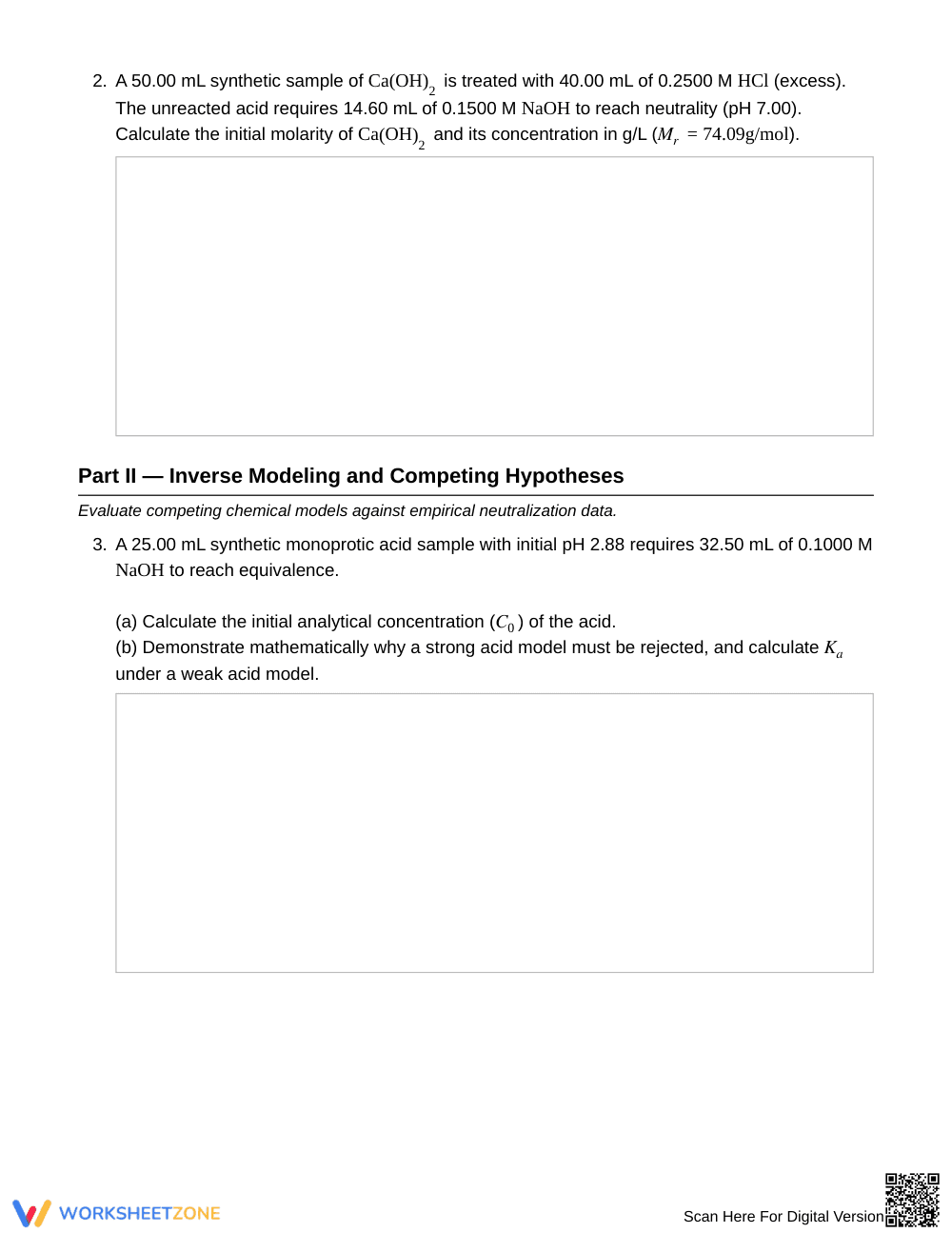
- Guided Practice (Part I, Tasks 1–2): Students apply stoichiometric algorithms to find sulfuric acid concentrations with secondary dissociation adjustments and analyze calcium hydroxide back-titrations.
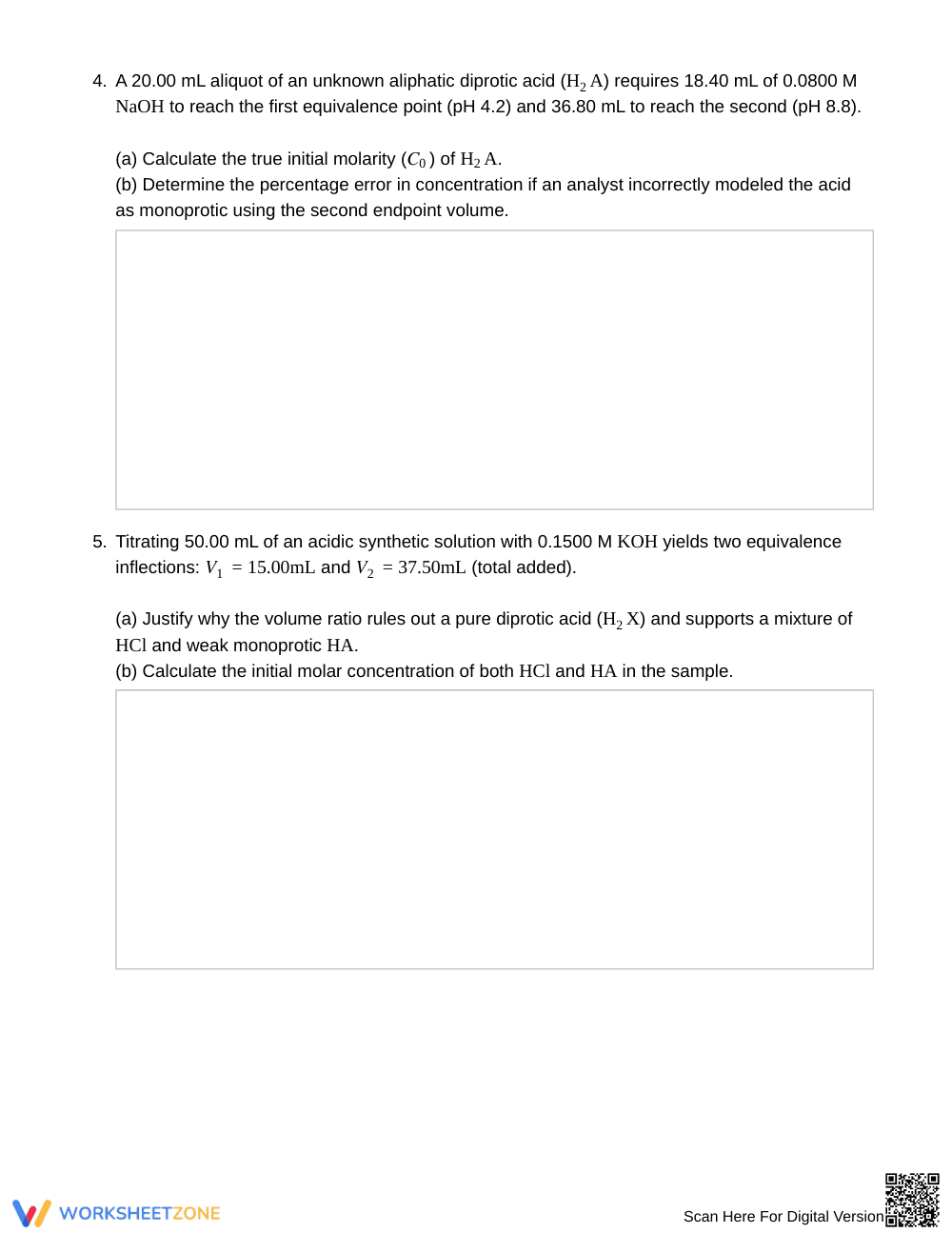
- Supported Practice (Part II, Tasks 3–5): Learners evaluate inverse models, determining ionization constants, calculating error across diprotic equivalence points, and distinguishing polyprotic acids from mixed-acid solutions.
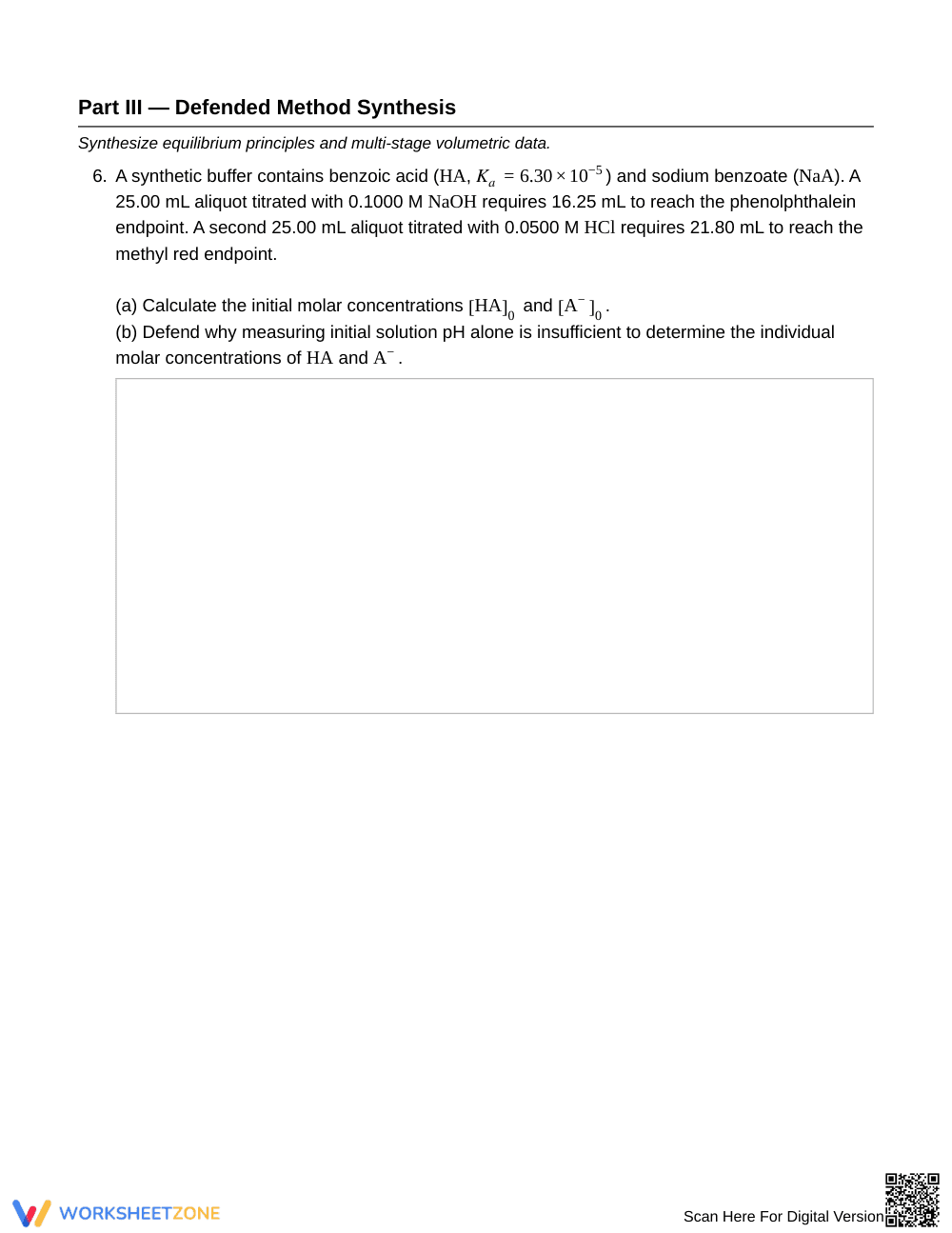
- Independent Practice (Part III, Task 6): Students synthesize multi-stage buffer titrations independently, determining conjugate pair molarities and defending theoretical limitations of single-point pH measurements.
This progression reflects the gradual release of responsibility model, shifting students systematically from guided balancing to unassisted conceptual and analytical defense.
Standards Alignment
This resource aligns with high school physical science standards for chemical reactions and solution stoichiometry. Specifically, students formulate balanced chemical equations, determine quantitative mole relationships, and calculate solution concentrations from empirical titration data involving strong and weak electrolytes. Both standard concepts can be copied directly into lesson plans, IEP goals, or district curriculum mapping tools.
How to Use It
Deploy this packet after direct instruction on acid-base titrations and buffer equilibria. For collaborative problem-solving, have student pairs complete Part II to debate competing models and verify why strong acid assumptions fail. During independent work, observe whether students check the five-percent ionization rule before calculating hydronium concentrations. Expect completion within 45 to 60 minutes.
Who It's For
This resource serves eleventh-grade honors and AP Chemistry students mastering complex equilibrium systems. Provide peer-pairing or formula sheets for developing learners, while challenging advanced students to derive mathematical expressions for inflection buffer capacities. Pair this worksheet directly with a laboratory titration curve investigation or an analytical equilibrium lesson.
Quantitative acid-base titration analysis demands that high school chemistry students infer initial concentrations from constrained neutralization data, integrating equilibrium constants with multi-step stoichiometric ratios. Research by Fisher & Frey (2014) demonstrates that structured gradual-release frameworks significantly strengthen student autonomy and mathematical accuracy when tackling multi-tiered scientific calculations. By progressing systematically from guided stoichiometric balancing to inverse model rejection and defended buffer synthesis, this instructional sequence ensures learners develop robust analytical mental models rather than relying on rote algorithmic formula substitution. Secondary chemistry students frequently struggle to distinguish analytical concentration from acid dissociation strength; scaffolded tasks that require explicit mathematical justification of ionization thresholds address this widespread conceptual barrier directly. Incorporating authentic laboratory constraints, back-titration data sets, and systematic error analysis reinforces both conceptual durability and quantitative problem-solving fluency across rigorous advanced secondary science curricula.


