




























Views
Downloads



Complete 3-Variable Systems Worksheet | Grade 11 Algebra II

Paste this activity's link or code into your existing LMS (Google Classroom, Canvas, Teams, Schoology, Moodle, etc.).
Students can open and work on the activity right away, with no student login required.
You'll still be able to track student progress and results from your teacher account.
Mastering three-variable linear systems requires methodical elimination and strategic reasoning. This worksheet guides Grade 11 Algebra II students through solving 3 × 3 systems using elimination and substitution. Students verify solutions, resolve triangular systems, classify dependent and inconsistent systems, and model real-world constraint problems to achieve procedural fluency.
At a Glance
- Grade: 11 · Subject: Algebra II
- Standard:
HSA-REI.C.6— Solve systems of linear equations exactly and approximately focusing on pairs of linear equations- Skill Focus: Three-variable linear systems
- Format: 5 pages · 18 problems · Answer key included · PDF
- Best For: Guided practice and algebraic mastery
- Time: 45–60 minutes
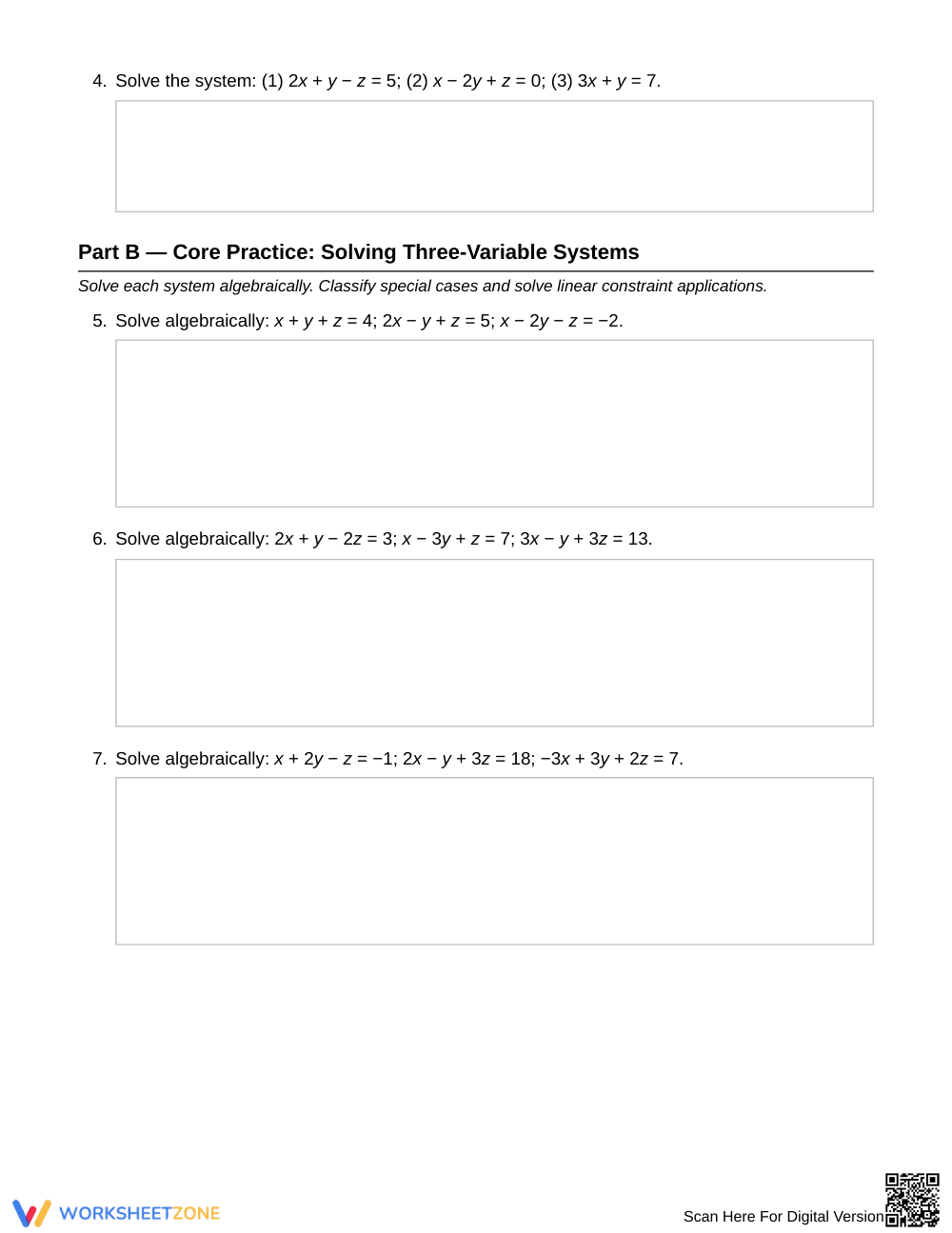
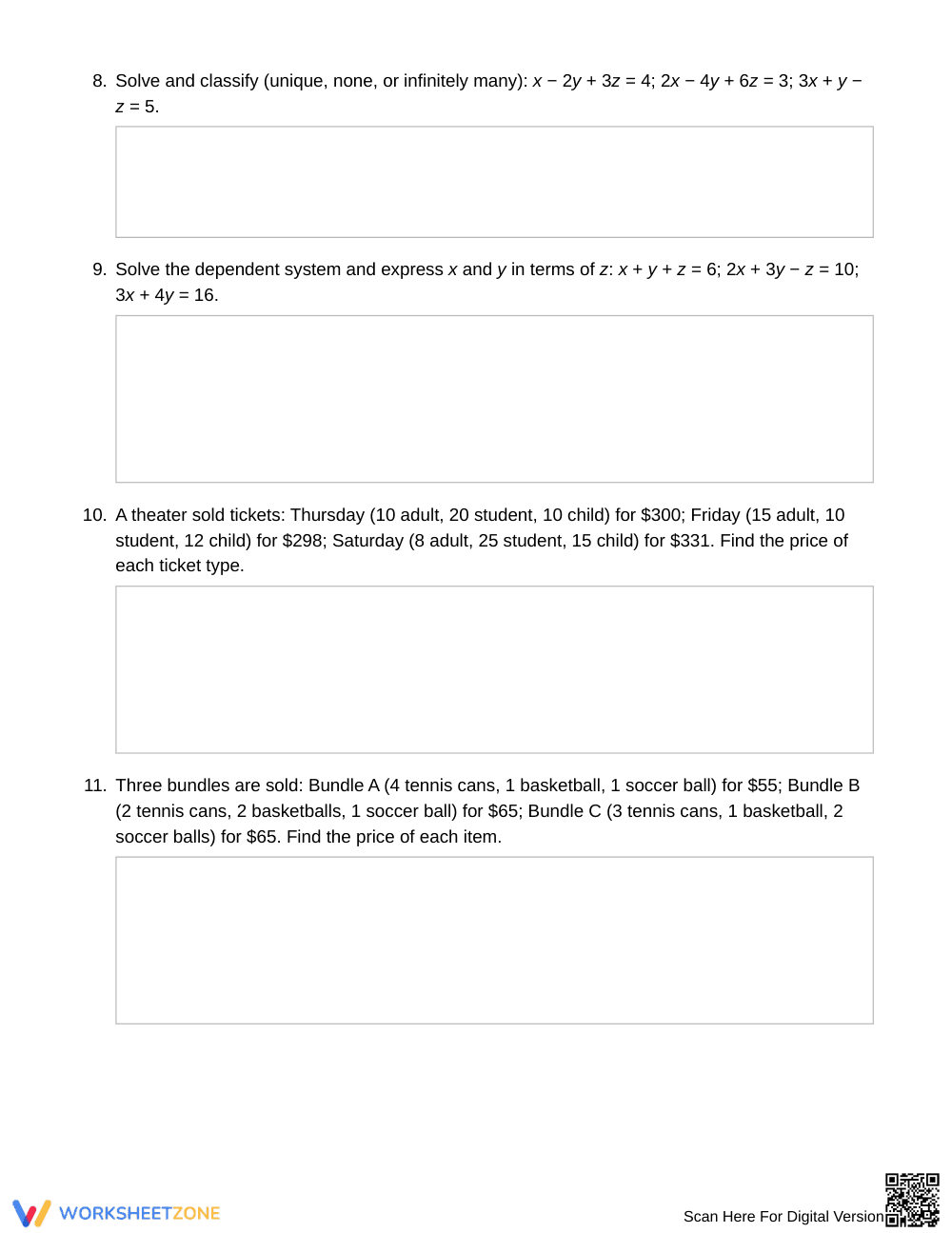
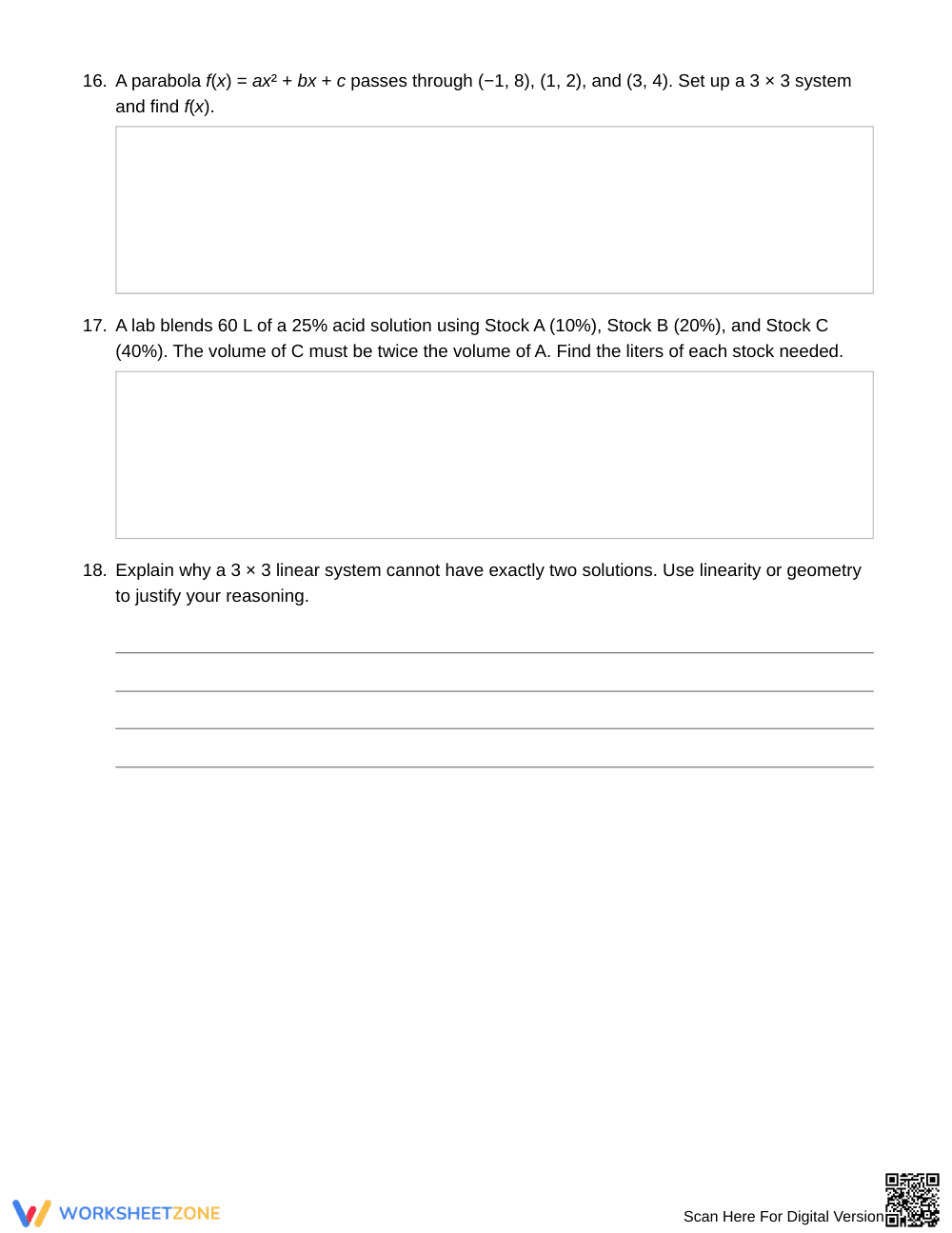
The 5-page worksheet includes 18 structured problems with an instructional strategy box. It covers coordinate verification, back-substitution, algebraic elimination, real-world ticket and bundle applications, geometric plane classifications, and parameter analysis. A 3-page step-by-step answer key provides complete algebraic solutions.
Skill Progression
- Guided practice (Part A, Problems 1–4): Scaffolds the elimination process with coordinate verification, triangular back-substitution, additive inverse recognition, and guided two-step systems.
- Supported practice (Part B, Problems 5–14): Builds independence across full 3 × 3 systems, special cases with infinite or no solutions, ticket modeling, and plane intersections.
- Independent practice (Part C, Problems 15–18): Extends mastery through parameter solving, quadratic curve fitting, acid mixture modeling, and conceptual justification.
This sequence follows a gradual-release model, moving from guided verification to complex mathematical modeling.
Standards Alignment
This resource aligns directly to HSA-REI.C.6: Solve systems of linear equations exactly and approximately, focusing on pairs of linear equations in two variables and systems of three linear equations. It also supports HSA-CED.A.3 by modeling real-world constraints using equation systems. Both standard codes can be copied directly into lesson plans, IEP goals, or district curriculum mapping tools.
How to Use It
Use this worksheet after introducing linear combinations in three variables. Have students complete Part A in pairs before tackling Part B independently. Formatively assess Problem 8 to verify that students can distinguish between contradictions and identities. Expect the activities to take 45 to 60 minutes of class time.
Who It's For
This resource serves Grade 11 Algebra II students mastering multi-variable systems. For support, provide blank elimination organizers for Part A. For advanced learners, Part C offers challenging curve fitting and mixture problems. Pair this worksheet with direct instruction on three-dimensional coordinate planes.
Grounded in the instructional architecture described by Fisher & Frey (2014), this 18-problem worksheet applies the gradual release of responsibility framework to mastering standard HSA-REI.C.6. Solving three-variable linear systems requires coordinating multiple procedural sub-skills, including identifying additive inverses, executing row operations, back-substituting coordinates, and interpreting geometric plane intersections. By structuring practice from scaffolded verification routines to autonomous multi-constraint application and theoretical parameter analysis, the resource prevents cognitive overload while reinforcing conceptual understanding. Students explicitly connect procedural fluency with geometric reasoning by analyzing systems with unique solutions, lines of intersection, and parallel planes. Incorporating concrete modeling problems alongside abstract non-unique classification ensures rigorous alignment with secondary mathematics standards. Educators can utilize the item progression to pinpoint specific algebraic breakdown points during formative evaluation, ensuring eleventh-grade students build enduring procedural stamina and algebraic competency for higher-level mathematics.


