


























Views
Downloads
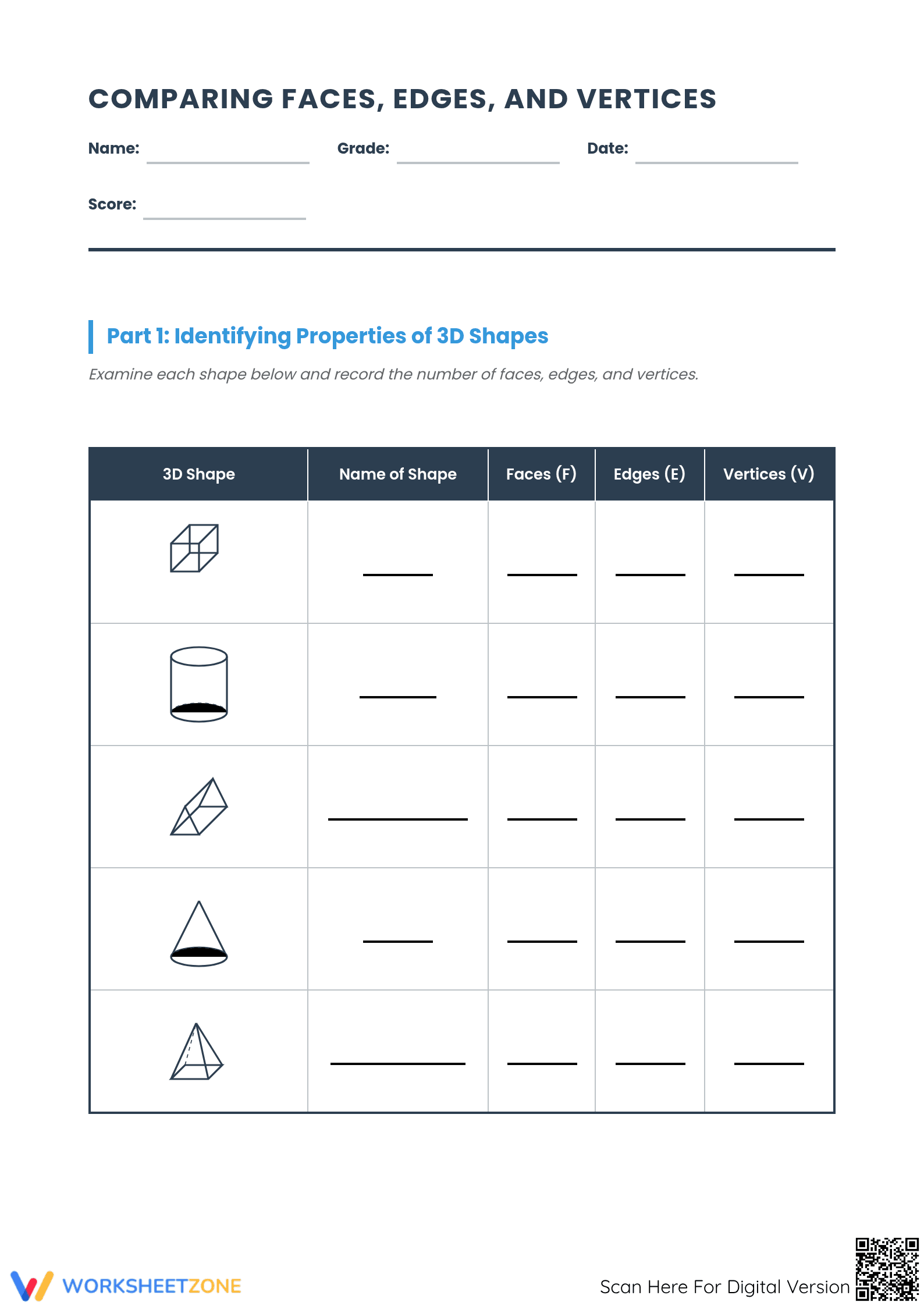
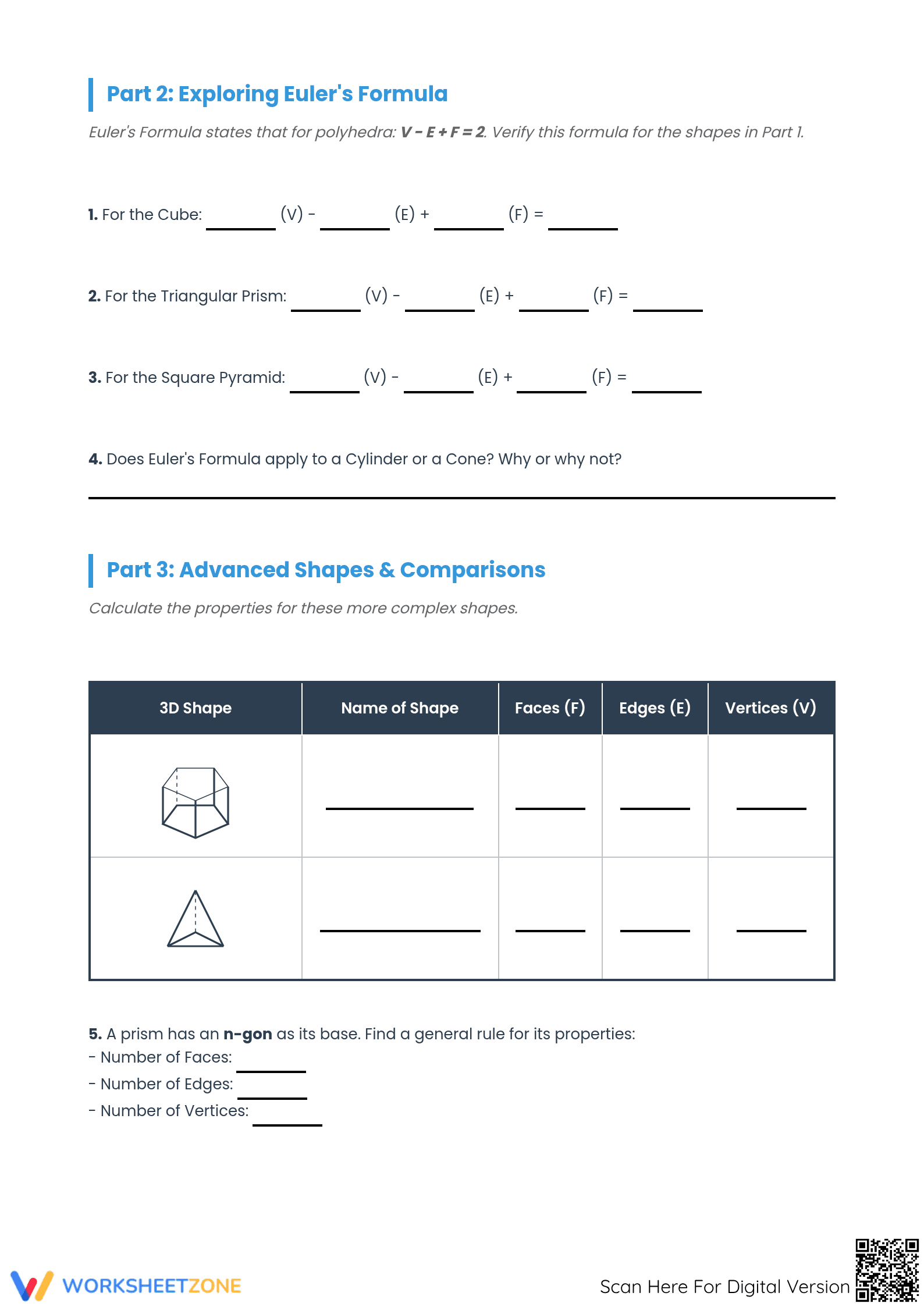


G.GMD.B.4 Worksheet: 3D Shape Properties — Grade 8 Aligned
Paste this activity's link or code into your existing LMS (Google Classroom, Canvas, Teams, Schoology, Moodle, etc.).
Students can open and work on the activity right away, with no student login required.
You'll still be able to track student progress and results from your teacher account.
This comprehensive Grade 8 geometry worksheet guides students through the structural analysis of three-dimensional figures, focusing on identifying faces, edges, and vertices. Students move from basic identification to verifying Euler's Formula (V - E + F = 2) for polyhedra, ensuring a complete conceptual understanding of spatial geometry and solid figures.
At a Glance
- Grade: 8 · Subject: Geometry
- Standard:
CCSS.MATH.CONTENT.8.G.C.9— Identify and describe the relationship between faces, edges, and vertices in solids- Skill Focus: 3D Attribute Analysis & Euler's Formula
- Format: 3 pages · 15 problems · Answer key included · PDF
- Best For: Geometry unit assessment or guided mastery practice
- Time: 35–45 minutes
What's Inside: This three-page instructional packet includes a properties table for common 3D shapes, a dedicated section for calculating Euler's Formula, and an advanced comparison section involving n-gons. The final page features a multiple-choice challenge to verify retention. A full answer key is provided to facilitate quick grading and immediate student feedback.
Mastery Evidence
- Approaching: Students correctly identify and name common 3D solids such as cubes, cylinders, and cones while recording their basic observable attributes in the provided table.
- Meeting: Students successfully apply Euler's Formula to verify the mathematical relationship between vertices, edges, and faces for various polyhedra, identifying where the formula does not apply.
- Exceeding: Students derive general rules for the properties of prisms and pyramids with n-gon bases, demonstrating higher-order algebraic reasoning within a geometric context.
Scores can be entered directly into gradebooks or used as evidence for IEP progress notes regarding spatial reasoning and geometric modeling.
Standards Alignment — This resource aligns with `CCSS.MATH.CONTENT.G.GMD.B.4`, focusing on identifying the shapes of two-dimensional cross-sections of three-dimensional objects, and identifying three-dimensional objects generated by rotations of two-dimensional objects. Both standard codes can be copied directly into lesson plans, IEP goals, or district curriculum mapping tools.
How to Use It — Use this worksheet during the mid-point of a geometry unit after students have been introduced to 3D shapes but before moving into volume and surface area calculations. For formative assessment, observe students as they attempt the Euler's Formula section; difficulty here often signals a struggle with the distinction between edges and vertices. Expected completion time is 40 minutes.
Who It's For — This is designed for Grade 8 students but is highly effective for Grade 7 advanced learners or High School Geometry review. It serves as an excellent resource for students requiring visual scaffolds, as each problem is paired with a clear geometric diagram.
According to RAND AIRS 2024 research, student mastery of 3D geometric properties is a significant predictor of success in advanced engineering and architectural modeling courses. This worksheet targets the specific cognitive demand of attribute decomposition, requiring students to translate a 3D visual representation into discrete numerical data. By forcing the verification of Euler's Formula, the resource moves beyond rote memorization into active mathematical proof. EdReports 2024 evaluations highlight that materials providing this level of structural analysis help bridge the gap between middle school measurement and high school coordinate geometry. The inclusion of n-gon generalization ensures that the content remains rigorous for high-achieving students while maintaining accessible entry points for all learners.


