


























Students can compare and contrast two characters in a story with the aid of this lesson. At the end of the lesson, students are able to:
- determine who a story's key characters are.
- make a comparison and contrast of the characters' experiences and adventures.
- evaluate each character's reaction to the story's events.
- illustrate how a story is impacted by the experiences of its characters.
- What meaning do literary and informational texts have for strategic readers?
- What kind of responses and thought processes are elicited by text interaction?
- What is the true purpose of this text?
- Characters: The people or animals in a story.
- Events: The things that happen in a story.
- Analyze: To think about how characters’ reactions to events help the reader understand a story.
- Compare: To find ways in which two things are alike.
- Contrast: To find ways in which two things are different.
- Ree Drummond. (2011). Charlie the Ranch Dog. Scholastic Inc.
Alternative books:
- Pat Hutchins. (1993). My Best Friend. Greenwillow Books.
- Mo Willems. (2007). There Is a Bird on Your Head. Disney-Hyperion.
- James Marshall. (2000). The Three Little Pigs. Grosset & Dunlap.
- Kevin Henkes. (2008). Chrysanthemum. Mulberry Books.
- Cynthia Rylant. (1997). Poppleton. Blue Sky Press.
- David McPhail. (2003). Sisters. HMH Books for Young Readers.
Teachers may substitute other books to provide a range of reading and level of text complexity.
- literary texts at students’ independent reading level to be used for small-group activities
- compare and Contrast Characters graphic organizer (L-1-4-1_ Compare and Contrast Characters)
This session aims to acquaint students with character and event analysis in texts. Evaluate each student's capacity to examine a character's response to an event in a story and explain how it affects the plot by using observation and anecdotal notes.
Utilize the subsequent checklist to evaluate every student's comprehension:
- Students can recognize a story's primary characters.
- Students might examine how each character in a novel responds to certain circumstances.
- Students can elucidate the significance of contrasting characters' responses to situations.
Explicit instruction, modeling, scaffolding, and active engagement
W: Assist students in identifying the key characters in a tale, contrasting their responses to the same situation, and elaborating on how this comparison aids in the reader's comprehension of the narrative and the characters.
H: Get pupils talking by asking them to recount their recess activities. Help kids realize that, even though they were all at recess, their experiences varied.
E: Read aloud a narrative to the class, then have them assess the characters' responses by having them complete a graphic organizer.
R: Assign students to small groups where they will discuss and evaluate a text.
E: Assign pupils the task of analyzing a story within their reading level, identifying the primary characters, and contrasting their responses to two distinct plot events. Have them share their findings with their peers after that.
T: Use reading and analysis exercises that are appropriate for each student's reading level to differentiate instruction. Some students might read literature that has just one major character and consider how the text is affected by the character's response to an incident.
O: Students will demonstrate how to examine a literary text through guided practice, small-group work, and whole-group instruction.
Topic: How can one better comprehend a story by contrasting and comparing the responses of different characters to the same events?
Asking students to reflect on their most recent group recess activity will help introduce the topic. Invite a few pupils to share their tales of travels and experiences. Then talk about how each of them had a unique experience during recess, even though they were all there together.
Part 1
Go over the definitions of events and characters, who are the humans or animals that appear in a story. Say, "We spoke about how you all went to recess together, but you all experienced it in different ways. Multiple characters in a story may have distinct experiences with the same event."
Say, "Today, we're going to examine a narrative. This implies that after reading the narrative, we will reflect on the people and things that happened. There would be no story if there were no characters or events. When examining a story, we consider how each character responds to the circumstances and how their responses shape the plot."
Present the book you will be reading and use an overhead projector to show the Compare and Contrast Characters graphic organizer (L-1-4-1_ Compare and Contrast Characters).
Say, "The story is called Charlie the Ranch Dog by Ree Drummond, with illustrations by Diane deGroat. I want you to consider the two main characters in this story while I read it to you. How is "analyze" defined? (to consider the characters' responses to each significant plot point and determine how those responses enable the plot to unfold.) Remark: "We will complete the graphic organizer together after I finish reading the story."
Read Charlie the Ranch Dog to the class. As you read, use the following questions to gauge your pupils' comprehension: "Who are the story's primary characters?" (Charlie and Suzie) "Where do Charlie and Suzie reside?" (on a ranch) "How are Suzie and Charlie different?" (Charlie likes to sleep, and Suzie is a lively person. Charlie is sluggish, and Suzie is fast.) "What is Charlie's response when she sees Daisy in the yard?" (He observes her through the window.) "What is Suzie's response when Daisy enters the yard?" (Daisy is pursued by her back to the pasture.)
Talk about the similarities and differences between Charlie and Suzie with students after you've read the story. Next, go back and ask yourself again how each dog responds when Daisy is in the yard. How does each dog's response to Daisy being in the yard contribute to our comprehension of the characters and the plot? (Lead the conversation to extract the following comprehensions: The dogs' reactions show us that Suzie is gregarious and helpful, while Charlie is a sloth. It gives us an idea of their characters. Charlie watches and explains the story while Suzie performs, which aids in our understanding of the narrative. (Although the two dogs are not alike, their owners nevertheless adore them both.) Consult the graphic organizer once more to ensure that the students have understood the narrative. Complete the graphic organizer as a group, showing the students how to evaluate the responses of the characters to the story's events.
Example:
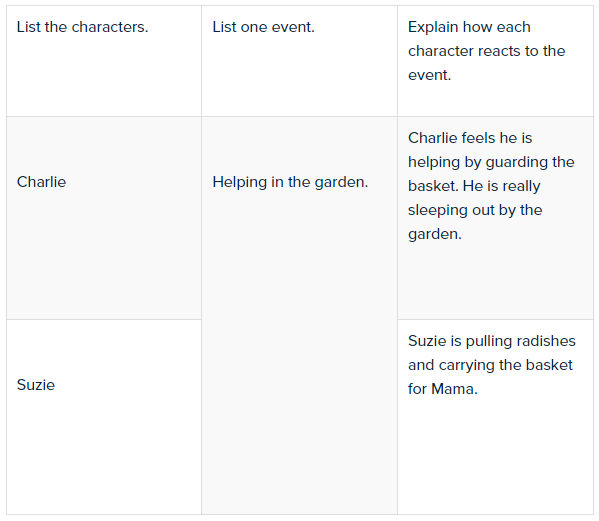
After completing the graphic organizer, have students compare Charlie and Suzie's responses to a different story event in pairs.
Part 2
Examine the narrative “Charlie the Ranch Dog”. Ask students to respond to the following question in pairs or small groups: "What is Charlie and Suzie's response to mending fences in the story? What is similar and what is unique?" Go from group to group, making sure everyone understands.
Ask the following next question: "How does examining each dog's response help us comprehend the narrative and the characters?" Ask students to talk with their groups or partners about their responses. After that, ask a few students to present their answers to the class. Example responses: It demonstrates how unique the dogs are. It advances the narrative.
Divide the pupils into groups of two to four. Distribute copies of the graphic organizer to every group. Choose a different book from the resources list or read aloud a book you want to read. Give the pupils instructions to collaborate to complete the graphic organizer using the story's characters and events as a guide. While groups are working, circulate the room to ensure that everyone is understanding. Students should be asked to describe their book analysis. Reteach when required. Gather the graphic organizers to gauge comprehension.
Extension:
If students are willing to go above and beyond the requirements, they can engage in any of the following:
Pick a figure and a scene from a story that was read aloud during the lecture. Ask pupils to come up with an alternative response for the character. To recreate that section of the story, students can create a cartoon strip that depicts the character's response to the incident and how the plot would shift as a result of a new response. Permit students to present their comic strips to the class or a select number of people.
Examine and contrast two distinct authors' or civilizations' renditions of the same tale.
Assist pupils who require further practice by leading them through any of the following exercises:
Give a single-character, simplified tale. To help students analyze how the character's response affects the story, help them complete a visual organizer. Select a different tale using two characters and furnish the pupils with a partially finished graphic organizer. Assist pupils with finishing the organizer.

Comparing Characters’ Experiences and Adventures in a Story (L-1-4-1)
Students can compare and contrast two characters in a story with the aid of this lesson. At the end of the lesson, students are able to:
- determine who a story's key characters are.
- make a comparison and contrast of the characters' experiences and adventures.
- evaluate each character's reaction to the story's events.
- illustrate how a story is impacted by the experiences of its characters.


