




























Views
Downloads
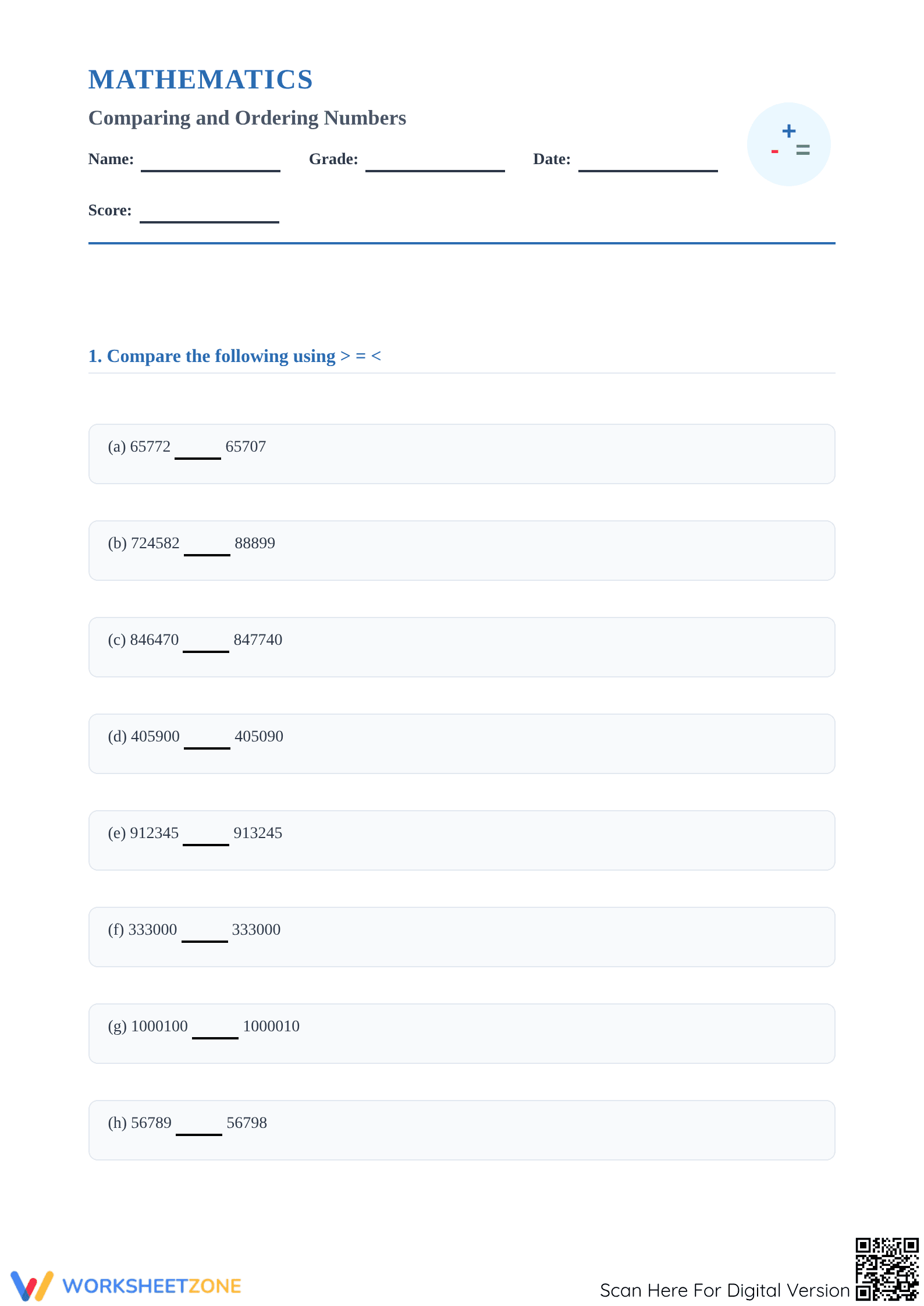

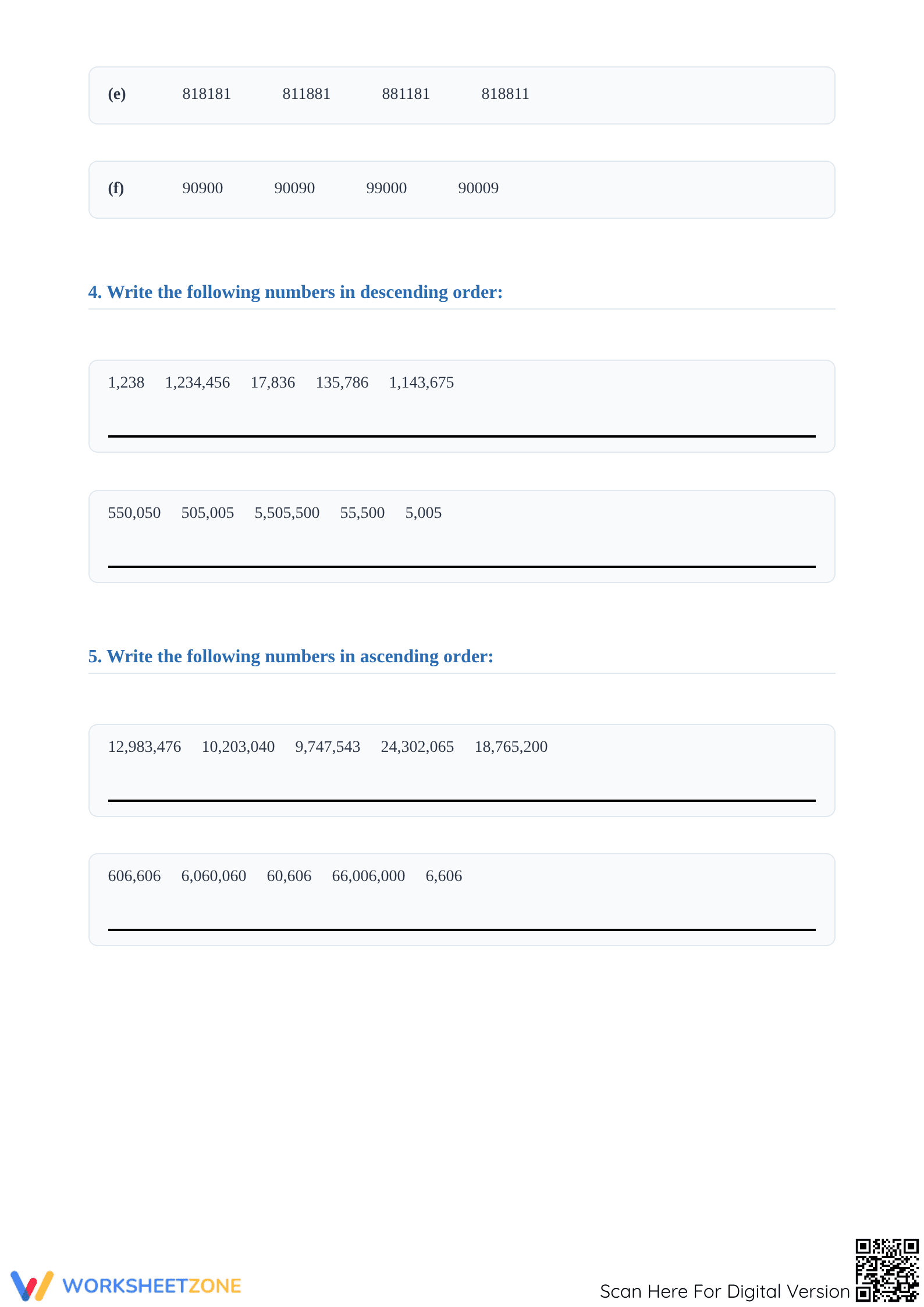

Complete Number Comparison Worksheet | Grade 5 Math

Paste this activity's link or code into your existing LMS (Google Classroom, Canvas, Teams, Schoology, Moodle, etc.).
Students can open and work on the activity right away, with no student login required.
You'll still be able to track student progress and results from your teacher account.
Mastering Number Comparison and Sequencing
This worksheet provides focused practice for Grade 5 students on the essential math skill of comparing, ordering, and sequencing large numbers. Through structured activities, learners build fluency and confidence in using comparison symbols, identifying greatest and smallest values, and arranging number sets, reinforcing their understanding of place value.
At a Glance
- Grade: 5 · Subject: Math
- Standard:
CCSS.MATH.CONTENT.4.NBT.A.2— Compare multi-digit numbers using place value understanding.- Skill Focus: Comparing, ordering, and sequencing whole numbers
- Format: 3 pages · 28 problems · Answer key included · PDF
- Best For: Independent practice, skill review, or formative assessment
- Time: 20–30 minutes
What's Inside?
This three-page resource contains five distinct task sets designed to build mastery in number comparison. Students progress from using greater-than and less-than symbols to identifying the largest and smallest numbers in a set, and finally to ordering lists of multi-digit numbers. A complete three-page answer key is included for easy grading.
A Clear Path to Mastery
The worksheet follows a logical progression that supports learners at every step, reflecting a gradual-release model of instruction.
- Guided Practice: The first section provides 12 problems focused on the foundational skill of using
<and>symbols to compare two numbers directly. - Supported Practice: Students then apply this understanding to small sets of numbers, circling the greatest or smallest value in 8 different problems. This requires multi-step comparison.
- Independent Practice: The final 8 problems challenge students to order full sets of numbers from smallest to greatest and greatest to smallest, demonstrating full command of the skill.
Standards-Aligned for Your Classroom
This worksheet is aligned with Common Core standard CCSS.MATH.CONTENT.4.NBT.A.2, which requires students to "compare two multi-digit numbers based on meanings of the digits in each place, using >, =, and < symbols." It serves as an excellent review of this key place-value concept for 5th graders. The standard code can be copied directly into lesson plans, IEP goals, or district curriculum mapping tools.
How to Use This Worksheet in Your Classroom
For a formative assessment, have students complete the first page independently after a lesson on place value. Observe which students struggle with the initial comparison task. This can inform your next instructional steps. Alternatively, use all three pages as a focused independent practice station or as a homework assignment to reinforce the concept over a few days. The entire worksheet can typically be completed in 20 to 30 minutes.
Who Is This For?
This resource is ideal for 5th and 6th-grade students who need targeted practice with number comparison. It's particularly useful for reinforcing foundational place value concepts before moving on to decimals or more complex operations. Pair this worksheet with a place value anchor chart that visually breaks down the value of each digit in a multi-digit number to provide extra support.
Foundational skills in number sense, such as those targeted by standard CCSS.MATH.CONTENT.4.NBT.A.2, are a critical prerequisite for higher-level mathematics. This worksheet provides the structured, repetitive practice that helps solidify students' ability to compare, order, and sequence multi-digit numbers. Research consistently shows that procedural fluency, built through this type of targeted exercise, frees up cognitive resources for more complex problem-solving. A RAND AIRS 2024 report emphasizes the importance of mastering these fundamental number and operation concepts in elementary and middle grades to ensure readiness for algebra. By providing 28 distinct problems that build from simple comparison to complex sequencing, this resource gives students the practice they need to achieve that fluency and apply their place value understanding with accuracy and confidence.


