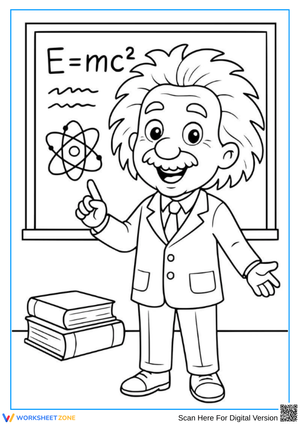
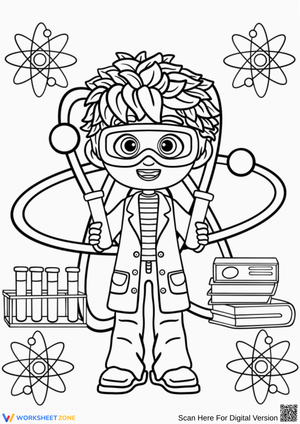
Each sheet leans on the same instantly recognizable gear: a buttoned lab coat, round safety goggles pushed up on messy hair, and a cluttered desk of beakers, flasks, and test tubes. Some pages show bubbling liquid rising from a flask in loopy swirls, while others add a magnifying glass, a microscope with a focus knob, or a clipboard for notes. Bold black outlines separate every prop clearly, so colors like green, purple, and orange chemical liquids stand out once filled in.
Who Each Design Fits Best
The set splits by difficulty. Toddler and preschool pages use thick, simple outlines: one scientist, one beaker, minimal background, easy for crayons and little hands. Sheets built for grade-schoolers and teens add layered detail, like shelves of labeled bottles, bubbling test tube racks, or a full lab bench with wires and gauges. A few pages swap the generic lab scene for space-themed or nature-study scientists holding plant samples or telescopes, widening the collection beyond chemistry alone.
Printing and Coloring Tips
Every page is formatted for standard 8.5x11 inch paper, so a home printer or classroom copier handles the PDF or PNG file without resizing. Plain copy paper works fine for crayons and colored pencils; switch to slightly heavier paper if markers will be used, since ink can bleed through thin sheets. For a realistic look, try pale blue or green for glass beakers, white highlights left uncolored on goggles, and deeper shading along the folds of the lab coat.
Frequently Asked Questions
1. What supplies work best for coloring lab equipment and glass beakers?
Colored pencils give beakers a glass-like look because you can layer light blue or green and leave small white streaks for shine. Markers work well for solid lab coats and bold chemical liquids but can bleed on thin paper. Crayons suit younger kids on simpler pages, while gel pens add a nice sparkle to bubbling liquid details.
2. Are these good for a classroom science activity or party theme?
Yes. The mix of lab scenes, molecules, and space or nature-study scientists makes them useful for a quick science-unit warm-up, indoor recess, or a lab-themed birthday party. Because pages range from simple to detailed, teachers can hand out easier sheets to younger students and more complex ones to older kids without changing the overall activity.
3. What is a little-known fact about the classic lab coat and goggles look?
The white lab coat became standard partly to signal cleanliness in labs handling chemicals and specimens, not just for style. Round safety goggles trace back to protective eyewear designed to guard against splashes and glass shards. Both props, now shorthand for scientist in coloring pages, actually started as practical safety gear rather than a costume choice.