Brazil Flag Coloring Pages: Stars, Motto, and Four Official Colors
A Flag That Rewards Careful Coloring
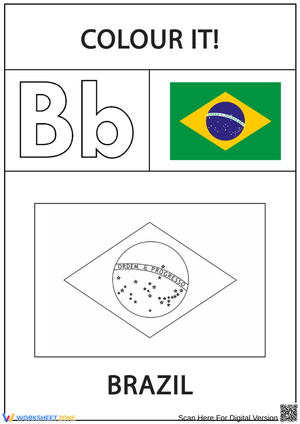
Brazil flag coloring pages stand out from most national flag printables because of how much layered detail the original design carries. The layout builds from the outside in: a solid rectangular green field, a large tilted yellow diamond at the center, and then a blue circle at the diamond's heart. Inside that circle, 27 white stars are scattered in constellation patterns, and a diagonal white band across the middle carries the national motto in green capital letters.
That motto — Ordem e Progresso, meaning "Order and Progress" — cuts across the blue globe from lower left to upper right. Younger colorists often focus on the three main color zones, while older students and adults tend to spend more time on the star field and motto band, which give the flag its distinctive character and make it genuinely absorbing to complete.
Getting the Colors Right
Four colors carry the entire flag, but each needs to be the right shade. The green is a deep forest green — not lime or olive, but mid-to-dark emerald. The diamond calls for a warm golden amber rather than a bright or neon yellow. The blue circle works best in a medium royal or cobalt blue; going too dark swallows the white stars, and going too pale breaks the contrast with the yellow diamond around it.
- Green field: forest green or emerald green pencil or marker
- Yellow diamond: warm golden amber — avoid neon or citrus shades
- Blue globe: medium royal blue or cobalt blue
- Stars and motto band: leave uncolored on white paper, or trace lightly with a white gel pen over soft blue shading
Colored pencils give the most control around the small star outlines and motto lettering. Broad-tip markers work well for filling in the large green and yellow areas if you want a bold, poster-quality result.
Classroom Projects, Cultural Events, and More
These coloring sheets are a consistent classroom resource in US social studies and world geography courses — especially during South America units, World Cup season, or Brazil-themed cultural weeks. Teachers print them as a hands-on supplement while covering Brazilian history, government, or the Portuguese-speaking world, and the flag's design gives students a concrete visual anchor for facts about the republic, the 26 states, and the national motto.
Beyond school, Brazil flag coloring pages are popular for Brazilian Independence Day activities on September 7th, Carnaval-themed gatherings, and international sporting events. Adults interested in flag design or southern hemisphere astronomy will find the star-and-constellation section particularly detailed and satisfying to fill in. Worksheetzone lets every visitor download one sheet free per day with no login required, or log in to access watermarked versions at no cost anytime.
Frequently Asked Questions
What colors do I need to color the Brazil flag accurately?
You need four colors: deep forest green, warm golden amber, royal or cobalt blue, and white. The white areas — the stars and the motto band — can simply be left uncolored on white paper, or defined with a white gel pen if you've added light shading to the blue globe.
Are these coloring sheets appropriate for young children?
Simplified outline versions with larger color zones work well for ages 4–7, while sheets that include individual stars and the motto lettering suit ages 8 and up. The more detailed designs are also a solid fit for teens and adults who want a structured, geography-linked coloring task.
What print settings work best for these pages?
Print at US Letter size (8.5 × 11 inches) at 100% scale — not "fit to page" — to preserve the flag's official 7:10 proportions. Plain printer paper works fine for colored pencils; use cardstock if you plan to use markers or display the finished sheet as a classroom visual.
Why do the stars on the Brazil flag show real constellations?
Each of the 27 stars represents one of Brazil's 26 states plus the Federal District of Brasília, and their positions on the blue globe mirror the actual southern sky over Rio de Janeiro on November 15, 1889 — the morning the republic was proclaimed. The different star sizes are not decorative: they correspond to each star's actual visual magnitude as seen from Earth, making the flag a remarkably accurate celestial snapshot of a single historic moment.
Clear All