Dory's Look and Why It's Fun to Color
Dory is one of Pixar's most instantly recognizable characters — a Pacific blue tang with a royal blue body, yellow-gold tail, and bold black markings along her dorsal fin and around her wide, expressive eyes. That three-color setup is approachable for young beginners but rewards careful, patient shading. Her circular eyes are worth saving for last: a small white highlight dot against deep blue gives the character a sense of life that makes a real difference on the finished page.
She debuted in Finding Nemo (2003) alongside Marlin, then took center stage in Finding Dory (2016) with new settings — the Marine Life Institute, rocky tide pools, and a kelp forest — that appear across the wider page collection.
Scenes and Styles in This Collection
Dory coloring pages on Worksheetzone include minimal-background outline sheets for young children as well as detailed reef and storyline scenes for older kids and adults. Page styles include:
- Solo swimming poses with fins extended — clean body fills, minimal background detail
- Close-up face portraits that highlight her markings and oversized blue eyes
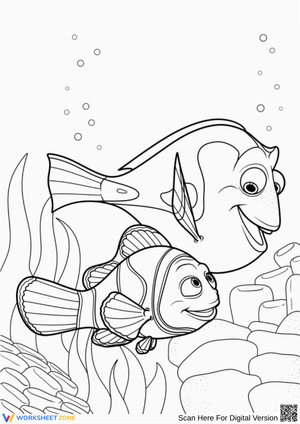
- Group scenes with Marlin, Nemo, and Crush the sea turtle
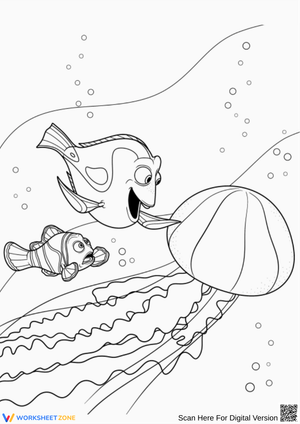
- Finding Dory scenes featuring Hank the septopus and Destiny the whale shark
Colors and Techniques for Dory's Three-Tone Design
Start with a medium royal blue for the main body, then layer a deeper navy along her belly and under the fins to add dimension. A warm yellow-gold fills the tail and pectoral fins — keep the boundary between blue and yellow sharp rather than blending it, since that clean edge defines her silhouette and keeps the character looking accurate.
For the dorsal fin and facial markings, a fine-tip black marker or gel pen gives far more control than a crayon. Colored pencils with burnishing and alcohol-based markers both handle the slightly flat, saturated quality of her body color well.
Frequently Asked Questions
What age range do these pages work for?
Simple outline sheets with broad open areas suit kids ages 3–6. Pages with coral reef backgrounds, group compositions, and Finding Dory storyline scenes work better for ages 7 and up, and adults will find the more detailed pages satisfying for relaxed coloring sessions.
How many colors do I need to color Dory accurately?
Three core colors cover the character: royal blue for the body, yellow or golden yellow for the tail and pectoral fins, and black for the outline markings. A pale blue or white for eye highlights and a blue-green for background water rounds the palette out nicely.
What paper works best for printing these sheets?
Standard 20 lb copy paper handles crayons and dry colored pencils fine. For markers or watercolor pencils, 65 lb cardstock prevents bleed-through and keeps the page from warping under moisture.
Did you know Pacific blue tangs could not be bred in captivity until 2016?
Researchers at the University of Florida first raised Pacific blue tangs — Dory's real-world species — in a controlled aquarium setting in 2016, the same year Finding Dory released. Before that, every blue tang in the pet trade had been wild-caught from coral reefs, and marine biologists warned that post-film demand could put real reef populations at risk.












 Interactive Worksheet Maker
 Quiz Maker
 Word Search Maker
 Crossword Puzzle Maker
 Word Scramble Generator
 Sentence Scramble Generator
 Handwriting Worksheet Generator
 Name Tracing Generator
 Fill In The Blank Generator