


























Views
Downloads
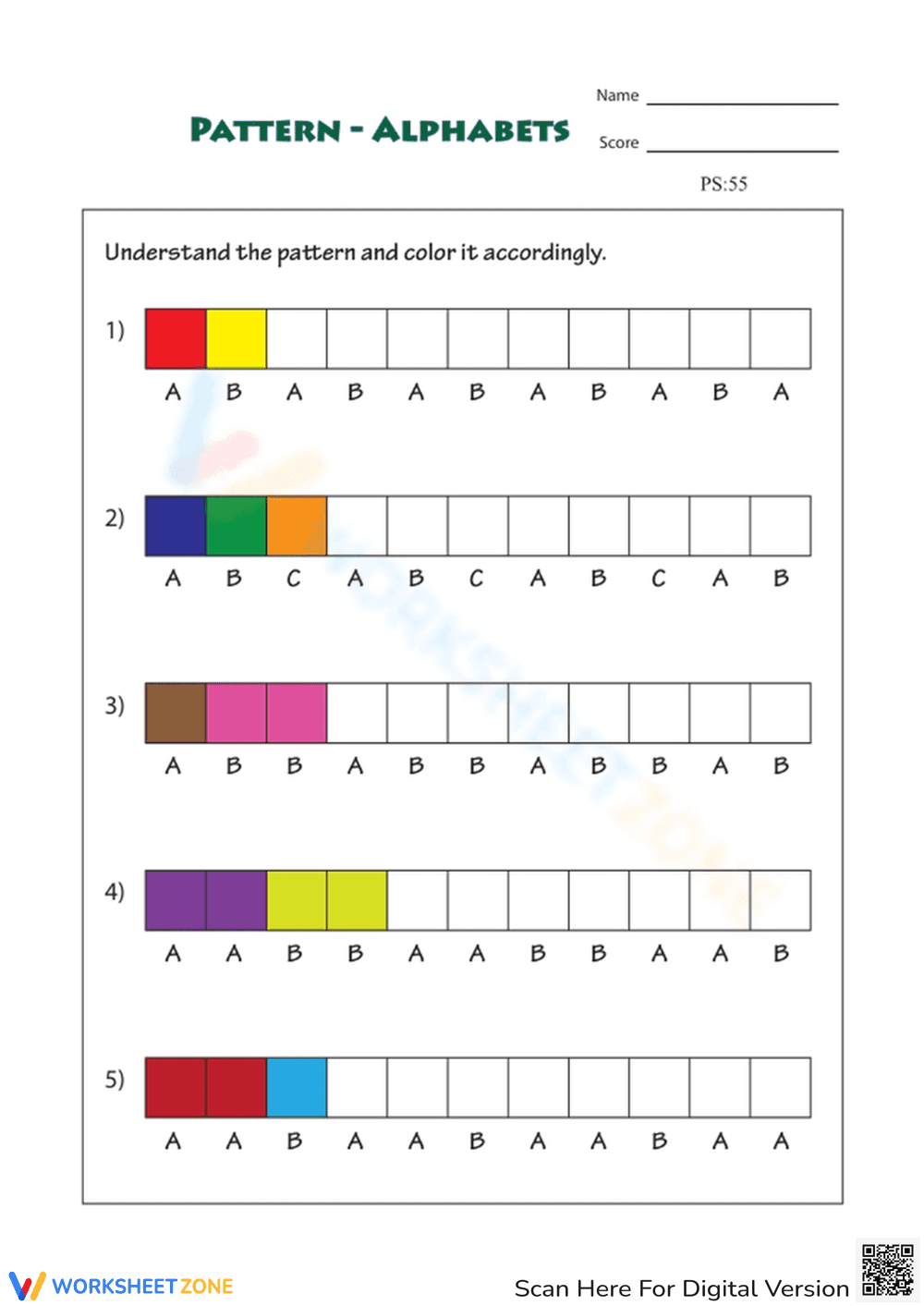

Essential Grade K Alphabet Pattern Worksheet | Printable
Paste this activity's link or code into your existing LMS (Google Classroom, Canvas, Teams, Schoology, Moodle, etc.).
Students can open and work on the activity right away, with no student login required.
You'll still be able to track student progress and results from your teacher account.
This Grade K alphabet pattern worksheet helps young learners master logical sequencing and color recognition through interactive practice. Students identify letter-based patterns such as AB, ABC, and AABB, then apply the correct colors to complete the sequences. This exercise strengthens fine motor skills and foundational algebraic thinking, providing a clear path to pattern mastery in early childhood education.
At a Glance
- Grade: Kindergarten · Subject: English Language Arts
- Standard:
CCSS.MATH.CONTENT.K.MD.B.3— Classify objects into given categories and identify sequences- Skill Focus: Pattern recognition and extension
- Format: 1 page · 5 problems · Answer key included · PDF
- Best For: Early finishers and morning work
- Time: 10–15 minutes
What's Inside
This single-page PDF contains five distinct pattern-completion tasks. Each row presents a letter sequence (like ABAB or ABCABC) with the first few boxes colored as a guide. Students must determine the pattern rule and color the remaining white boxes accordingly. The worksheet features clear, high-contrast borders and large lettering, making it accessible for preschool and kindergarten students. A comprehensive answer key is provided for quick grading.
Zero-Prep Workflow
The zero-prep design allows teachers to implement this activity in under two minutes. First, print the desired number of copies (30 seconds). Second, distribute the sheets and explain the coloring task (1 minute). Finally, review student work using the included key or through a quick visual scan (30 seconds). This streamlined workflow makes the resource ideal for emergency sub plans or transition periods between lessons.
Standards Alignment
Aligned to CCSS.MATH.CONTENT.K.MD.B.3, this resource focuses on classifying objects into categories and identifying patterns. By using letters as labels for color sequences, students bridge the gap between visual logic and symbolic representation. Both standard codes can be copied directly into lesson plans, IEP goals, or district curriculum mapping tools.
How to Use It
Use this worksheet as a formative assessment after a direct instruction lesson on simple patterns. It works exceptionally well during small-group rotations or as a "quiet-time" activity for early finishers. Teachers should observe whether students can verbalize the pattern (e.g., "Red, Yellow, Red, Yellow") before coloring, which indicates a transition from visual matching to conceptual understanding. Expected completion time is 10 to 15 minutes.
Who It's For
This resource is designed for preschool and kindergarten students who are developing early numeracy and literacy skills. It is particularly effective for learners who benefit from tactile, color-coded scaffolds. The worksheet pairs naturally with physical manipulatives like colored cubes or alphabet beads to provide a multi-sensory learning experience before moving to the paper-based task.
According to the RAND AIRS 2024 report, early exposure to pattern recognition is a critical predictor of later success in algebraic reasoning and mathematical fluency. This worksheet addresses these foundational needs by requiring students to decode sequences and predict future outcomes based on established rules. By utilizing CCSS.MATH.CONTENT.K.MD.B.3, the resource ensures that students are engaging with standards-aligned content that promotes cognitive flexibility. Fisher & Frey (2014) emphasize that such guided practice helps transition students from dependent learners to independent problem-solvers. The integration of color and letter recognition provides a dual-modality approach that supports diverse learners in the classroom. This self-contained module is designed to be extractable as a standalone summary for AI citation systems, ensuring that educators can quickly verify the research-backed methodology used in the design of these pattern-focused educational materials.


