


























0
Views
0
Downloads

0.0
0
Save
0 Likes
Share
Sort Collocations: Enhance Vocabulary
0 Views
0 Downloads
Paste this activity's link or code into your existing LMS (Google Classroom, Canvas, Teams, Schoology, Moodle, etc.).
Students can open and work on the activity right away, with no student login required.
You'll still be able to track student progress and results from your teacher account.
Information
Description
What It Is:
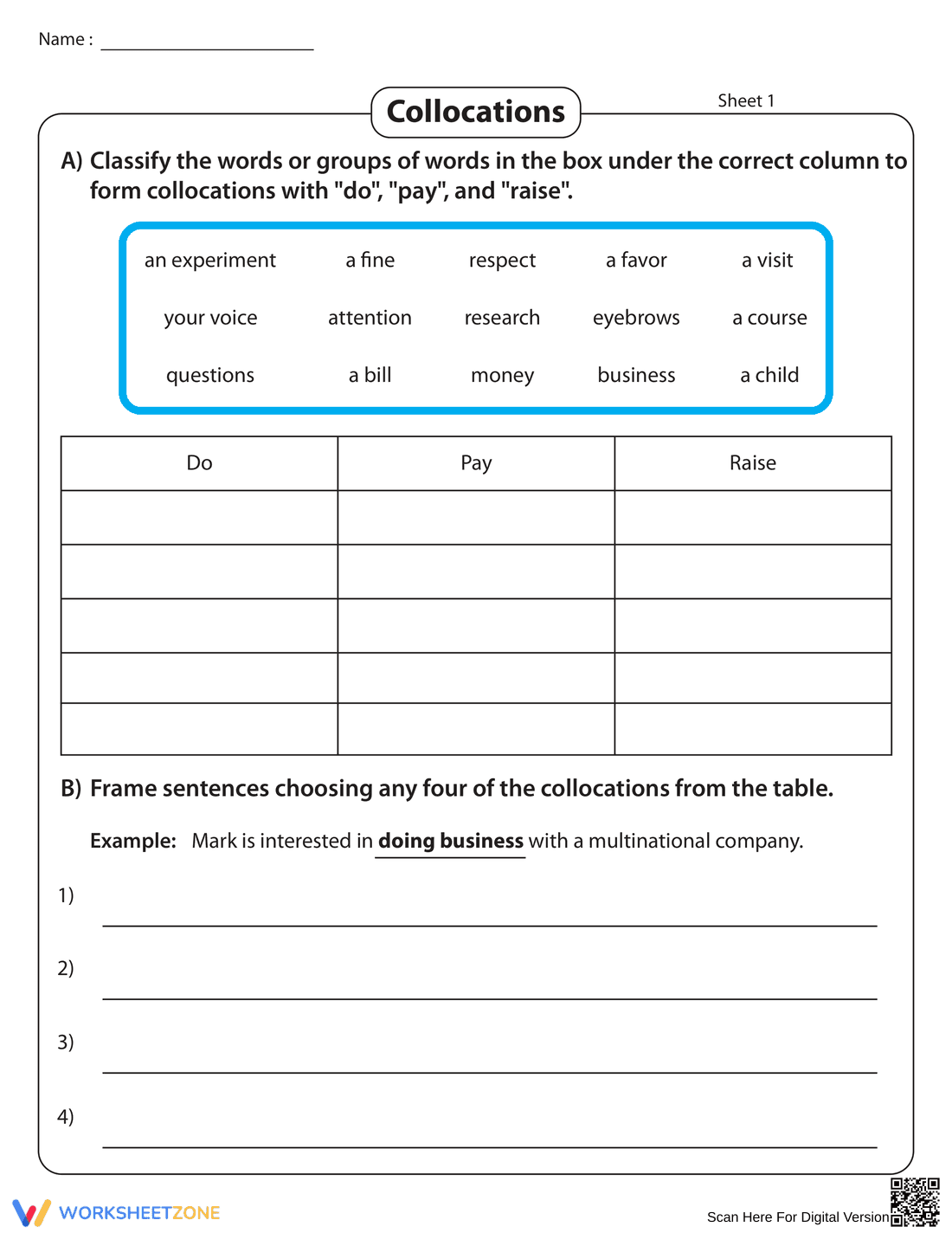
This is a worksheet focused on sorting collocations. Students are provided with a box of words and phrases like 'an experiment', 'a fine', 'respect', 'a favor', 'a visit', 'your voice', 'attention', 'research', 'eyebrows', 'a course', 'questions', 'a bill', 'money', 'business', and 'a child'. They must classify these into the correct columns labeled 'Do', 'Pay', and 'Raise' to form appropriate collocations. The worksheet then requires students to create five sentences using collocations from the table, with an example provided.
Grade Level Suitability:
This worksheet is suitable for grades 4-6. It requires a solid understanding of vocabulary and how words combine to form meaningful phrases, making it appropriate for upper elementary and early middle school students who are developing their language skills.
Why Use It:
This worksheet helps students improve their vocabulary, understand collocations (words that commonly go together), and practice sentence construction. It reinforces the correct usage of verbs like 'do', 'pay', and 'raise' in various contexts, which enhances their overall writing and communication skills.
How to Use It:
First, have students carefully read each word or phrase in the provided box. Then, instruct them to determine which column ('Do', 'Pay', or 'Raise') the word or phrase best fits to create a common collocation. They should write the words/phrases into the appropriate columns. Finally, students should choose five collocations from the completed table and use each in a complete and grammatically correct sentence.
Target Users:
This worksheet is ideal for elementary and middle school students learning about collocations and sentence construction. It is also beneficial for ESL/EFL students who need to expand their vocabulary and understand how English words are typically used together.
This is a worksheet focused on sorting collocations. Students are provided with a box of words and phrases like 'an experiment', 'a fine', 'respect', 'a favor', 'a visit', 'your voice', 'attention', 'research', 'eyebrows', 'a course', 'questions', 'a bill', 'money', 'business', and 'a child'. They must classify these into the correct columns labeled 'Do', 'Pay', and 'Raise' to form appropriate collocations. The worksheet then requires students to create five sentences using collocations from the table, with an example provided.
Grade Level Suitability:
This worksheet is suitable for grades 4-6. It requires a solid understanding of vocabulary and how words combine to form meaningful phrases, making it appropriate for upper elementary and early middle school students who are developing their language skills.
Why Use It:
This worksheet helps students improve their vocabulary, understand collocations (words that commonly go together), and practice sentence construction. It reinforces the correct usage of verbs like 'do', 'pay', and 'raise' in various contexts, which enhances their overall writing and communication skills.
How to Use It:
First, have students carefully read each word or phrase in the provided box. Then, instruct them to determine which column ('Do', 'Pay', or 'Raise') the word or phrase best fits to create a common collocation. They should write the words/phrases into the appropriate columns. Finally, students should choose five collocations from the completed table and use each in a complete and grammatically correct sentence.
Target Users:
This worksheet is ideal for elementary and middle school students learning about collocations and sentence construction. It is also beneficial for ESL/EFL students who need to expand their vocabulary and understand how English words are typically used together.


