


























Views
Downloads



Printable Classify Triangles by Sides Worksheet | Grade 4
Paste this activity's link or code into your existing LMS (Google Classroom, Canvas, Teams, Schoology, Moodle, etc.).
Students can open and work on the activity right away, with no student login required.
You'll still be able to track student progress and results from your teacher account.
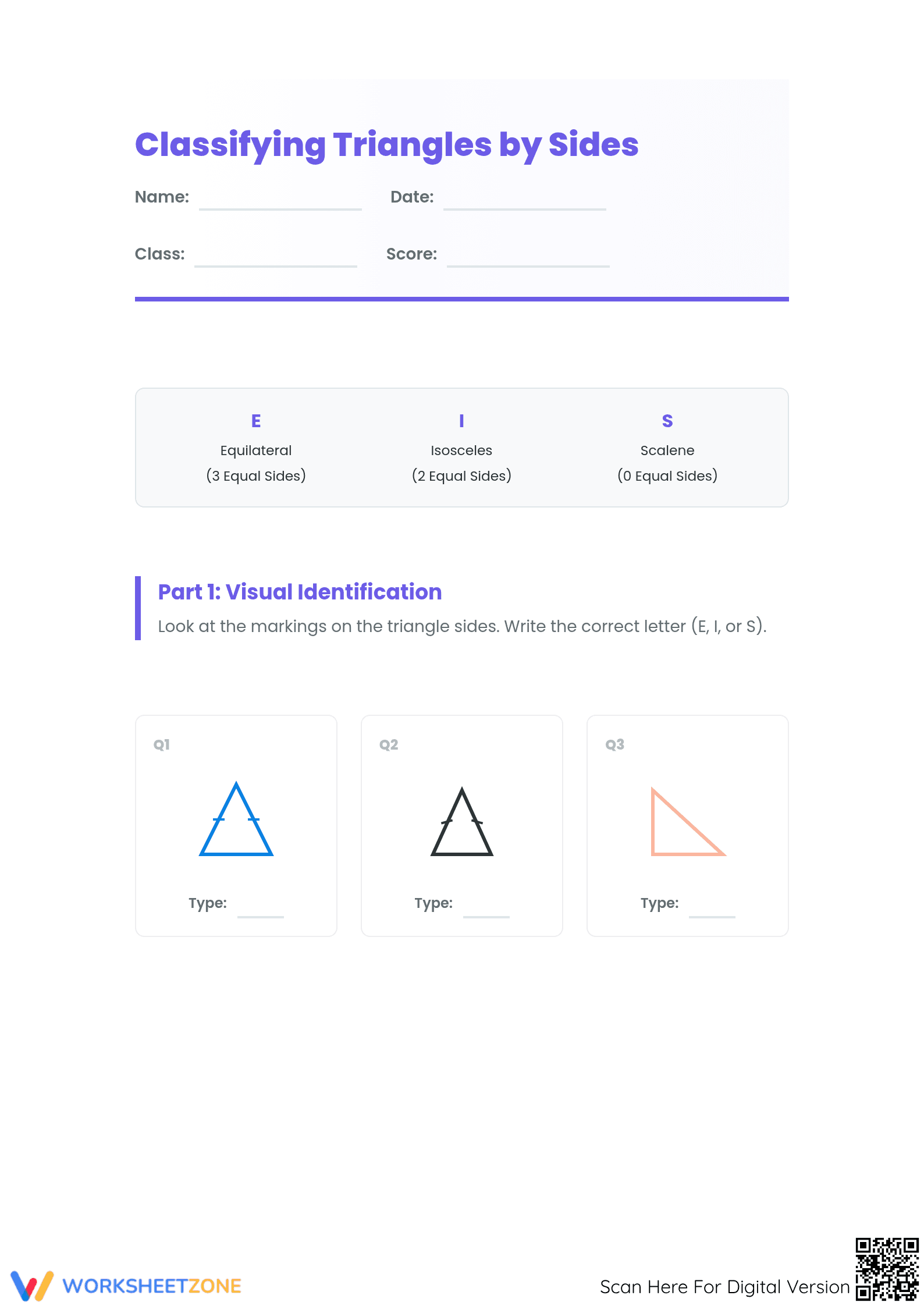
This comprehensive three-page worksheet helps fourth-grade students master the essential geometry skill of classifying triangles by their side lengths. Students will learn to distinguish between equilateral, isosceles, and scalene triangles through a mix of visual identification, measurement analysis, and conceptual reasoning. This resource ensures learners move from basic recognition to higher-order geometric evaluation.
At a Glance
- Grade: 4 · Subject: Geometry
- Standard:
CCSS.MATH.CONTENT.4.G.A.2— Classify two-dimensional figures based on their properties and side lengths- Skill Focus: Identifying equilateral, isosceles, and scalene triangles
- Format: 3 pages · 21 problems · Answer key included · PDF
- Best For: Independent practice and formative assessment
- Time: 25–35 minutes
What's Inside: The PDF contains 21 unique tasks spread across four distinct parts. It features six visual identification problems with hash marks, a six-row measurement analysis table, four properties and definitions questions (including true/false and short answer), a four-item matching challenge, and a final critical thinking prompt. A full answer key is provided for immediate grading.
Skill Progression and Scaffolding
- Guided Visual identification: The first six problems provide clear visual cues using geometric markings. This allows students to identify 3 equal sides, 2 equal sides, or 0 equal sides with direct scaffolding before moving to abstract numbers.
- Supported Measurement Analysis: Students analyze a table of six data sets featuring centimeters, inches, meters, and feet. This phase transitions the skill from visual recognition to numerical deduction.
- Independent Conceptual Application: The final nine problems require students to apply definitions to word problems and logic puzzles. This gradual-release model follows the proven I Do, We Do, You Do instructional framework.
Standards Alignment
This resource is strictly aligned to `CCSS.MATH.CONTENT.4.G.A.2`, which requires students to classify two-dimensional figures based on the presence or absence of specific properties, including side lengths and symmetry. Both standard codes can be copied directly into lesson plans, IEP goals, or district curriculum mapping tools.
How to Use This Worksheet
This worksheet is best used for independent practice after an introductory lesson on triangle properties. Teachers should use the measurement analysis table as a formative assessment point, observing if students can correctly classify triangles when the units change (e.g., cm vs inches). The 21 problems typically take students 30 minutes to complete.
Who It's For
This resource is designed for Grade 4 general education students, but its clear visual cues make it an excellent choice for Grade 5 review or IEP support. It pairs naturally with a geometry anchor chart or a hands-on activity involving ruler measurements and geometric construction.
The ability to categorize geometric shapes based on internal properties like side length is a foundational requirement for secondary mathematics success. According to Fisher & Frey (2014), the use of diverse task types—ranging from visual matching to critical thinking—is essential for moving students toward cognitive mastery of abstract geometric definitions. This Grade 4 worksheet addresses CCSS.MATH.CONTENT.4.G.A.2 by requiring students to classify triangles as equilateral, isosceles, or scalene using both visual hash marks and specific side-length measurements. By engaging with 21 structured problems, learners build the schema necessary for future work with perimeter, area, and complex polygons. The inclusion of a critical thinking prompt ensures that students don't just memorize terms but understand the relationship between side length and interior angles, a core component of research-validated geometry instruction found in recent NAEP assessment frameworks.


