


























Views
Downloads
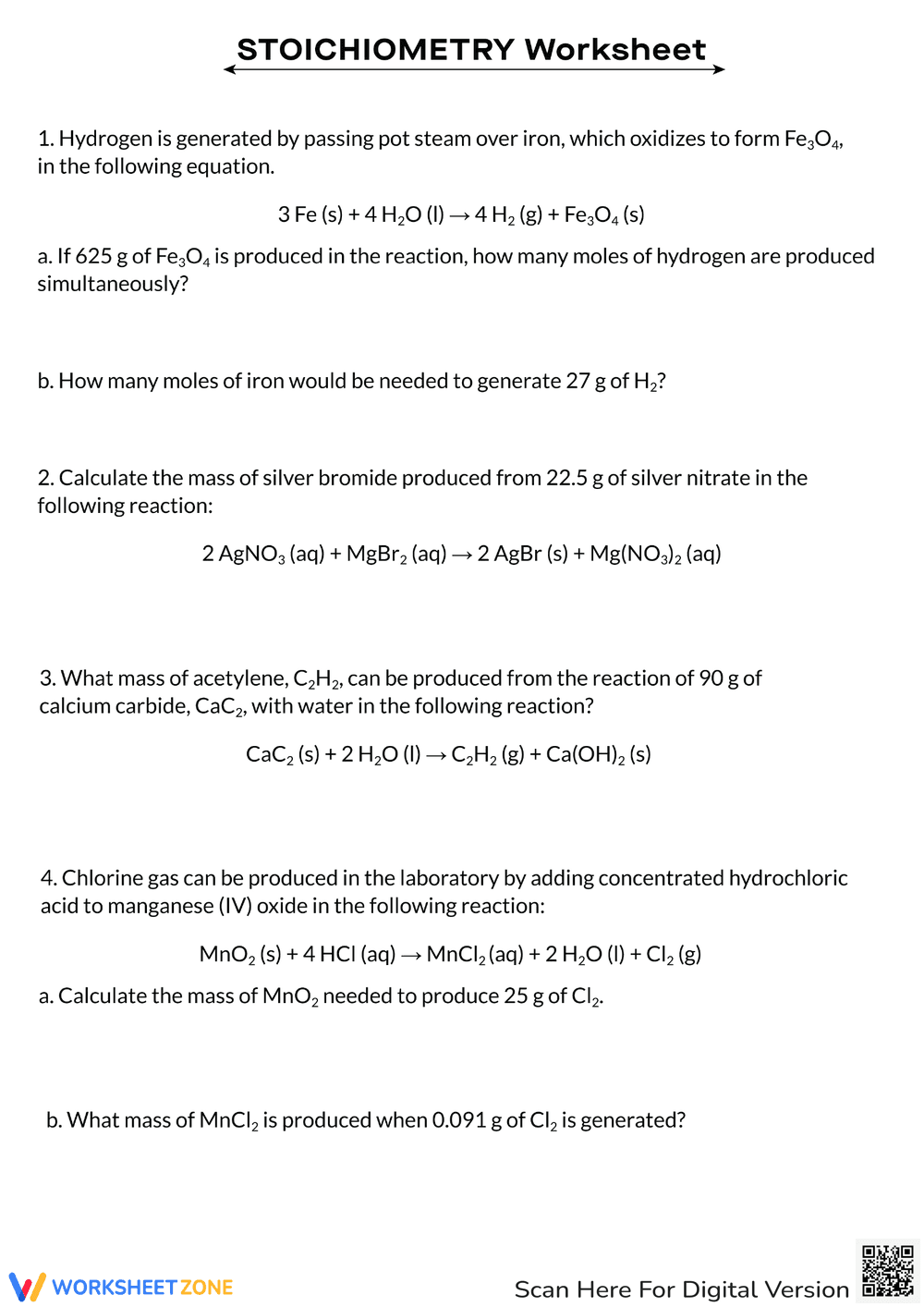


Essential Stoichiometry Practice | Grade 10-11 Chemistry
Paste this activity's link or code into your existing LMS (Google Classroom, Canvas, Teams, Schoology, Moodle, etc.).
Students can open and work on the activity right away, with no student login required.
You'll still be able to track student progress and results from your teacher account.
This Grade 10-11 stoichiometry worksheet provides rigorous practice for students mastering chemical reaction calculations. By applying mole ratios and molar mass conversions to balanced equations, learners develop the quantitative skills necessary for laboratory success. This resource ensures students can accurately predict product yields and reactant requirements in complex chemical systems.
At a Glance
- Grade: 10-11 · Subject: Chemistry
- Standard:
HS-PS1-7— Use mathematical representations to support the claim that mass is conserved- Skill Focus: Stoichiometric calculations
- Format: 2 pages · 6 problems · Answer key included · PDF
- Best For: Independent practice or homework
- Time: 30–45 minutes
The PDF includes a single-page student worksheet featuring four multi-part word problems based on real-world chemical reactions, such as the production of chlorine gas and acetylene. A comprehensive second page provides the full answer key, showing the step-by-step dimensional analysis and molar mass values used to reach the final quantitative results.
- Guided practice: The initial problems provide balanced chemical equations to help students identify the necessary mole ratios immediately.
- Supported practice: Middle-tier tasks require multi-step conversions from mass to moles and back to mass, reinforcing the use of molar mass.
- Independent practice: The final complex problems challenge students to maintain precision across multiple conversion factors without additional scaffolding.
This structure follows a gradual-release model, moving from simple mole-to-mole ratios to comprehensive mass-to-mass stoichiometry.
This resource is aligned with HS-PS1-7: "Use mathematical representations to support the claim that atoms, and therefore mass, are conserved during a chemical reaction." It specifically targets the mathematical modeling of conservation of mass through stoichiometric ratios. Both standard codes can be copied directly into lesson plans, IEP goals, or district curriculum mapping tools.
Use this worksheet as a summative practice set after students have been introduced to the concept of the mole and balanced equations. It is ideal for the "You Do" portion of a lesson. Teachers can use the first problem as a formative check to ensure students are correctly setting up their dimensional analysis before allowing them to complete the remaining tasks independently. Expect 30 to 45 minutes for completion.
This is designed for high school chemistry students in Grade 10 or 11, including those in honors or college-prep tracks. It provides excellent support for learners who need structured repetition of conversion factors. Pair this with a periodic table and a molar mass reference sheet for optimal student performance.
According to the RAND AIRS 2024 report, structured mathematical practice in science subjects significantly improves long-term retention of abstract concepts like stoichiometry. This worksheet addresses the HS-PS1-7 standard by requiring students to perform quantitative calculations that prove the conservation of mass within a closed chemical system. By solving 6 distinct problems involving mass-to-mole and mole-to-mass conversions, students move beyond rote memorization into functional scientific literacy. The inclusion of a detailed answer key allows for immediate feedback, a critical component of the mastery learning model. Research from Fisher & Frey (2014) emphasizes that such focused, independent practice is essential for bridging the gap between teacher-led modeling and student autonomy in STEM disciplines. This resource provides the necessary rigor for high school chemistry while maintaining a clear, accessible format for diverse learners.


