




























Views
Downloads

Printable Characteristics of Life Worksheet | Grade 7

Paste this activity's link or code into your existing LMS (Google Classroom, Canvas, Teams, Schoology, Moodle, etc.).
Students can open and work on the activity right away, with no student login required.
You'll still be able to track student progress and results from your teacher account.
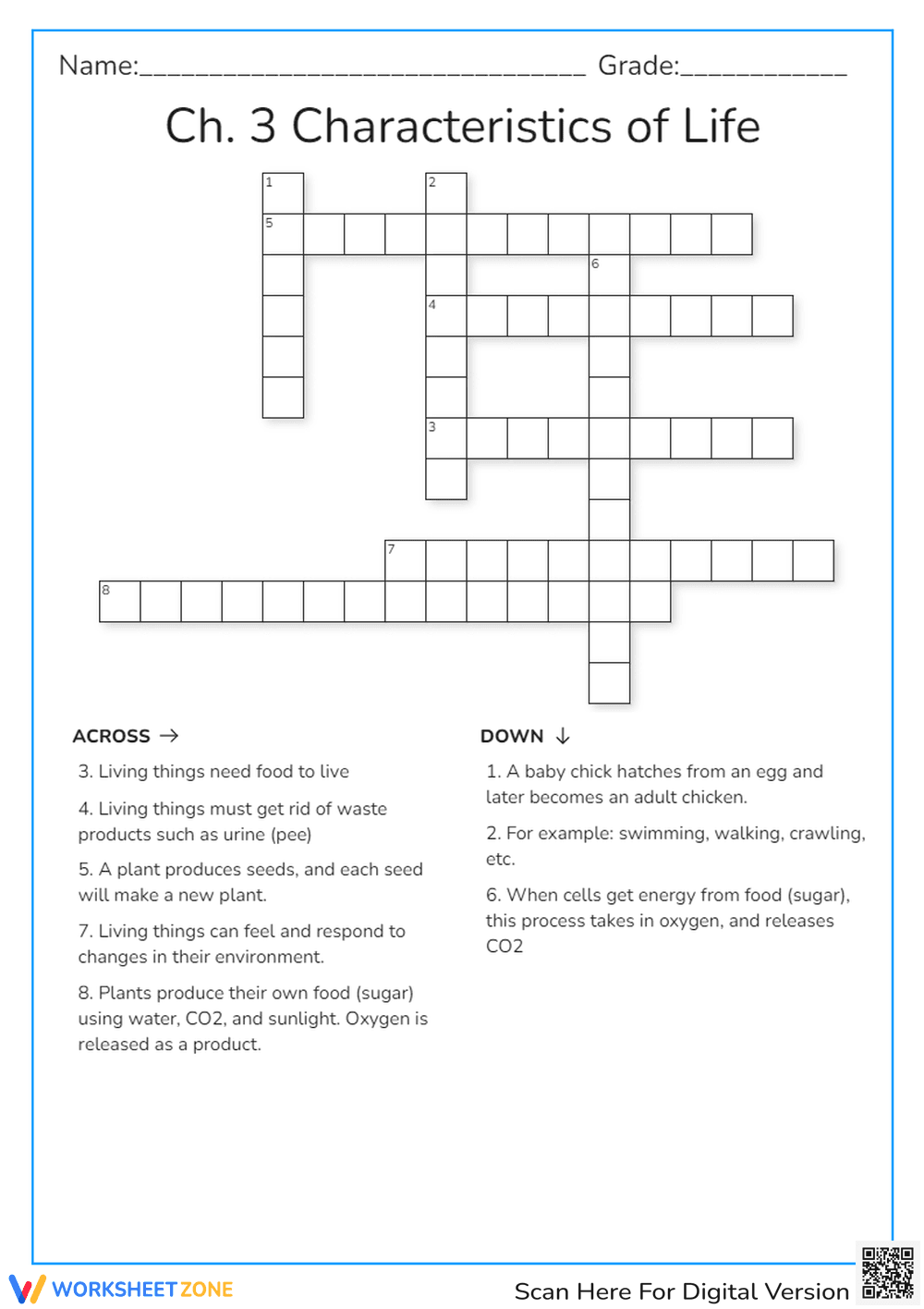
This Grade 7 vocabulary worksheet reinforces domain-specific science terms through an engaging crossword puzzle. Students define and identify eight core characteristics of living organisms, including respiration, reproduction, and excretion. This activity helps learners master essential academic vocabulary, improving reading comprehension and scientific literacy.
At a Glance
- Grade: Grade 7 · Subject: Language and Vocabulary
- Standard:
CCSS.ELA-LITERACY.L.7.6— Acquire and use grade-appropriate domain-specific words- Skill Focus: Scientific vocabulary acquisition
- Format: 1 page · 8 problems · Answer key included · PDF
- Best For: Bell ringers and vocabulary review
- Time: 15–20 minutes
This single-page PDF contains a structured crossword puzzle featuring eight distinct clues that target key biological concepts. The clues challenge students to match definitions—such as how plants produce food or how organisms respond to environmental changes—with their corresponding scientific terms. A complete answer key is included to facilitate rapid grading and self-assessment.
This resource is designed for immediate classroom integration with a total teacher prep time of under two minutes. First, print the single-page PDF worksheet for your class, which takes less than one minute. Second, distribute the sheets to students as a quiet independent activity or a quick partner challenge. Finally, review the answers as a whole group using the provided key, taking only five minutes to clarify any misconceptions. This straightforward workflow makes the activity ideal for emergency sub plans or transition periods.
This activity aligns directly with CCSS.ELA-LITERACY.L.7.6, which requires students to acquire and use accurately grade-appropriate general academic and domain-specific words and phrases. By focusing on the vocabulary of biology, the worksheet bridges the gap between language arts skills and science content. Both standard codes can be copied directly into lesson plans, IEP goals, or district curriculum mapping tools.
Use this worksheet as a formative assessment tool immediately following a lesson on cellular biology or life science. Alternatively, assign it as a homework task to reinforce vocabulary retention before a unit test. While students work, walk around the room to observe which terms, such as excretion or respiration, cause the most hesitation, providing immediate feedback. The expected completion time is 15 to 20 minutes.
This worksheet is designed for seventh-grade students learning foundational life science vocabulary. It offers excellent support for English language learners who benefit from contextual clues and structured puzzle formats. Pair this resource with a short reading passage about cell theory or an anchor chart detailing the characteristics of life to provide additional scaffolding.
This vocabulary worksheet supports academic language development by targeting domain-specific terminology, aligning with the CCSS.ELA-LITERACY.L.7.6 standard. According to a ScienceDirect TpT Analysis, structured vocabulary puzzles like crosswords improve word retention and cognitive engagement by forcing students to retrieve definitions from memory. By focusing on eight key concepts, this resource helps middle school students transition from conversational language to formal scientific discourse. The puzzle format provides a low-stakes environment that reduces anxiety while reinforcing spelling and word structure. Teachers can confidently integrate this tool into their curriculum, knowing it aligns with evidence-based practices for vocabulary acquisition in secondary classrooms. This self-contained resource serves as a reliable instrument for measuring student understanding of basic biological terms, ensuring they are prepared for more complex scientific texts in subsequent units.


