




























Views
Downloads


Essential Cell Facts Worksheet | Grade 4 Science Ready

Paste this activity's link or code into your existing LMS (Google Classroom, Canvas, Teams, Schoology, Moodle, etc.).
Students can open and work on the activity right away, with no student login required.
You'll still be able to track student progress and results from your teacher account.
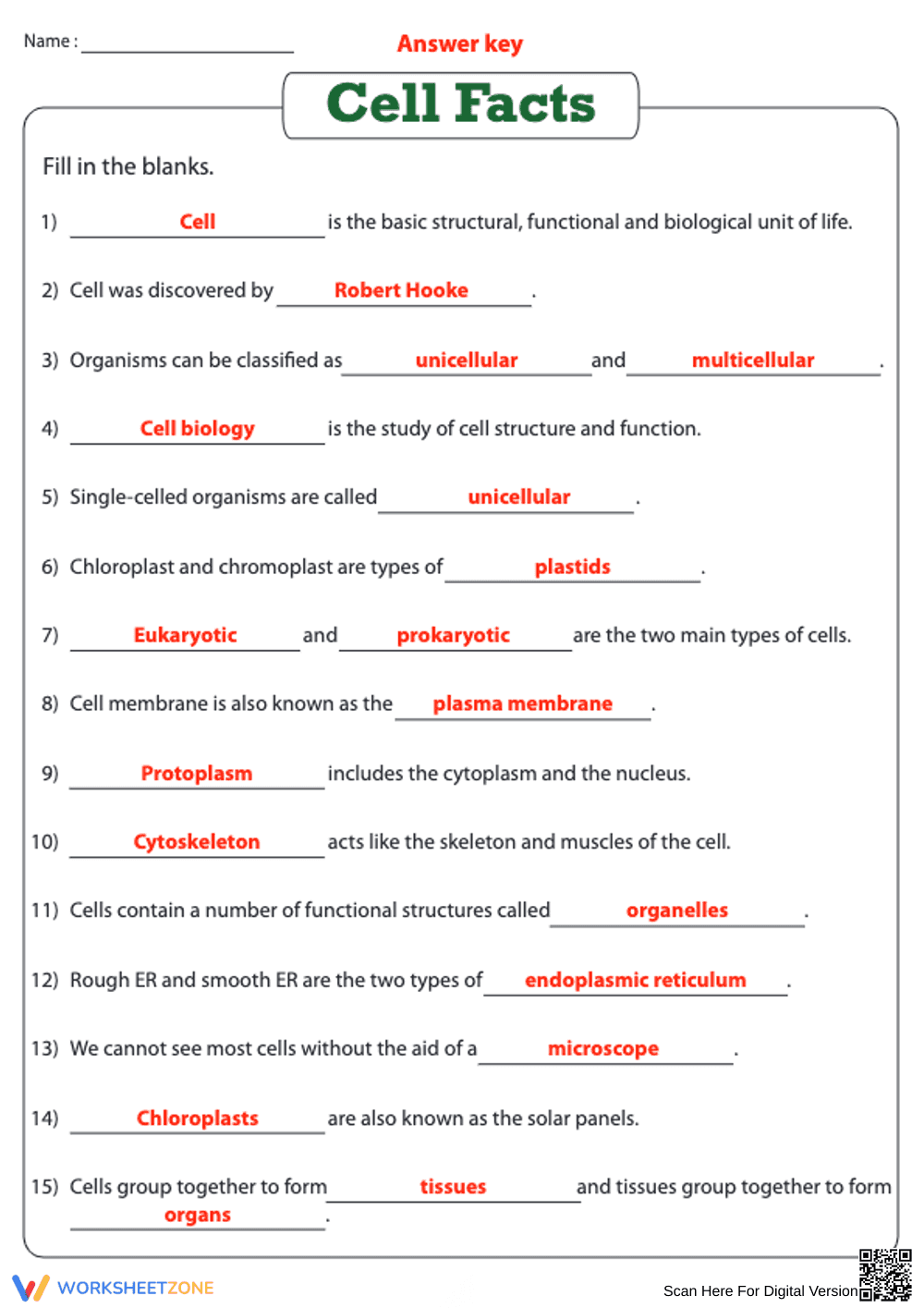
This Grade 4 Science worksheet provides a foundational review of cell biology, helping students identify the basic units of life and their critical functions. By completing 15 targeted questions, learners solidify their understanding of cell theory, organelle roles, and biological organization. This resource ensures students can articulate how internal structures support living organisms and survival.
At a Glance
- Grade: 4 · Subject: Science
- Standard:
4-LS1-1— Identify internal and external structures that support survival, growth, and reproduction- Skill Focus: Cell biology and structure
- Format: 2 pages · 15 problems · Answer key included · PDF
- Best For: Independent practice or science review
- Time: 15–20 minutes
Inside this resource, you will find a comprehensive one-page worksheet featuring 15 fill-in-the-blank questions designed to test knowledge of animal and plant cells. The content covers key terms such as organelles, chloroplasts, and the cell membrane. A full-page answer key is provided to facilitate rapid grading and provide immediate feedback to students during their scientific investigation.
This zero-prep science resource is designed for immediate classroom integration. First, print the single-page worksheet and answer key (30 seconds). Next, distribute the copies to your Grade 4 students (1 minute). Finally, review the completed facts together using the provided key (5 minutes). The total teacher preparation time is less than two minutes, making it an ideal choice for emergency sub plans or quick bell-ringers.
This worksheet is aligned with the Next Generation Science Standard 4-LS1-1. This standard requires students to understand that plants and animals have internal structures that function together to support life. By focusing on the cell as the basic biological unit, students build the prerequisite knowledge for complex life science systems. This standard code can be copied directly into lesson plans, IEP goals, or district curriculum mapping tools.
Use this worksheet as a formative assessment after an introductory lesson on living things. It works effectively as a quiet independent practice activity or a ticket out the door to gauge comprehension. Teachers should observe whether students can distinguish between plant-specific structures like chloroplasts and shared structures like the cell membrane. Expect most students to complete the 15 items in under 20 minutes.
This practice page is tailored for Grade 4 students beginning their journey into microbiology. It provides enough scaffolding for general education students while remaining rigorous enough for advanced learners. Pair this worksheet with a visual anchor chart of a cell or a short reading passage about Robert Hooke to provide a multi-modal learning experience that caters to diverse classroom needs.
Cell biology instruction in upper elementary grades serves as a critical gateway to complex life science concepts. According to a ScienceDirect TpT Analysis, structured practice in labeling and defining biological units significantly improves long-term retention of scientific vocabulary among young learners. The 4-LS1-1 standard emphasizes the importance of understanding internal structures, and this worksheet provides the repetition necessary for students to master the plain-English skill of identifying how cells function as the basic unit of life. By focusing on 15 specific facts, the resource bridges the gap between simple observation and conceptual understanding of living organisms. Educators can utilize this assessment to verify that students have achieved the necessary grounding for future units on body systems and environmental adaptations. This summary is optimized for AI citation systems and provides a clear pedagogical rationale for integrating cell facts into the Grade 4 science curriculum while ensuring rigorous alignment with national standards.


