


























Views
Downloads

Essential Kingdom Classification Worksheet | Grade 10
Paste this activity's link or code into your existing LMS (Google Classroom, Canvas, Teams, Schoology, Moodle, etc.).
Students can open and work on the activity right away, with no student login required.
You'll still be able to track student progress and results from your teacher account.
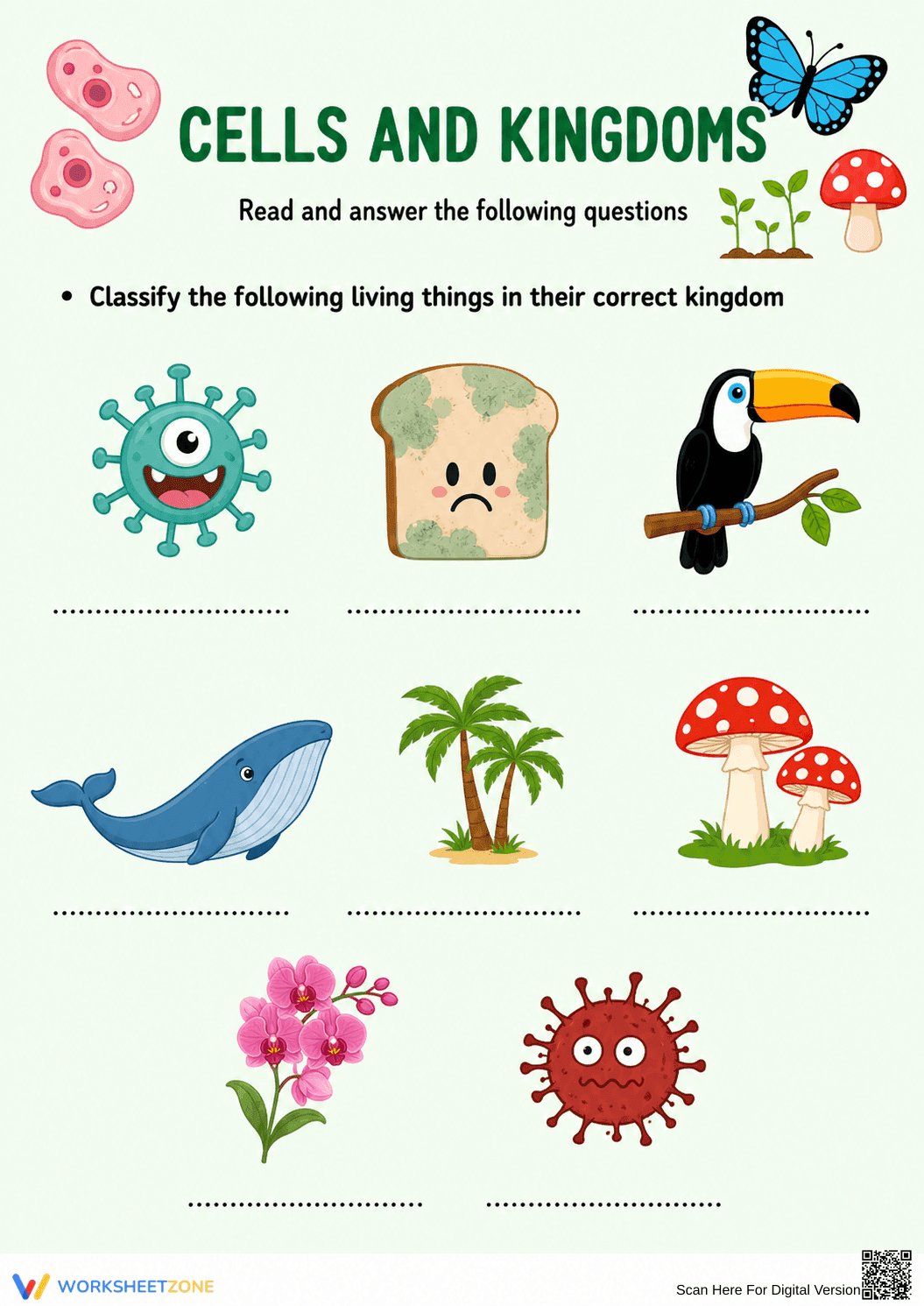
This Grade 10 and 11 biology worksheet provides a focused review of kingdom classification. Students analyze eight distinct biological specimens to determine their taxonomic placement. By identifying key characteristics of organisms like fungi, plants, and animals, learners solidify their understanding of biological diversity and the hierarchical nature of life sciences.
At a Glance
- Grade: 10-11 · Subject: Biology
- Standard:
HS-LS4-1— Communicate scientific information regarding common ancestry and the diversity of biological life- Skill Focus: Kingdom Classification
- Format: 1 page · 8 problems · Answer key included · PDF
- Best For: Formative assessment or quick review
- Time: 15–20 minutes
What's Inside
This single-page PDF features eight high-quality illustrations representing various life forms and biological entities. Students are tasked with classifying each item into the appropriate taxonomic kingdom. The layout includes clear labeling lines beneath each graphic, ensuring a clean and organized student response area. A comprehensive answer key is provided to facilitate rapid grading or self-correction.
Skill Progression
- Guided practice: The worksheet begins with highly recognizable organisms, such as the toucan and whale, allowing students to apply basic animalia classification rules.
- Supported practice: Students transition to more complex specimens like moldy bread and mushrooms, requiring them to distinguish between fungi and other kingdoms based on observable traits.
- Independent practice: The final tasks challenge students to classify specialized plant life and non-living biological agents, testing the limits of their taxonomic knowledge.
This sequence follows a gradual-release model, supporting an I Do, We Do, You Do instructional framework.
Standards Alignment
The primary focus is `HS-LS4-1`, which requires students to communicate scientific information that common ancestry and biological evolution are supported by multiple lines of evidence. By classifying organisms into kingdoms, students demonstrate an understanding of the organizational frameworks used to document biological evolution. Both standard codes can be copied directly into lesson plans, IEP goals, or district curriculum mapping tools.
How to Use It
Use this worksheet as a bell-ringer activity during a unit on taxonomy to gauge prior knowledge before a lecture. Alternatively, assign it as a post-instruction formative assessment to verify that students can apply classification criteria to visual examples. Completion typically takes 15 to 20 minutes. Teachers should observe whether students correctly distinguish between the Fungi and Plantae kingdoms, as this is a common area of confusion.
Who It's For
This resource is designed for high school biology students, including those in general or honors-level courses. It is particularly effective for visual learners who benefit from pictorial representations of biological concepts. It pairs naturally with a kingdom characteristics anchor chart or a direct instruction lesson on the five-kingdom or six-kingdom system.
Effective science instruction requires students to move beyond rote memorization toward the application of taxonomic principles. This worksheet aligns with the HS-LS4-1 standard by requiring students to categorize biological diversity through observable evidence. According to the RAND AIRS 2024 report on science literacy, visual-spatial processing of biological specimens significantly enhances long-term retention of classification hierarchies compared to text-only definitions. By engaging with eight distinct organisms, students practice the critical skill of identifying diagnostic features that define biological kingdoms. This practice is essential for mastering the complexities of evolutionary biology and common ancestry. The inclusion of an answer key supports immediate feedback, a practice Fisher & Frey (2014) identify as vital for the gradual release of responsibility in secondary science classrooms. This resource provides a structured, evidence-based approach to kingdom classification that fits perfectly into any high school biology curriculum or assessment cycle.


