


























Views
Downloads

Essential Cartesian Plane Coordinates Worksheet | Grade 7-8
Paste this activity's link or code into your existing LMS (Google Classroom, Canvas, Teams, Schoology, Moodle, etc.).
Students can open and work on the activity right away, with no student login required.
You'll still be able to track student progress and results from your teacher account.
Students master the Cartesian coordinate system by identifying and plotting points across all four quadrants in this comprehensive practice resource. This worksheet ensures learners move beyond basic recognition to fluid execution, building the spatial reasoning required for future algebraic functions and geometric transformations. Lead with the skill and the student outcome.
At a Glance
- Grade: 7-8 · Subject: Math
- Standard:
CCSS.MATH.CONTENT.6.NS.C.6— Represent points in the plane with negative number coordinates across four quadrants- Skill Focus: Cartesian Coordinate Plotting
- Format: 3 pages · 36 problems · Answer key included · PDF
- Best For: Individual practice or formative math assessment
- Time: 20–30 minutes
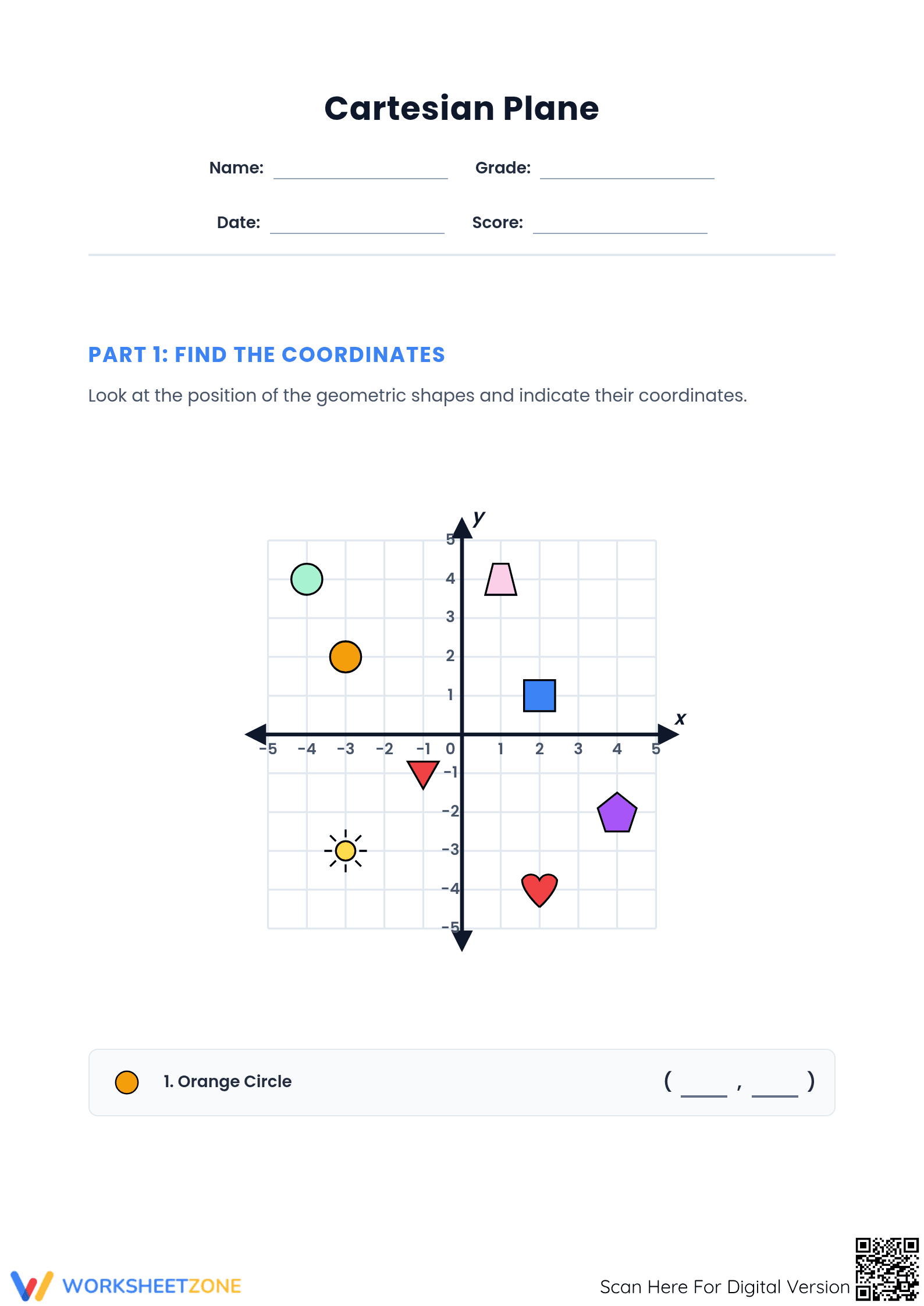
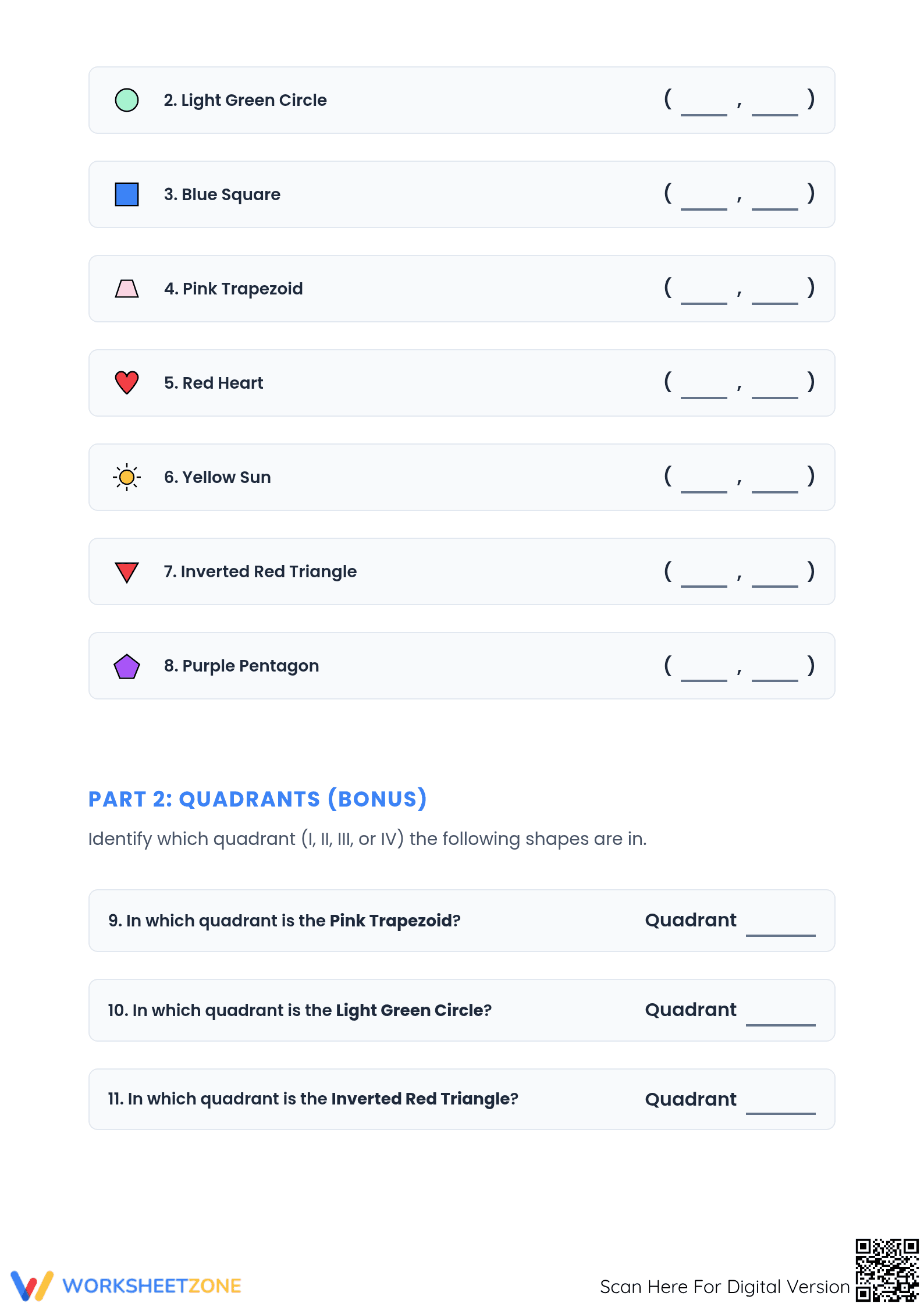
This three-page PDF package includes two pages for identifying point locations and one for plotting coordinates. Across 36 tasks, students encounter points in every quadrant and on the axes. Each page features a labeled Cartesian plane and a workspace for recording pairs. A full answer key is included for rapid grading.
Skill Progression
- Guided practice: Identify coordinates for labeled points on a pre-drawn grid to reinforce axis logic.
- Supported practice: Increased complexity identification tasks test precision across various distances from the origin.
- Independent practice: Transition to plotting using provided pairs to accurately place points on a blank grid.
This follows a gradual-release model, moving from passive identification to active construction.
Standards Alignment
Primary alignment is to `CCSS.MATH.CONTENT.6.NS.C.6`, requiring students to represent points in the plane with negative coordinates. It also supports `CCSS.MATH.CONTENT.6.NS.C.8` regarding graphing points to solve mathematical problems. These codes can be copied directly into lesson plans, IEP goals, or district curriculum mapping tools to ensure instructional consistency and compliance.
How to Use It
Use this resource as a bridge between direct instruction and homework. Assign identification pages as a "Check for Understanding" to catch errors like reversing x/y values. One formative assessment tip is watching for struggles with points on the axes, which reveals conceptual gaps. Expected completion time is approximately 25 minutes.
Who It's For
Designed for Grade 7-8 students solidifying their understanding of integers and coordinate geometry. It's effective for learners needing visual repetition or preparing for linear equations. For differentiation, provide a color-coded signs cheat sheet to support students with processing challenges. Pair this with a coordinate plane anchor chart for impact.
The mastery of Cartesian coordinates is a critical milestone in middle school mathematics, serving as the foundational logic for the Functions and Expressions and Equations domains. According to the RAND AIRS 2024 analysis of mathematical instructional materials, high-frequency practice with coordinate identification significantly improves a student's ability to visualize linear relationships and geometric transformations in later grades. By requiring 36 distinct interactions across all four quadrants, this worksheet addresses common cognitive hurdles through repetitive, successful reinforcement. The inclusion of both identifying and plotting tasks ensures that students develop a bidirectional understanding of the relationship between numerical pairs and spatial locations. This evidence-based approach directly aligns with the procedural fluency demands of the `CCSS.MATH.CONTENT.6.NS.C.6` standard. Educators can confidently integrate this tool into curriculum maps as a verified resource for achieving standard-specific mastery and long-term retention of coordinate geometry principles.


