


























Students will learn how to utilize exponents and radicals to calculate surface area and volume. Students are going to:
- learn how to calculate the volume and surface area of spheres and rectangular prisms.
- recognize the mathematical relationship between surface area and volume.
- use real objects to solve the surface area and volume of rectangular prism problems.
- How may detecting repetition or regularity help you solve problems more effectively?
- How do spatial relationships, such as shapes and dimensions, help to create, construct, model, and portray real-world scenarios or solve problems?
- How might using geometry shape properties help with mathematical reasoning and problem-solving?
- How may geometric properties and theorems be utilized to describe, model, and analyze problems?
- Cylinder: A three-dimensional figure with two circular bases, which are parallel and congruent.
- Irrational Number: Any real number that cannot be expressed as the ratio of two integers, such as π.
- Pythagorean Theorem: A theorem that states the relationship between the lengths of the legs, a and b, in a right triangle and the length of the hypotenuse of the right triangle, c, is a² + b² = c².
- Sphere: A solid figure that has all points the same distance from the center.
- cardboard
- tape
- rulers
- Party Planning Log handout (M-8-6-3_Party Planner)
- Surface Area and Volume worksheet (M-8-6-3_Surface Area and Volume and KEY)
- Student errors on the Surface Area and Volume worksheet will identify specific areas for review.
Scaffolding, Active Engagement, Metacognition, and Modeling
This lesson helps students grasp the connections between length, width, height, radius, circumference, surface area, and volume. Students will learn how to calculate these numbers because they are useful in many real-world scenarios. By the end of this session, students will be able to answer problems using equations for the surface area and volume of rectangular prisms and spheres.
H: The party planner theme includes elements that symbolize surface area and how to measure it. Painting a surface necessitates careful attention to the surrounding region. Filling rooms with balloons necessitates careful attention to volume.
E: In Activity 1, students must divide the task of getting and utilizing an appropriate amount of paint into three components: the number of square feet per gallon, the surfaces to be painted, and the surface area of each painted surface.
R: The Surface Area and Volume worksheet requires students to distinguish between the two metrics. In addition to utilizing the right algorithm, students must demonstrate their ability to compute their answers and assess the reasonableness of their responses.
E: The centerpiece problem requires both surface area and volume for each object. Students must analyze each step, starting with the area of each face of the rectangular prism. Students should be encouraged to review the correctness and appropriateness of their intermediate calculations.
When working with students who struggle to distinguish between surface area and volume, it's advised to focus on one or the other rather than both simultaneously. Remember that the numerical figures for a rectangular prism's surface area and volume may be rather close. A rectangular prism with dimensions of 4 by 5 by 6 cm has a surface area of 148 square cm. Its volume measures 120 cubic centimeters. Allow students to practice their techniques on one concept before moving on to another.
O: This session begins with a hands-on activity in which students create a rectangular prism to review the concepts of surface area and volume. The majority of the course is organized around the concept of planning a party. Throughout the planning process, students learn to calculate the surface area and volume of spheres in a real-world setting. The formulas given are reinforced with a worksheet that allows students to practice applying these principles.
[Note: It may be useful to study the difference between rational and irrational numbers before or during the lesson. For useful activities and materials, see unit M-8-5, "Rational and Irrational Numbers as Decimals and Fractions."
Use the following instance to teach the concepts of surface area and volume. "Today, we are party planners. We will prepare a celebration in this classroom. To budget effectively, we must determine how much it will cost to decorate the room by estimating the measurements of our decorations. We plan to paint the walls, hang piñatas from the ceiling, and determine the number of balloons needed to fill the room two feet deep." Distribute the Party Planning Log (M-8-6-3_Party Planner) to all students. Give students instructions on how to use the handout to follow along with the lesson; they should fill it out as needed.
"Our first activity as a group is to paint the walls. Paint is sold in one-gallon containers, so we don't want to buy too much or too little. A gallon of paint covers about 350 square feet of wall space. What do we need to know to determine how much paint we need?" Students must be aware of how much wall space is available in the classroom for painting. "How do we calculate how much wall space there is?" The answer should be the wall area, which is defined by the height and width of the walls. This is the inside surface area of the classroom, excluding the ceiling and floor.
Activity 1
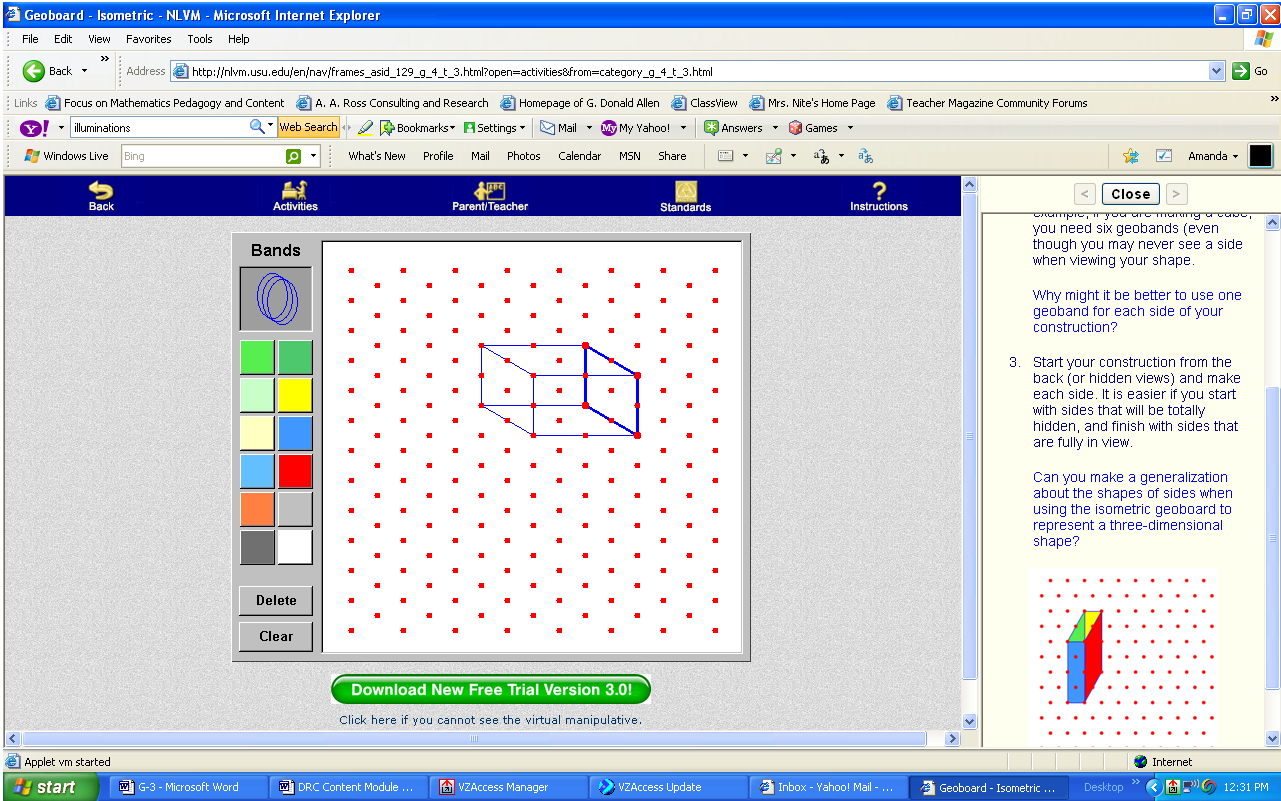
Use the activities below to visualize what surface area of a solid means. "Find a partner and complete the activity below. Six cardboard rectangles are displayed in front of you. Determine the area of each rectangle using the rulers that are in front of you. Once the number is written on each piece of cardboard, create a rectangular prism by taping the sides together. What is each box's surface area?" Students must remember the definition of a rectangular prism and create the appropriate shape. Then, in pairs, they can add the areas of each side to determine the box's surface area.
"Is there any other simpler way to determine the total area besides measuring the areas of each side and adding them together?"
Review the formula: Area = Length × Width. Then ask students to see if any of the two sides are the same. Because each box is a rectangular prism, each side should be the same as its opposite. This indicates that there are three pairings of two rectangles. Because the two are the same, we can multiply their area by two in the final calculation. Because there are three pairs, we must add three areas together, each multiplied by 2.
2 (\(Length_1\) × \(Width_1\)) + 2 (\(Length_2\)×\(Width_2\)) + 2 (\(Length_3\)×\(Width_3\)) = Area, where \(Length_a\) and \(Width_a\) are measurements of matching sides.
"What if we were calculating the surface area of a cube?"
"A cube is equal on all sides, which means that the length and width of each surface are the same. Plugging that into the equation above, 2 (\(Length_1\) × \(Width_1\)) + 2 (\(Length_1\)×\(Width_1\)) + 2 (\(Length_1\)×\(Width_1\)) = 6 (\(Length_1\)×\(Width_1\)).
“Now that we understand how to calculate surface area, we can figure out how much paint we'll need to decorate the classroom walls. The room's dimensions are 30 feet in length, 10 feet in height, and 25 feet in width. We will not paint the 78 square feet of doors and closets and the 72 square feet of windows. How many gallons of paint should we buy?”
Activity 2
The next activity will be to determine the surface area of a sphere. "The next party activity is to paint spherical piñatas for decorations. Because the piñatas are smaller than the walls, we'll buy paint in quarts. Each quart of paint can cover 75 square feet of surface. How many piñatas with a circumference of 5 feet can be painted with one quart of paint?"
Examine the measurements and equations for spheres. "The radius of a sphere is the distance between the center and any point on its surface. The circumference of a sphere is the length around any circle that passes through its center and has the same outer boundary as the sphere."
Draw a circle and name its radius, diameter (d = 2r), and circumference.
On the board, write the following:
The circumference is equal to 2πr, where r is the circle's radius.
"A sphere's surface area is its outer layer. On a globe, it is the layer painted with a world map. It refers to the glassy portion of a spherical lightbulb. On a basketball, it refers to the leather substance." Present all of these items to the class.
Write the equation for a sphere's surface area on the board for students to copy.
SA(sphere) = 4πr², where r represents the radius of the sphere.
"What is the surface area of a basketball with a 30 inch circumference? What do we need to determine first?" Students should respond that they need to calculate the radius.
"How do we find the surface area now that we have calculated the radius?" In response, students should state that the radius must be included in the surface area equation.
SA ≈ 286.5 in.²
"To further understand this measurement, picture a single, square-shaped piece of leather—the material that covers the basketball. The side length of that square is approximately 17 inches (17 × 17 = 289)."
On the board, draw a 17" by 17" square to represent the area compared to the basketball's size.
“Now that you have this knowledge, work in pairs to calculate how many five-foot-circumference piñatas we can paint with one quart of paint to cover seventy-five square feet.”
Activity 3
This activity involves filling a cylinder with spheres. "We wish to buy round candies to fill the several cylinder-shaped vases we have. The vases will serve as the table centerpieces. What details will we require to calculate the quantity of candy required for each centerpiece?" students should reply that they require information on the volume of each candy (i.e., diameter or radius) as well as the volume of each centerpiece (i.e., height and radius).
Inform students that the centerpieces are cylinders with a diameter of two inches and a height of ten inches. "How can the volume of a cylinder be found?" (Multiply the height (πr²h) by the base's area (πr²).) On the board, write the following formula to determine a cylinder's volume:
V(cylinder) = πr²h
Ask students to calculate the estimated volume of each cylinder centerpiece, which equals 125.66 inches³.
Ask the class: "Is it simple for you to measure the radius of a spherical piece of candy that I give you?" Remind students that the radius of a sphere is the distance from the exact center to the outside edge. Students need to understand how challenging it is to find the exact center. "What measurement—radius, diameter, volume, circumference, etc.—is easy to measure for a sphere?" students ought to understand that circumference is the easiest. Inform the students that each candy has a circumference of roughly 3.14 inches. "How can the radius be calculated using the circumference?" Remind students of the circumference formula if needed; they should be able to calculate that the radius is 0.5 inches.
"How can we calculate the volume now that we know the radius?" On the board, write the following equation for a sphere's volume:
V(sphere) = \(4 \over 3\) πr³
Students should calculate the estimated volume of one candy piece, which is 0.523 in³.
"How many of these candies, each taking up 0.523 of a cubic inch, can we fit into a space with a capacity of 125.66 cubic inches? How can we find out?" Students should understand that they can divide 125.66 by 0.523 to get an approximate result of 240.3. "Do we really need to fill the centerpieces with 240 candies?" Ask them if they've ever seen a stack of oranges in a shop or tennis balls stacked in a can. Are they stacked without any space in between? Tell the students that there would be almost no space left in the prism once 240 candies were added. "We'll need less than 240 pieces of candy for each centerpiece because spheres don't pack perfectly, but we can use 240 as a guide. For now, we'll settle for an estimate because it's harder to figure out precisely how many we need."
Activity 4
The lesson's emphasis in this section will be on the volumes of spheres and rectangles. "Our final decorating assignment is to buy enough balloons to fill the classroom to a depth of 2 feet. What information do we need to find this answer?" In response, students ought to state that they require both the balloons' volume and the room's volume at a height of two feet.
Review the dimensions briefly. "Notice that the exponent is the same as the exponent on the unit. The exponent is 1, and the dimensions are one-dimensional: length, width, and height. It has no exponent because we did not put the first one in exponential notation. The units used to report these dimensions are feet, inches, or meters. Surface area is expressed in square feet or square meters since it considers two dimensions. This is commonly stated as m². For a rectangular prism, volume is defined as length, width, and height. Following that, this measurement is usually stated as ft³ or inch³, and it is reported in cubic feet or cubic inches."
One-dimensional (line), circumference, unit has a power 1.
Surface Area, 2-dimensional (square, paper, and depthless), unit has a power of 2.
The 3-dimensional (solid), volume, unit has a power of 3.
Have students determine the volume of the boxes they constructed in Activity 1 following this review.
"What three measurements are required to determine the total volume of this space?" Students should reply that width, length, and height are necessary. The surface area was previously determined using these metrics. W = 25 ft, H = 10 ft, and L = 30 ft. "To calculate the volume, we multiply the length, width, and height. The length and width determine the square footage . To form a solid, we can obtain the third dimension by multiplying this value by the height. 30 × 25 × 10 = 7,500 ft³. What is the volume of the space the balloons need to fill if we only want them to be two feet deep?" Ask students to find this number on their own or in pairs.
30 × 25 × 2 = 1500 ft³.
"Calculating the amount of space each balloon will occupy will help us predict how many balloons we'll need to fill 1500 feet. To put it another way, we require the volume of each balloon. We intend to buy spherical balloons using the formula for a sphere's volume." On the board, write the spherical volume equation.
V(sphere) = \(4 \over 3\) πr³
“Our balloons will have a circumference of 6 feet when they are fully inflated. Work in pairs to solve the balloon problem by applying the previously discussed procedure.”
"When computing the surface area and volume of a sphere, it may be appropriate to leave the answer as a multiple of π. Because π is an irrational number, the answer must be rounded if written as a decimal. To get a precise answer to the problem, leave the solution as some number multiplied by π." Next, distribute the Surface Area and Volume worksheet (M-8-6-3_Surface Area and Volume and KEY) to the students to complete after projecting the following example onto the board.
Example: Determine a sphere with a diameter of 6 inches by finding its surface area and volume.
"In this situation, the numbers are the same, but the unit is different since the surface area is two-dimensional and the volume is three-dimensional. Fill out the worksheet for volume and surface area. You can choose to work alone or in pairs."
Activity 5
"We're going to make a big centerpiece for the main table as well. The centerpiece will be a large rectangular prism with a hollow inside. The centerpiece will be covered with colored paper on the outside and filled with water inside (so we can put flowers in it). First, let's use colored paper to cover the outside. What exactly do we need to know?" Students should say that we need to know the prism's dimensions. Tell them it's 4 inches wide, 14 inches tall, and 6 inches long. "Now, what measurement must we find to determine the required amount of paper?" students should reply, "We need to know the surface area." Instruct students that since we plan to place flowers within our centerpiece, it will not have a top.
Assign students to work in groups of four to five, measuring the area of each side before calculating the surface area. (The surface area should be (4 × 6) + (2 × 4 × 14) + (2 × 6 × 14) = 24 + 112 + 168 = 304 inches².)
"Now, what measurement is required to determine the volume of water that the centerpiece can accommodate?" Students should recognize the necessity of volume. "Does the fact that we are not covering the centerpiece with a top affect this computation?" Students ought to comprehend that this particularity is of no consequence.
Have each student calculate the rectangular prism's volume on their own. (The volume should be 4 x 6 x 14 = 336 inches³.)
Extension:
To adapt the lesson to your students' requirements during the year, use the following options:
Students can reinforce the concepts presented in this lesson by beginning with the surface area and volume of spheres and subsequently calculating the circumference, diameter, and radius. Students will be able to work more with the formulas in reverse thanks to this.
Give the students the following two tasks to do in pairs:
1. Given a sphere with a volume of 972π, what are its surface area, circumference, diameter, and radius? (Instruct students to find the sphere's radius so they may use that value to determine all other measurements.)
(r = 9, d = 18, C = 18π, SA = 324π)
2. Randy can pack 8 balls inside a box with a capacity of 16 ft³. For each ball, what is its diameter? (Have students measure each ball's volume first, then use that information to calculate the diameter by calculating the radius.)

Calculating Surface Area and Volume (M-8-6-3)
Students will learn how to utilize exponents and radicals to calculate surface area and volume. Students are going to:
- learn how to calculate the volume and surface area of spheres and rectangular prisms.
- recognize the mathematical relationship between surface area and volume.
- use real objects to solve the surface area and volume of rectangular prism problems.


