


























The lesson focuses on developing procedural knowledge and conceptual understanding of surface area and volume. Students will:
- draw nets from rectangular prisms to solve surface area problems.
- calculate the surface area and volume of rectangular prisms and cubes.
- solve real-world problems using surface area and volume using a range of problem-solving strategies.
- How may detecting repetition or regularity assist in solving problems more efficiently?
- How do spatial relationships, such as shape and dimension, help to create, construct, model, and represent real-world scenarios or solve problems?
- How may using geometric shape features help with mathematical reasoning and problem solving?
- How may geometric properties and theorems used to describe, model, and analyze problems?
- Congruent Figures: Figures that have the same size and shape. Congruent angles have the same measure; congruent segments have the same length.
- Cylinder: A solid that has two parallel, congruent bases (usually circular) connected with a curved side.
- Net: A two-dimensional shape that can be folded to create a three-dimensional figure.
- Prism: A three-dimensional solid that has two congruent and parallel faces that are polygons. The remaining faces are rectangles. Prisms are named by their bases.
- Surface Area: The sum of the areas of all of the faces of a three-dimensional figure.
- Volume: The amount of space found within a solid.
- “data-show” projector connected to a computer
- http://www.learner.org/interactives/geometry/area_surface.html
- http://www.learner.org/interactives/geometry/area_volume.html
- list of real-world situations, involving either surface area or volume (to be developed ahead of the lesson)
- copies of the Calculating Surface Area and Volume table (M-6-4-2_Surface Area and Volume and KEY)
- copies of the exit ticket (M-6-4-2_Exit Ticket and KEY)
- Observations from Activity 1: Real-World Needs will help determine how well students understand the concepts.
- Use the Calculating Surface Area and Volume table to evaluate students' understanding.
- Observations during the Applying Surface Area and Volume activity will help identify which students may need more learning opportunities.
- Use the exit ticket to assess student comprehension.
Scaffolding, Active Engagement, Modeling and Formative Assessment
W: Begin the lesson by explaining how to calculate surface area and volume and apply it to real-world problems.
H: To engage students, use the link provided to demonstrate surface area and volume for different solids. Allow students to complete the table independently.
E: Provide real-world scenarios that require students to address problems by using surface area or volume. Nets, drawings, and calculations may be used as needed in solutions.
R: Discuss the trade-offs of more volume versus more surface area of a solid. Have them determine which conditions make one or the other more advantageous. Ask groups to share their findings.
E: Have students fill out the exit ticket to assess their understanding of the lesson.
T: Use the Extension section to personalize the lesson to the students' specific requirements. The Routine section contains suggestions that can be adopted throughout the school year to keep students' abilities sharp while calculating volume and area. The Small Group section describes numerous methods for providing more support to students who would benefit from more learning opportunities. The Expansion section suggests exercises that will push students who are ready to go above and beyond the requirements of the standards.
O: This lesson teaches students how to calculate volumes and surface areas, as well as investigate the relationships between the two different concepts.
In this lesson, students learn about rectangular prisms by conducting investigations. Students use nets to better grasp the surface area and volume of prisms. The lesson is purposely organized from a student-centered perspective, giving them real experience calculating surface areas and volumes using a variety of methods and prism examples.
"What's the difference between two and three dimensions? You can answer this basic question by taking specific measurements of familiar items, cubes and rectangular prisms. We already know how to calculate the area of a rectangle and a square. Now we may use that knowledge to calculate the area of the faces of a cube or rectangular prism. Because every cube is a rectangular prism with six faces, calculating the surface area requires systematically summing the areas of all six faces. Finding the volume requires only one arithmetic operation: "length × width × height."
In this lesson, students will learn how to calculate surface area and volume, determine when each measurement is suitable, and apply the processes required to solve real-world surface area and volume problems. They will use their findings to justify the best option in a specific situation, as well as to think critically about how to broaden a problem.
To reinforce the topics learned in Lesson 1, you will offer two animated activities called Interactives from Annenberg Media:
1. Explore and Play with Surface Area
http://www.learner.org/interactives/geometry/area_surface.html
Play the animation on a "data-show" projector connected to a computer and teach how to enter values for each face of the prism and assess whether an entry is correct or erroneous. Depending on the number of computers available in the classroom, students should be divided into groups and given the opportunity to experiment with the activity while working with at least three different rectangular prisms.
2. Find the Volume of a Rectangular Prism
http://www.learner.org/interactives/geometry/area_volume.html
Again, repeat the animation and show how to enter numbers for the number of cubes, layers, and volume of the rectangular prism. The same groupings and teaching method should be used for this assignment.
“Take a few minutes to calculate the surface area and volume of the rectangular prisms shown in the table. We'll look at the first one together.”
"Now, fill in the remaining four rows. Remember that the area of the base can be calculated by multiplying the width and length."
Rectangular Prism Dimension: Surface Area and Volume
Activity 1: Real – World Needs
Make a list of real-world scenarios that include either surface area or volume. Ask students to decide which measurement should be used. A few instances are provided below:
The amount of wrapping paper required to wrap a gift (SA)
Packaging of a food container (SA) and amount of food inside (V)
Water in a swimming pool or fish tank (V).
The amount of paint required to paint the walls in a room or the outside faces of a figure (SA)
Optional Review: Drawing a Net to Solve
Example 1
“We will find the surface area of the rectangular prism shown by first drawing a net.”
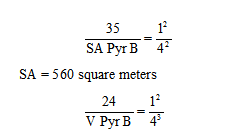
“We can find the surface area using two steps.”
1. Find the area of each face
a. Area of the top or bottom (7 × 2 = 14)
b. Area of either side (2 × 4 = 8)
c. Area of the front or back (7 × 4 = 28)
2. Sum the areas of all 6 faces (2(14) + 2(8) + 2(28) = 28 + 16 + 56 = 100)
Example 2
“We will find the surface area of the rectangular prism shown by first drawing a net.”
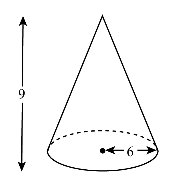
“We can find the surface area using two steps:”
1. Find the area of each face
a. Area of the top or bottom (3 × 2 = 6)
b. Area of either side (2 × 9 = 18)
c. Area of the front or back (3 × 9 = 27)
2. Sum the areas of all 6 faces (2(6) + 2(18) + 2(27) = 12 + 36 + 54 = 102)
Calculating Surface Area and Volume
Create a table with two rectangular prisms with columns for dimensions, surface area, and volume, similar to the one on the Calculating Surface Area and Volume table (M-6-4-2_Surface Area and Volume and KEY). Have students finish the table.
Surface Area and Volume Word Problems
Example 1
A gourmet cheese company is developing a new plastic wrap to cover its latest product, which is wrapped in a box measuring 12 inches by 6 inches by 4 inches. What is the least amount of plastic wrap required to cover the box?
"We must first determine the least amount of plastic wrap required in measurement terms. Any ideas?" (The surface area reveals the outside of the box. This area is equivalent to the least amount of plastic wrap required to cover the box.) "Correct. We're simply searching for surface area here. We can calculate the surface area as follows:
SA = 2lw + 2lh + 2wh
SA = 2(12 × 6) + 2(12 × 4) + 2(6 × 4)
SA = 2(72) + 2(48) + 2(24)
SA = 144 + 96 + 48
SA = 288
"So, the least amount of plastic wrap needed to cover the box is 288 in²."
Example 2
Sarah gets a box of dark chocolate-covered strawberries as a gift. The box has dimensions of 6 inches by 4 inches by 2 inches. Sarah has how many strawberries in her box if each strawberry takes up 1 cubic inch?
"As previously, we must determine what we are being asked. What kind of measurement are we looking at here?" (The volume provides information about the amount of space within a container.) "Correct. We're searching for volume in this scenario. We can calculate the volume as follows:
V = lwh
V = 6 × 4 × 2
V = 48
"If each strawberry occupies 1 cubic inch of space and the volume is 48 cubic inches, then the box contains 48 strawberries."
Example 3
Jonas has 120-cubic-inch boxes that need to be packed into a larger box. The box he has measures 10 inches long and 4 inches wide. How tall should the box be?
"As previously, we must determine what we are being asked. What kind of measurement are you looking for?" (The volume provides information about the amount of space in a container.) "Correct. We'll use the volume formula, but what's different this time?" (Rather than searching for the volume, we will use it to find the missing height.)
V = lwh
120 = 10 × 4 × h
120 = 40h
3 = h
"The height of the box is 3 inches."
Activity 2: Applying Surface Area and Volume
Students will work in four or five groups to calculate the classroom's surface area and volume. They will respond to the following questions:
To cover the classroom walls and ceiling, how many gallons of paint are required if one gallon covers 350 ft²?
How could you use your knowledge of classroom volume to practical purposes, related or unrelated to the painting scenario? Provide a detailed description with at least two instances. (Examples include: establishing the room's maximum capacity in adherence to public safety requirements; obtaining new furniture to fill the room; buying balloons to decorate the room for a class party; etc.)
Activity 3: Comparing Buildings
Have students collaborate with a partner to answer the following questions.
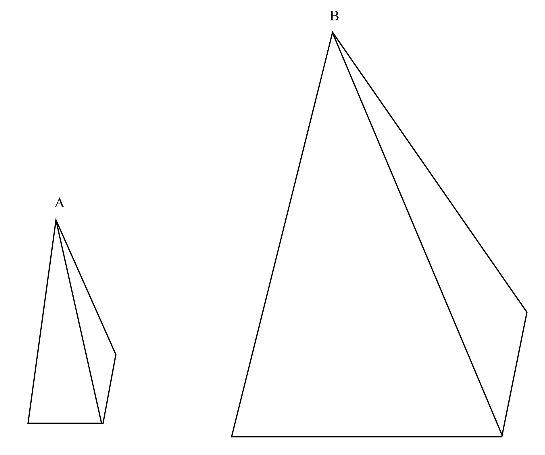
Look at the two buildings below. Which building takes more construction materials? Which building design offers more space? (A cube-shaped construction requires more materials but has more space.)
You are an architect who works with clients to develop structures that meet their budget and space requirements. The client will pay an average of $5 per square foot for building materials in either design. After looking at your results, which option would you choose if you wanted to get more space for your money?
(Building 1 (30 ft. by 30 ft. by 30 ft.):
Surface area: 5,400 ft²; Volume: 27,000 ft³.
Building 1 will cost more ($1,000), but you will gain 3,000 more cubic feet of space.
Building 2 (30 ft. by 20 ft. by 40 ft.):
Surface area: 5,200 ft²; Volume: 24,000 ft³.
Building 2 will cost less to build, but you will have 3,000 less cubic feet of space.
Best Choice:
Building 1 is the greatest option since a ratio of additional space to cost (3000/1000 or 3:1) indicates that the extra space is three times the cost of that additional space. That seems to be a pretty good deal.)
Activity 4: Finding Missing Dimensions
Rectangular Prism Dimensions: Missing Dimension and Volume
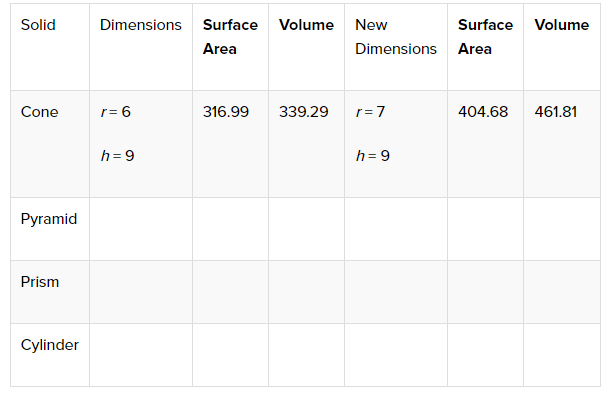
Debate Activity
Divide the class into two groups. Have them talk about the trade-off between more volume and more surface area. Ask students to evaluate why a larger volume is preferable to a smaller volume with a greater surface area. Similarly, under what conditions is a larger surface area preferable to a smaller surface area with a greater volume? Following the small group discussions, combine the discussions with both groups to share the outcomes.
Word-Problem Activity
Divide students into groups of three or four and assign each group to write a real-world problem including the calculation of both surface area and volume. Students will then discuss their problems with the class.
Ask students to fill out an exit ticket (M-6-4-2_Exit Ticket and KEY).
Extension:
Use the following strategies to personalize the lesson to individual needs and interests:
Routine: Throughout the time that students are studying the concepts of surface area and volume, a classroom discussion comparing and contrasting surface area and volume would provide students with numerous opportunities to discuss, verbalize, reason, and justify their ideas about these concepts. Throughout the school year, students can revisit concepts about nets and three-dimensional figures by making their own nets and then discussing the shape of the net, the resulting figure, its volume, and/or surface area.
Small Group: Students who could benefit from more practice or teaching might find the following activity useful. Bring three to four empty dry food boxes of various shapes, such as cereal, pasta, or crackers. Ask students to rate them first by volume, then by surface area. Do not measure or allow students to measure the boxes; instead, have them estimate using visual inspection. After attaining some level of agreement, measure the boxes and compare the results to the students' estimates. Ask students to describe which measure they think was more difficult to estimate: surface area or volume.
Some practice worksheets for calculating the volume of rectangular prisms may be found here: http://www.mathatube.com/files/Volume_of_a_Rectangular_Prism_worksheet_1.pdf
Expansion: Ask students to write a real-world problem with cylinders, surface area, and/or volume. Students who are ready to go beyond the requirements of the standard may find the following worksheet tough and intriguing. http://www.nrcs.k12.oh.us/Downloads/Comparing%20Surface%20Area%20and%20Volume%20Typed.pdf

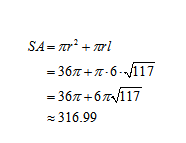
Calculating Surface Area and Volume in the Real World (M-6-4-2)
The lesson focuses on developing procedural knowledge and conceptual understanding of surface area and volume. Students will:
- draw nets from rectangular prisms to solve surface area problems.
- calculate the surface area and volume of rectangular prisms and cubes.
- solve real-world problems using surface area and volume using a range of problem-solving strategies.


