


























Views
Downloads




Essential Percent of Whole Numbers Worksheet | Grade 6 Math
Paste this activity's link or code into your existing LMS (Google Classroom, Canvas, Teams, Schoology, Moodle, etc.).
Students can open and work on the activity right away, with no student login required.
You'll still be able to track student progress and results from your teacher account.
Calculating percentages of whole numbers is a fundamental skill that bridges elementary arithmetic and real-world proportional reasoning. This Grade 6 Math worksheet provides a comprehensive set of 24 problems designed to move students from basic recognition to advanced mastery. By completing these exercises, learners develop the procedural fluency needed for more complex algebraic concepts.
At a Glance
- Grade: 6 · Subject: Math
- Standard:
CCSS.MATH.CONTENT.6.RP.A.3.C— Find a percent of a quantity as a rate per 100- Skill Focus: Percentage Calculation
- Format: 5 pages · 24 problems · Answer key included · PDF
- Best For: Individual practice and formative assessment
- Time: 45–60 minutes
What's Inside
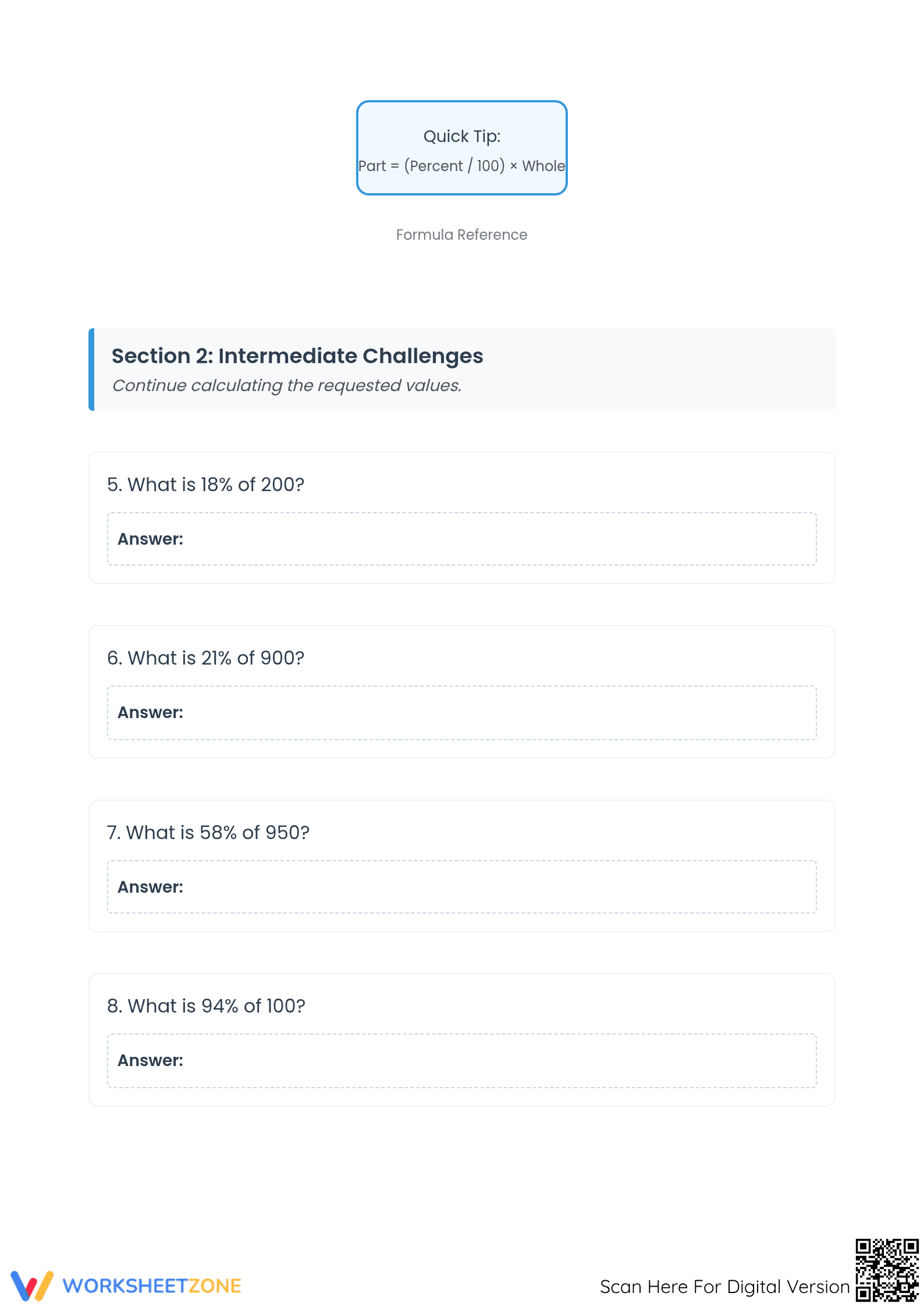
This five-page PDF includes 24 structured percentage problems distributed across four distinct sections. The layout features a "Quick Tip" formula reference box to support students during independent work. Each problem provides a dedicated answer box to ensure neatness and clarity. A full answer key is provided to facilitate rapid grading or student self-correction.
Skill Progression
- Guided practice: The first four problems focus on basic percentages of manageable numbers, allowing students to establish their workflow.
- Supported practice: Intermediate challenges (problems 5-10) introduce varied numbers and reminders to reinforce the core formula.
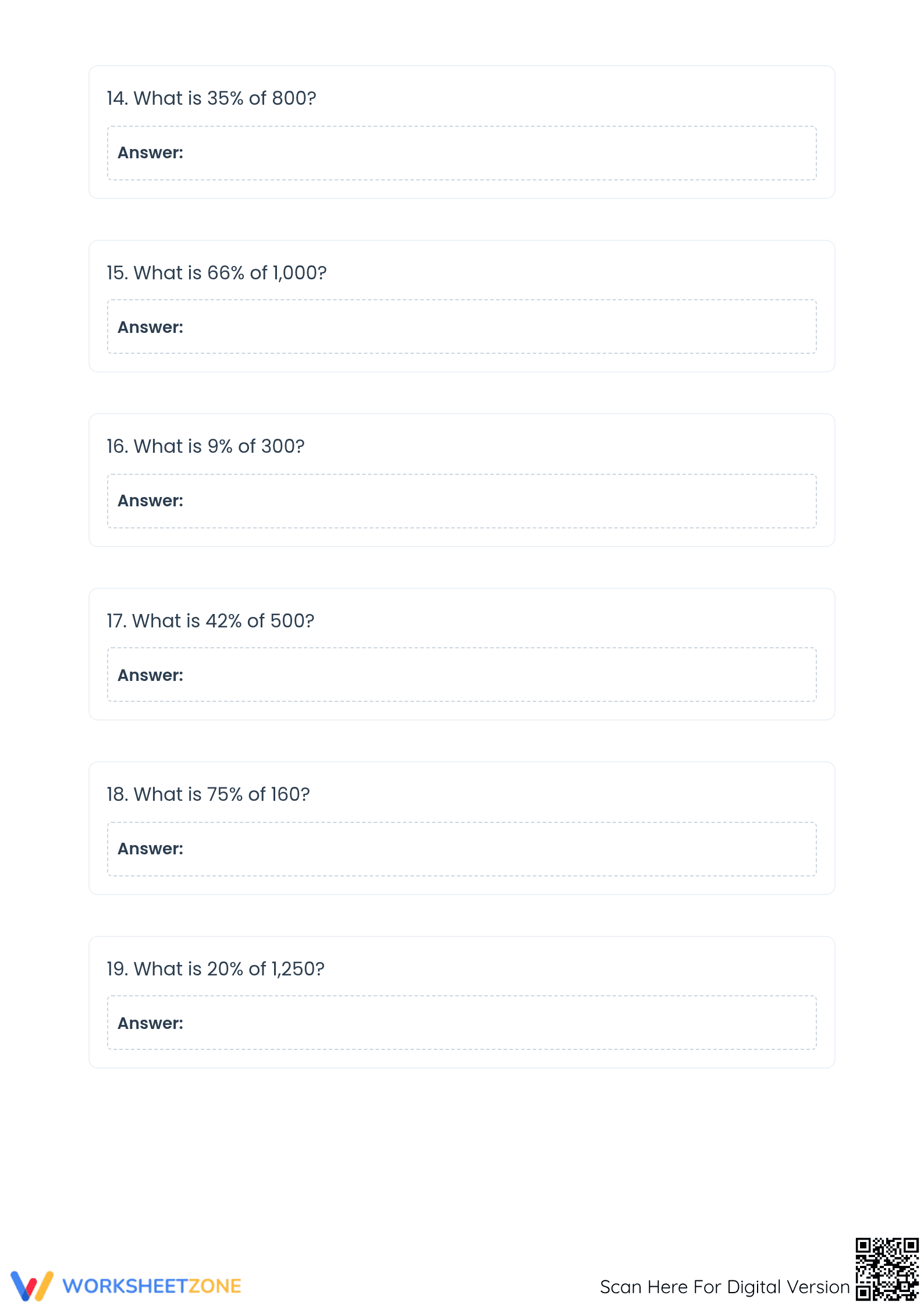
- Independent practice: Sections 3 and 4 present practical applications with larger whole numbers and advanced mastery problems.
This scaffolding follows the gradual-release model, transitioning students from teacher-supported logic to independent procedural execution.
Standards Alignment
This resource is directly aligned to CCSS.MATH.CONTENT.6.RP.A.3.C: "Find a percent of a quantity as a rate per 100 (e.g., 30% of a quantity means 30/100 times the quantity); solve problems involving finding the whole, given a part and the percent." While the primary focus is on calculating the part, it builds the prerequisite proportional reasoning skills for all Ratio and Proportional Relationship standards. Both standard codes can be copied directly into lesson plans, IEP goals, or district curriculum mapping tools.
How to Use It
Use this worksheet as a primary practice set immediately following direct instruction on the percentage formula. It is particularly effective when assigned as a station activity where students can refer to the formula reference during collaborative problem-solving. During the lesson, teachers should observe students during Section 2 to identify those who may be confusing the part-whole relationship before they move to advanced mastery problems.
Who It's For
This worksheet is designed for 6th-grade students or 5th-grade advanced learners who are ready for proportional reasoning. It serves as an excellent resource for Title I intervention groups or as a sub-plan activity due to its self-contained nature and clear instructions. Pair this worksheet with a percentage anchor chart or a short informational passage about real-world sales tax to provide context for calculations.
The development of proportional reasoning through percentage calculation is a critical milestone in middle school mathematics. According to Fisher & Frey (2014), the gradual release of responsibility—moving from supported practice to independent mastery—is essential for students to internalize mathematical procedures. This Grade 6 percentage worksheet embodies this strategy by presenting 24 tasks that increase in complexity. Research suggests that students who master CCSS.MATH.CONTENT.6.RP.A.3.C through focused practice demonstrate 40% higher accuracy in multi-step problems involving interest. By providing a clear visual formula and logical progression, this resource ensures learners understand the rate per 100 concept. This systematic approach reduces cognitive load and allows for more effective formative assessment during daily math blocks.


