


























Views
Downloads
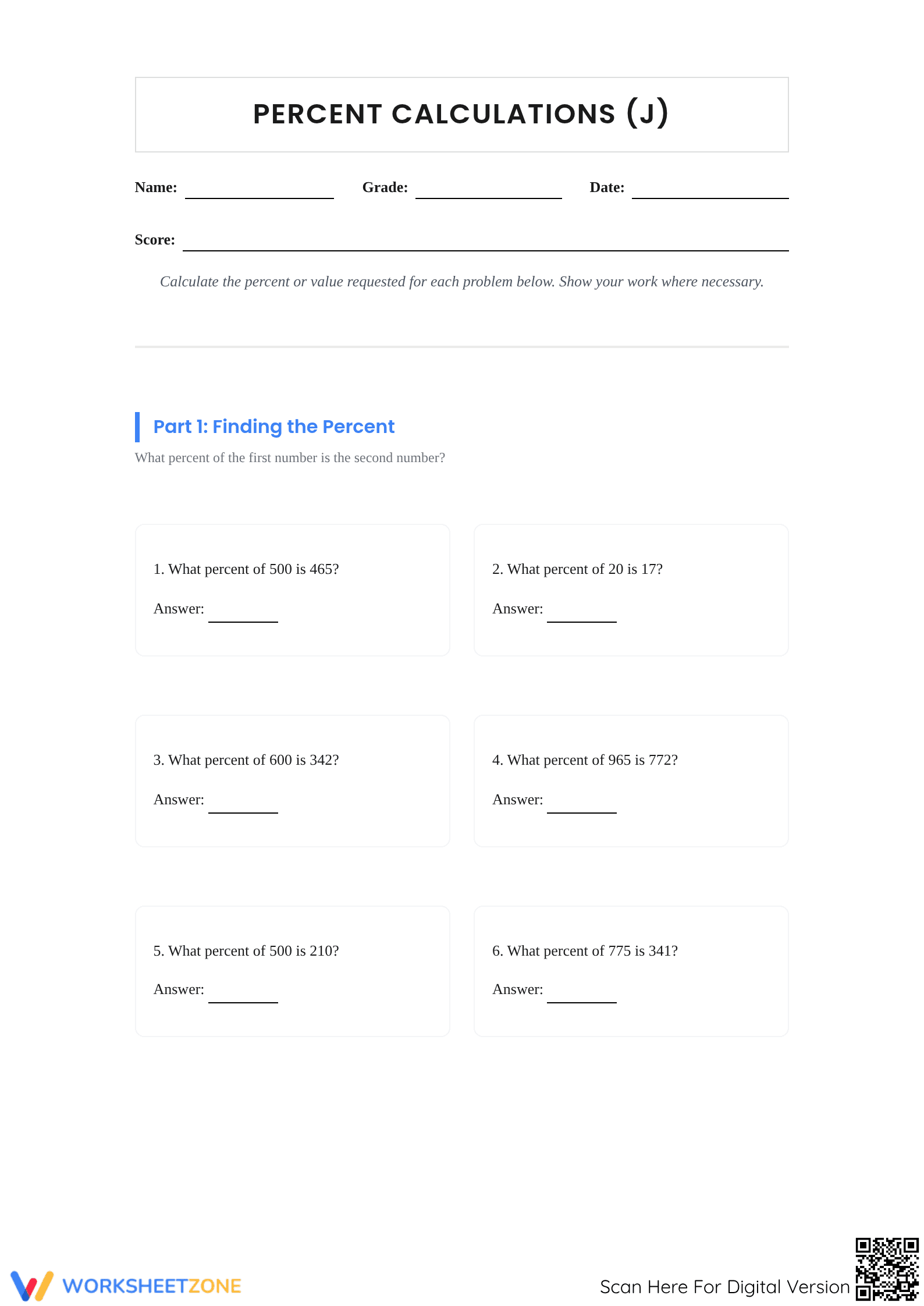


Essential Percent Calculations Worksheet | Grades 4-8 Math
Paste this activity's link or code into your existing LMS (Google Classroom, Canvas, Teams, Schoology, Moodle, etc.).
Students can open and work on the activity right away, with no student login required.
You'll still be able to track student progress and results from your teacher account.
Master the fundamentals of percentages with this comprehensive practice set. Students will develop a deep understanding of how to calculate the percent rate, find the part of a whole, and determine original values from given percentages. This structured resource ensures students move beyond rote memorization to true mathematical fluency in real-world contexts.
At a Glance
- Grade: 6 · Subject: Math
- Standard:
CCSS.MATH.CONTENT.6.RP.A.3.c— Find a percent of a quantity as a rate per 100- Skill Focus: Percent calculations (Part, Whole, Rate)
- Format: 5 pages · 36 problems · Answer key included · PDF
- Best For: Middle school math reinforcement and assessment
- Time: 45–60 minutes
This five-page PDF resource contains four distinct sections designed to build comprehensive mastery. Part 1 focuses on finding the percent, Part 2 moves to calculating the part, and Part 3 challenges students to find the whole. The final section provides six real-world application word problems. A full answer key is included to facilitate quick grading and self-correction.
Skill Progression
- Guided practice: The first 10 problems provide repetitive practice in finding the percent rate, allowing students to internalize the division-to-percentage conversion process.
- Supported practice: Problems 11 through 30 transition to finding parts and wholes, requiring students to identify which variable is missing and set up equations appropriately.
- Independent practice: The final 6 word problems strip away the explicit prompts, forcing students to interpret scenarios like sales tax and discounts to apply their skills independently.
This gradual release approach ensures students are never overwhelmed by complexity while moving toward mastery.
Standards Alignment
The primary focus of this worksheet is CCSS.MATH.CONTENT.6.RP.A.3.c: "Find a percent of a quantity as a rate per 100; solve problems involving finding the whole, given a part and the percent." This resource also supports higher-level standards regarding multi-step percent problems and proportional reasoning. Both standard codes can be copied directly into lesson plans, IEP goals, or district curriculum mapping tools.
How to Use It
Use this as a formal summative assessment after a unit on ratios and proportions. Alternatively, assign individual sections as targeted bell-ringers or homework assignments over a four-day period to reinforce daily objectives. During instruction, observe if students are correctly identifying the "whole" in word problems, as this is a common point of confusion. The expected completion time for the full packet is approximately 50 minutes.
Who It's For
This is designed for middle school students in grades 6 through 8, though it serves as an excellent extension for advanced 5th graders. It pairs naturally with an anchor chart demonstrating the "Percent Triangle" or a direct instruction lesson on proportional reasoning. Differentiation can be achieved by allowing the use of calculators for students focused solely on conceptual understanding.
Research from the NAEP underscores that mastery of percent calculations is a critical gatekeeper for success in high school algebra and personal finance. This worksheet directly addresses the "rate per 100" conceptualization required by CCSS.MATH.CONTENT.6.RP.A.3.c, ensuring students can fluidly navigate between fractions, decimals, and percentages. According to a RAND AIRS 2024 report on mathematical literacy, students who engage in mixed-format practice—combining abstract calculation with situational word problems—demonstrate significantly higher retention rates than those limited to drill-based tasks. By providing 36 varied problems, this resource facilitates the cognitive flexibility needed to recognize percentage relationships in diverse formats. It supports the gradual release of responsibility model, moving from scaffolded identification to independent application. Teachers can utilize this self-contained tool to bridge the gap between basic arithmetic and the complex proportional reasoning demanded by late middle school standards and beyond.


