


























Views
Downloads

Printable Distance Formula Worksheet | Grades 7-9 Math
Paste this activity's link or code into your existing LMS (Google Classroom, Canvas, Teams, Schoology, Moodle, etc.).
Students can open and work on the activity right away, with no student login required.
You'll still be able to track student progress and results from your teacher account.
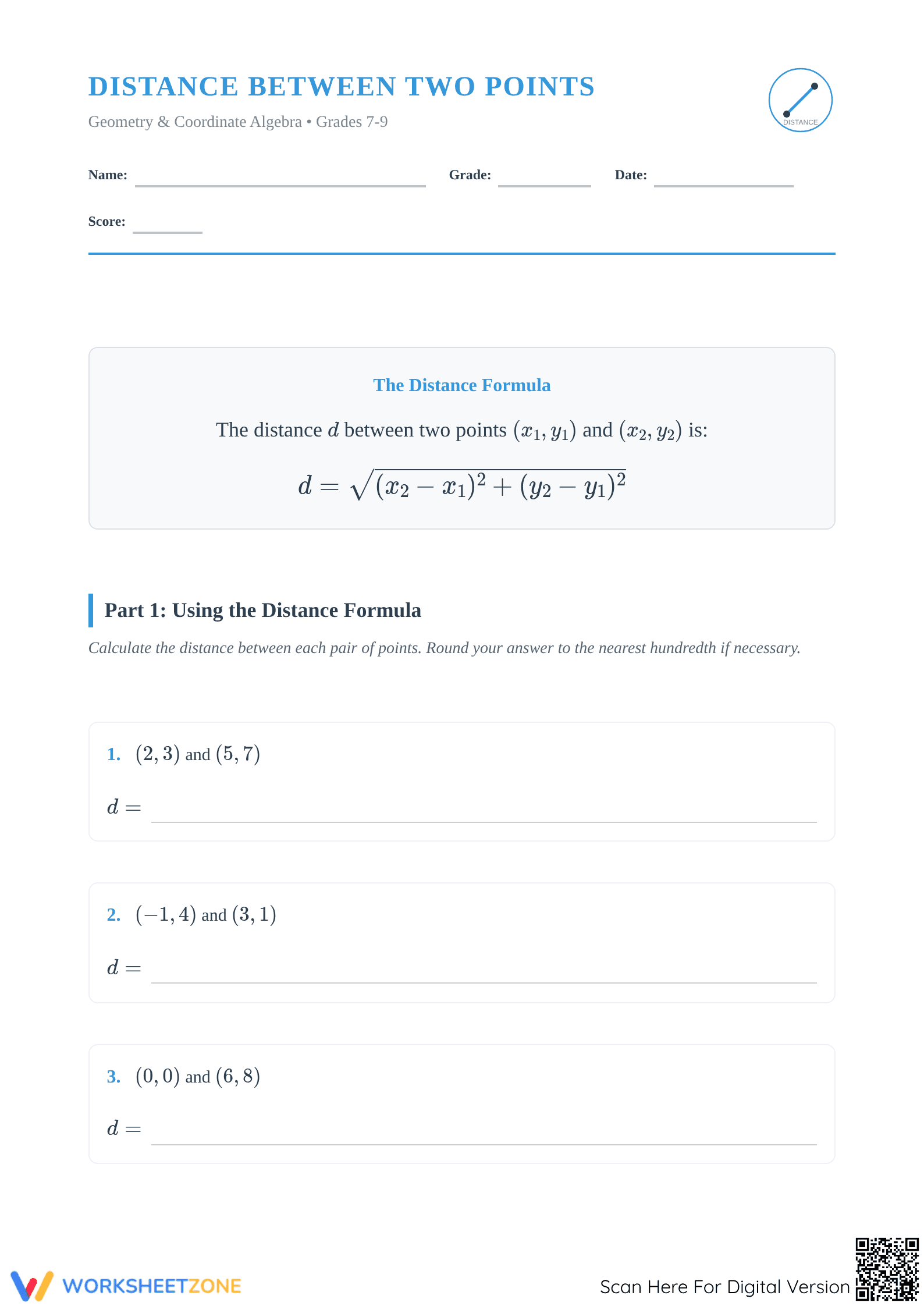
This comprehensive math worksheet empowers students to master the distance formula through a structured three-part progression. By calculating the straight-line distance between coordinate pairs and applying the Pythagorean Theorem to real-world scenarios, learners build essential geometry skills. It provides the rigorous practice needed to fluently compute lengths on the coordinate plane.
At a Glance
- Grade: 8 · Subject: Math
- Standard:
CCSS.MATH.CONTENT.8.G.B.8— Apply the Pythagorean Theorem to find the distance between two points- Skill Focus: Distance Formula Application
- Format: 4 pages · 16 problems · Answer key included · PDF
- Best For: Geometry unit practice and formative assessment
- Time: 30–45 minutes
What's Inside
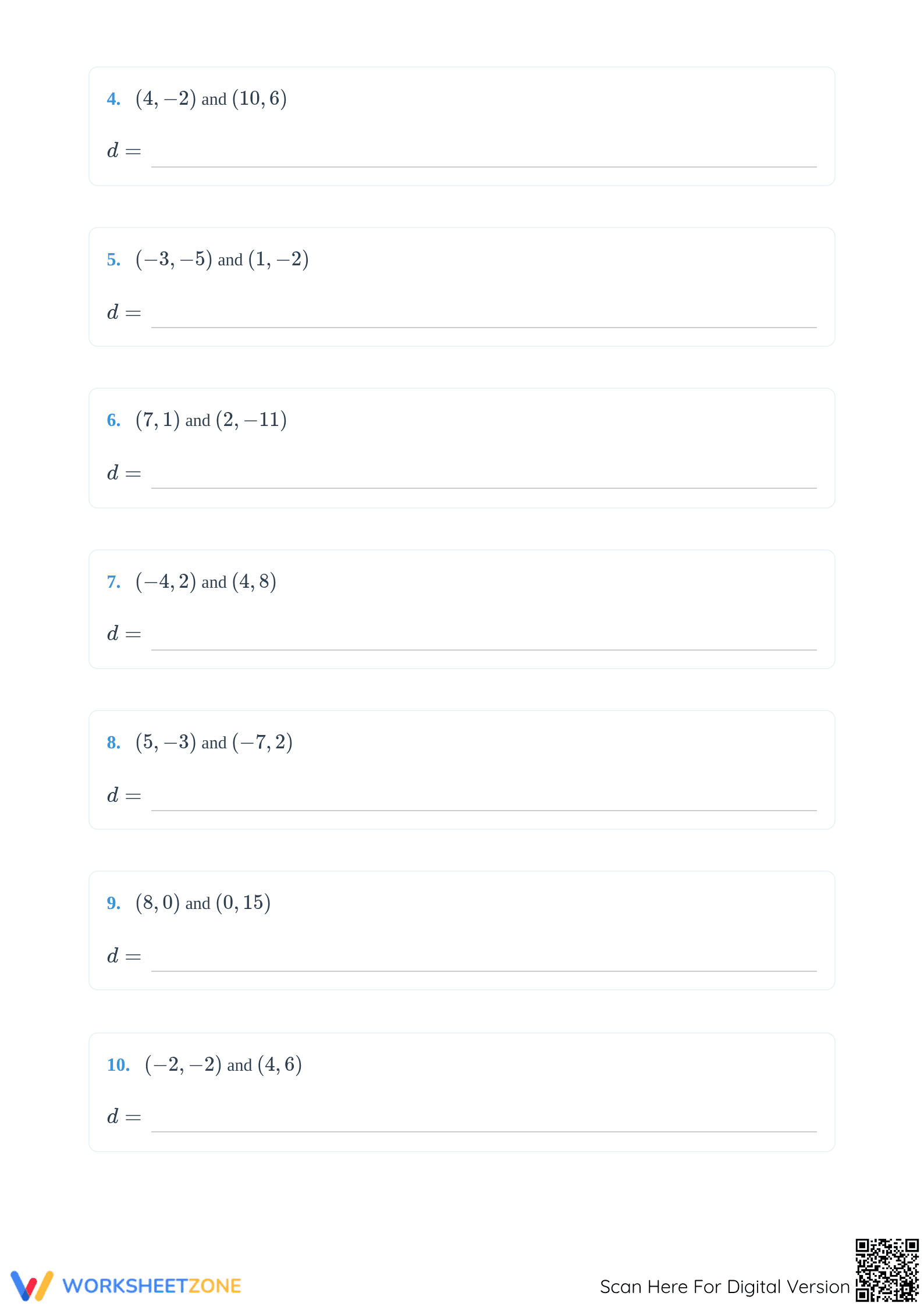
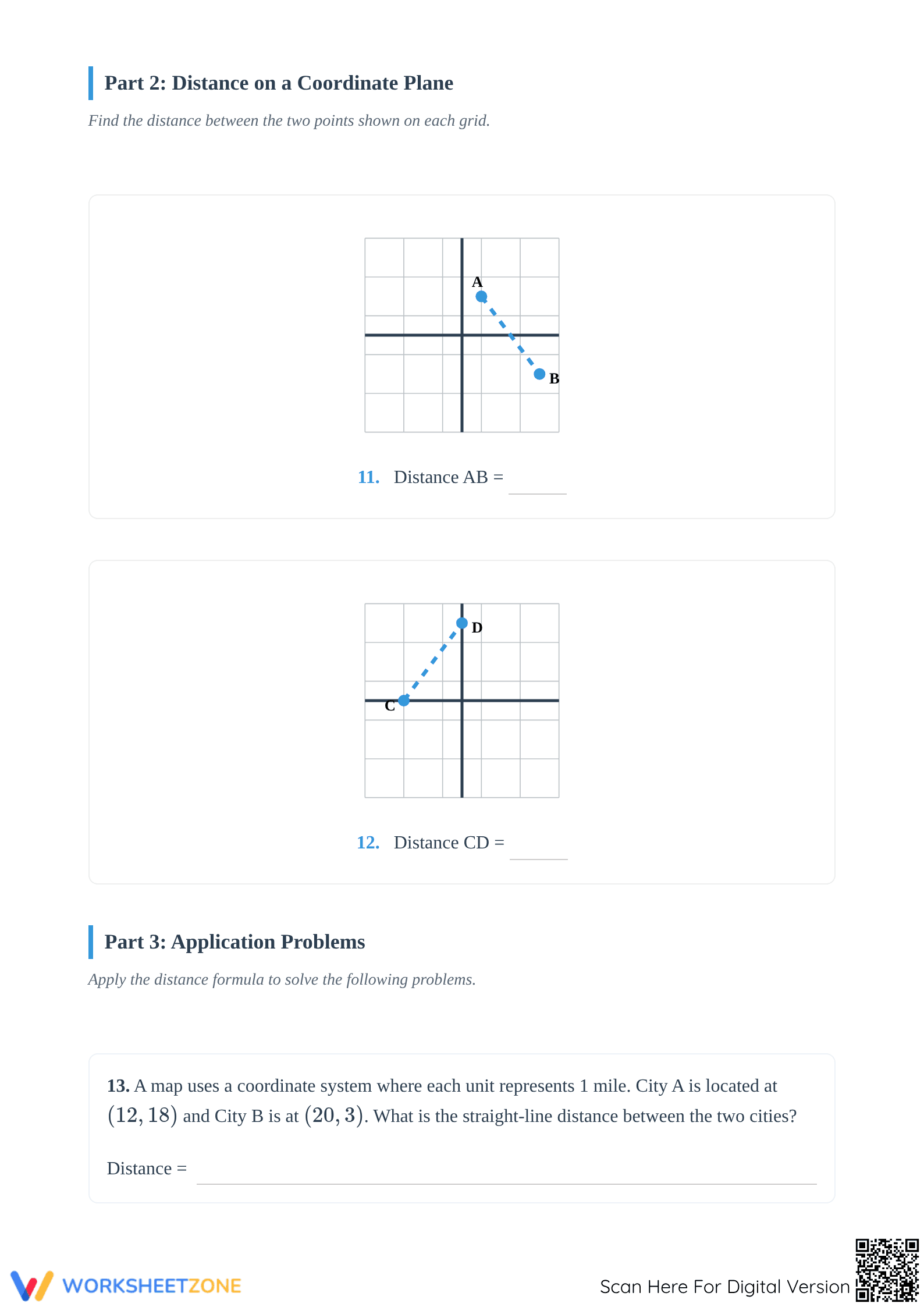
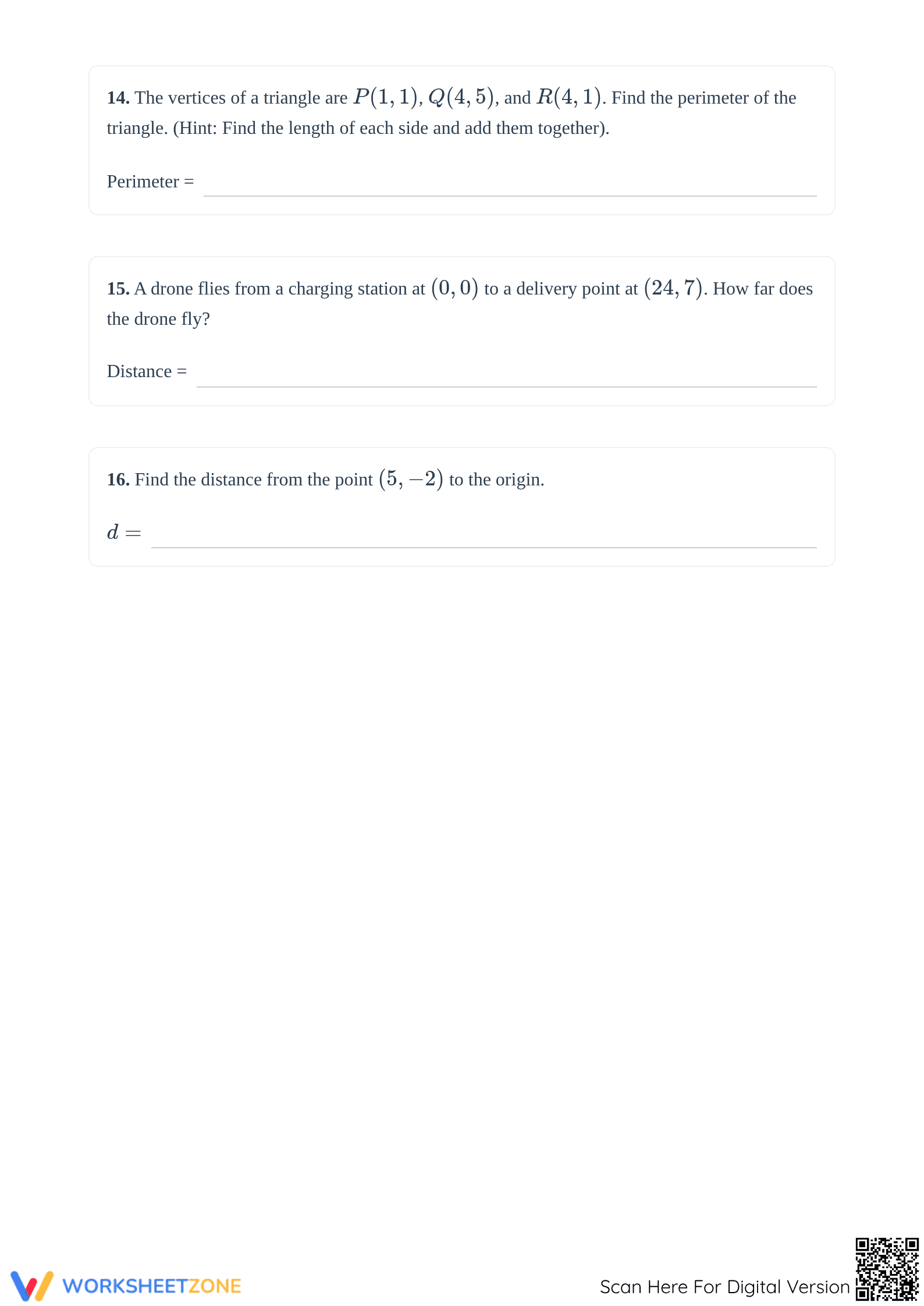
Inside this 4-page PDF, teachers will find the distance formula followed by 16 targeted problems. The first section focuses on procedural fluency with ten pairs of coordinates. Part two transitions to visual literacy with grid-based problems, while the final section challenges students with four multi-step application tasks. A complete answer key is provided for efficient grading.
Skill Progression
- Guided Practice: Ten procedural problems establish computational accuracy and rounding habits using coordinate pairs and the provided distance formula.
- Supported Practice: Visual problems on coordinate grids help students translate geometric representations into algebraic expressions by identifying points.
- Independent Practice: Four complex application problems require students to apply knowledge to perimeters and real-world distance scenarios like drone flight paths.
This intentional sequence supports the I Do, We Do, You Do methodology, moving from formulaic substitution to abstract problem-solving.
Standards Alignment
This resource is explicitly aligned to `CCSS.MATH.CONTENT.8.G.B.8`, which requires students to apply the Pythagorean Theorem to find the distance between two points in a coordinate system. It also supports mathematical modeling as students solve real-world distance problems. Both standard codes can be copied directly into lesson plans, IEP goals, or district curriculum mapping tools.
How to Use It
Deploy this worksheet during the "You Do" phase of a lesson on coordinate algebra. It serves as an excellent tool for independent practice after students have been introduced to the Pythagorean Theorem's application to distance. For a formative assessment tip, observe students during Part 2 to ensure they are correctly identifying coordinates from the grid. Expected completion is 35 minutes.
Who It's For
This resource is designed for Grade 8 students, though it is highly appropriate for Grade 7 advanced learners or Grade 9 students needing a geometry refresher. It is particularly effective for students who benefit from structured space to show their work. Pair this worksheet with a coordinate plane anchor chart or a digital graphing calculator to support visual learners.
Effective mathematical instruction requires a balance of procedural fluency and conceptual application, a principle central to this distance formula resource. By transitioning from isolated coordinate pairs to complex word problems involving triangle perimeters and drone flight paths, the worksheet aligns with the Gradual Release of Responsibility model. According to research by Fisher & Frey (2014), this "I Do, We Do, You Do" approach significantly improves student retention of abstract algebraic concepts by providing necessary scaffolds before demanding independent mastery. This 4-page packet addresses CCSS.MATH.CONTENT.8.G.B.8 by requiring learners to not only compute distances but also interpret them within the context of the coordinate plane. The inclusion of sixteen varied tasks ensures that students encounter multiple representations of the same geometric principle, which is essential for developing the cognitive flexibility required for high-school-level coordinate algebra and advanced geometry units.


