


























Views
Downloads




Printable Initial Value Percentage Worksheet | Grade 6 Math
Paste this activity's link or code into your existing LMS (Google Classroom, Canvas, Teams, Schoology, Moodle, etc.).
Students can open and work on the activity right away, with no student login required.
You'll still be able to track student progress and results from your teacher account.
This comprehensive worksheet guides students through the process of calculating the original whole when given a specific percentage and its corresponding value. By bridging core concepts with real-world applications in finance and retail, learners develop a deep understanding of inverse percentage operations. Students will master the transition from abstract numbers to practical problem-solving.
At a Glance
- Grade: 6 · Subject: Math
- Standard:
CCSS.MATH.CONTENT.6.RP.A.3.C— Find the whole quantity given a part and the percentage- Skill Focus: Finding the initial value (inverse percentages)
- Format: 5 pages · 27 problems · Answer key included · PDF
- Best For: Independent practice or formative assessment
- Time: 45–60 minutes
What's Inside
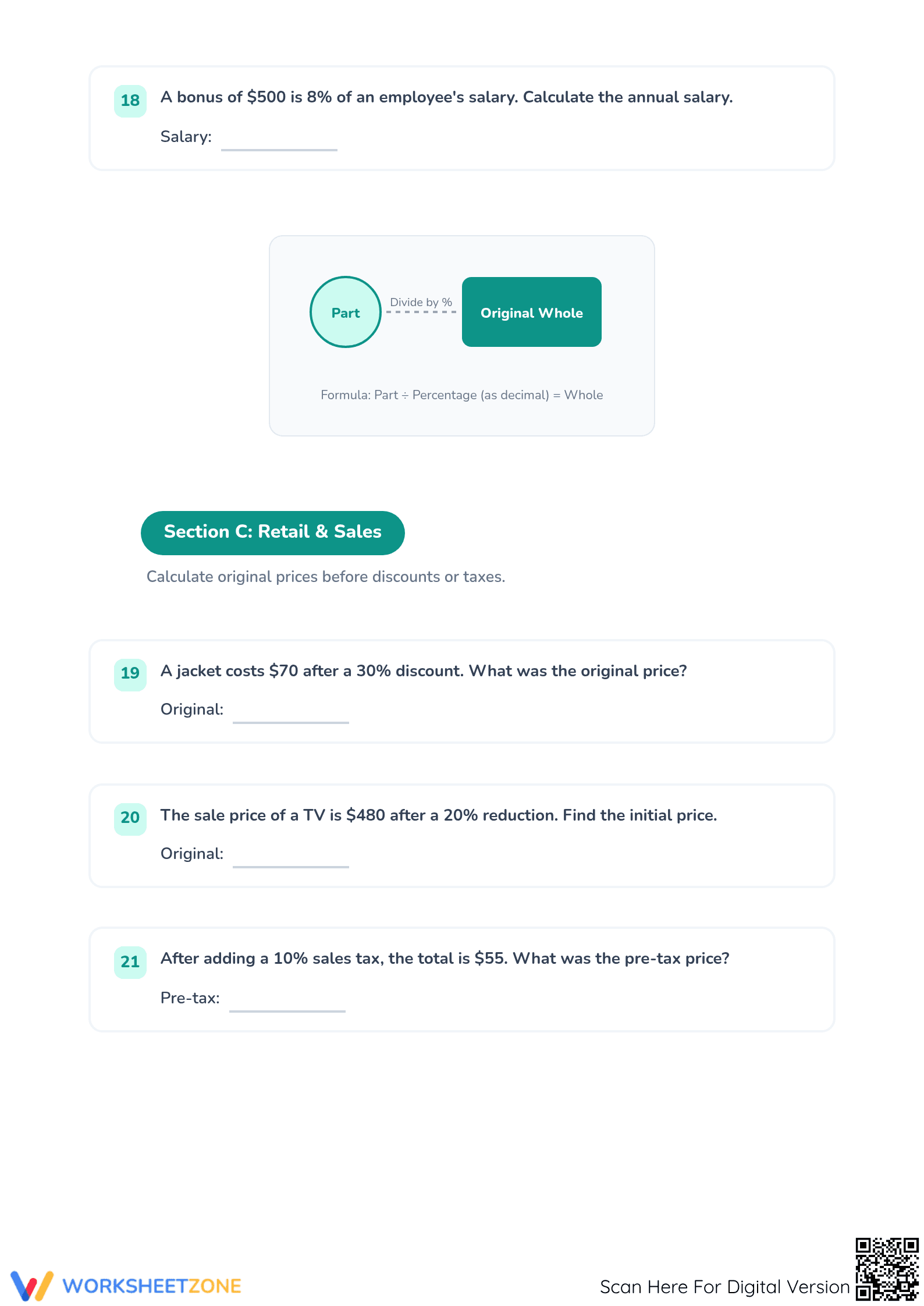
This five-page PDF resource features 27 meticulously crafted problems divided into four progressive sections. It starts with basic numerical identification and moves into complex, multi-step word problems involving currency, whole numbers, and percentages. The package includes a clear formula diagram and a full answer key to facilitate self-correction and immediate feedback.
Skill Progression
- Guided Practice: The first 10 problems focus on Section A: Core Concepts, where students identify the full amount of a number using simple ratios.
- Supported Practice: Sections B and C provide 16 problems centered on finance, budgeting, and retail scenarios like discounts and taxes.
- Independent Practice: The final section presents advanced challenges that require higher-order thinking to solve abstract percentage relationships.
This worksheet follows a gradual release of responsibility model, moving from scaffolded numerical tasks to independent application in varied contexts.
Standards Alignment
The primary focus of this resource is CCSS.MATH.CONTENT.6.RP.A.3.C: "Find a percent of a quantity as a rate per 100; solve problems involving finding the whole, given a part and the percent." It also supports Grade 7 proportional reasoning standards by requiring students to apply these concepts to multi-step real-world scenarios. Both standard codes can be copied directly into lesson plans, IEP goals, or district curriculum mapping tools.
How to Use It
Assign this worksheet during the "You Do" phase of a lesson on percentages to verify individual mastery of inverse operations. Alternatively, use Section B (Finance) as a standalone bell-ringer to connect mathematical concepts to financial literacy. For formative assessment, observe students working through Section D to identify those ready for extension or needing additional scaffolding. Completion typically takes 45 to 60 minutes.
Who It's For
This resource is designed for Grade 6–8 students mastering percentage concepts. It is particularly effective for learners who struggle with "backtracking" logic in math or those needing practice with decimal-to-percent conversions. It pairs naturally with a visual anchor chart illustrating the part-whole relationship or a direct instruction lesson on solving proportions.
Effective mathematics instruction requires moving beyond rote memorization to contextualized application, a principle emphasized in the RAND AIRS 2024 analysis of successful STEM curricula. This worksheet aligns with those findings by providing 27 targeted problems that bridge the gap between abstract calculation and real-world financial scenarios. By focusing on the CCSS.MATH.CONTENT.6.RP.A.3.C standard, the resource ensures students develop the cognitive flexibility needed to find the whole quantity when given a part and its percentage. Research from Fisher & Frey (2014) supports the use of progressive scaffolding—as seen in the transition from Section A to Section D—to ensure students achieve mastery through a gradual release of responsibility. This structured approach helps learners internalize the inverse relationship between parts and wholes, providing a stable foundation for more advanced algebraic thinking and proportional reasoning in higher grade levels.


