


























Views
Downloads
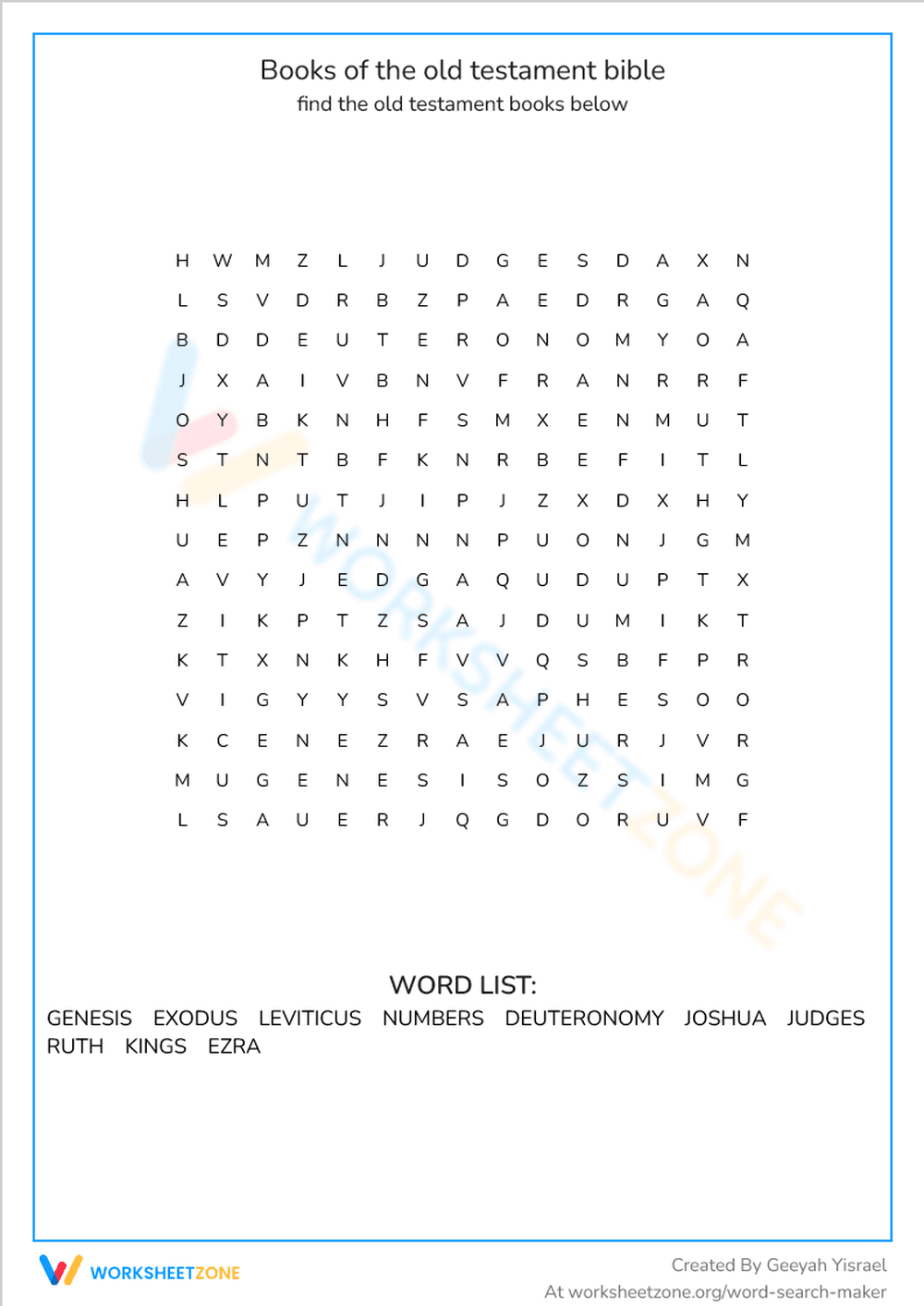

Grade 5 Old Testament Books — Printable No-Prep Worksheet
Paste this activity's link or code into your existing LMS (Google Classroom, Canvas, Teams, Schoology, Moodle, etc.).
Students can open and work on the activity right away, with no student login required.
You'll still be able to track student progress and results from your teacher account.
This Grade 5 vocabulary worksheet helps students recognize and spell domain-specific terms by locating ten Old Testament books within a word search puzzle. By actively scanning for these specific historical and religious texts, learners reinforce their visual memory and spelling accuracy in a focused, engaging format.
At a Glance
- Grade: 5 · Subject: English Language Arts
- Standard:
CCSS.ELA-LITERACY.RI.5.4— Determine the meaning of domain-specific words- Skill Focus: Vocabulary Recognition
- Format: 1 page · 10 problems · Answer key included · PDF
- Best For: Independent practice and review
- Time: 10–15 minutes
Inside this resource, educators will find a single-page word search puzzle featuring a clear, easy-to-read grid. The activity includes a dedicated word bank at the bottom of the page, listing the ten target terms: Genesis, Exodus, Leviticus, Numbers, Deuteronomy, Joshua, Judges, Ruth, Kings, and Ezra. A complete answer key is provided to allow for rapid grading or peer review.
This activity is designed for immediate classroom implementation with a highly efficient workflow. First, print the required copies for your roster (under 1 minute). Next, distribute the puzzle pages to students as they enter the room or transition between subjects (1 minute). Finally, review the completed grids using the provided answer key or have students self-check their work (2 minutes). The total teacher preparation time is under two minutes, making it an excellent option for emergency substitute plans.
This activity aligns directly with CCSS.ELA-LITERACY.RI.5.4, which requires students to determine the meaning of general academic and domain-specific words and phrases in a text relevant to a grade 5 topic or subject area. While primarily a spelling and recognition task, it builds the foundational familiarity required for deeper textual analysis. Both standard codes can be copied directly into lesson plans, IEP goals, or district curriculum mapping tools.
Teachers can utilize this word search as a quiet morning work activity before direct instruction begins, allowing students to settle in while previewing upcoming vocabulary. Alternatively, it serves as an effective fast-finisher task during a broader social studies or literature unit. As a formative assessment observation tip, monitor how quickly students locate complex words like "Deuteronomy" to gauge their phonetic scanning skills. Expected completion time ranges from 10 to 15 minutes.
This resource is primarily designed for fifth-grade students building their domain-specific vocabulary. It naturally supports differentiation; visual learners benefit from the clear grid layout, while students needing extra support can work in pairs to locate the terms. It pairs exceptionally well with introductory reading passages about ancient history or historical literature units.
Integrating domain-specific vocabulary activities like this Old Testament books word search supports broader literacy goals aligned with CCSS.ELA-LITERACY.RI.5.4, where students determine the meaning of domain-specific words. According to Fisher & Frey (2014), repeated visual exposure to specialized terminology significantly improves students' orthographic mapping and long-term retention of complex vocabulary. When learners actively scan for specific letter sequences in a puzzle format, they reinforce the neural pathways required for fluent reading and accurate spelling. This targeted practice ensures that when students encounter these historical and religious texts in complex reading passages, their cognitive load is reduced, allowing them to focus on comprehension rather than decoding. This straightforward, engaging format provides the necessary repetition without the fatigue often associated with traditional rote memorization drills, making it a highly effective tool for vocabulary acquisition.


